Sometimes, the only way to get a trillion-dollar company to listen is a healthy dose of collective internet fury.
Let’s be honest: tech giants love forcing “innovations” down our throats until we collectively scream in protest. If you’ve spent the last month accidentally clicking a stubborn, hovering AI icon while trying to edit a spreadsheet, I have some brilliant news. The latest Microsoft Copilot update is rolling out, and it brings the ultimate feature we’ve all been begging for: a banish button.
But this week isn’t just about Microsoft retreating from its aggressive AI push. We’ve also witnessed a massive security breach at GitHub, an urgent emergency patch from Nvidia that you need to install right now, and an AI-driven logistical nightmare at Pizza Hut that ended up in a massive courtroom showdown. Let’s unpack the chaos.
The Floating Nightmare: How the Microsoft Copilot Update Saved Us From Our Own Tools
We’ve all been there. You are deep in the zone, aligning a critical row of financial data in Excel or writing a document, and suddenly, a sleek, colorful button pops up right over your workspace. You try to close it. You can’t. You try to drag it away. It stubbornly snaps back to the side of your sheet like an over-eager digital puppy.
This was the reality of Microsoft’s recent UI push. In their desperate attempt to drive up AI adoption metrics, they slapped a floating Copilot button directly on top of the user workspace in Word, Excel, and PowerPoint. It was Clippy all over again, but without the nostalgic charm.
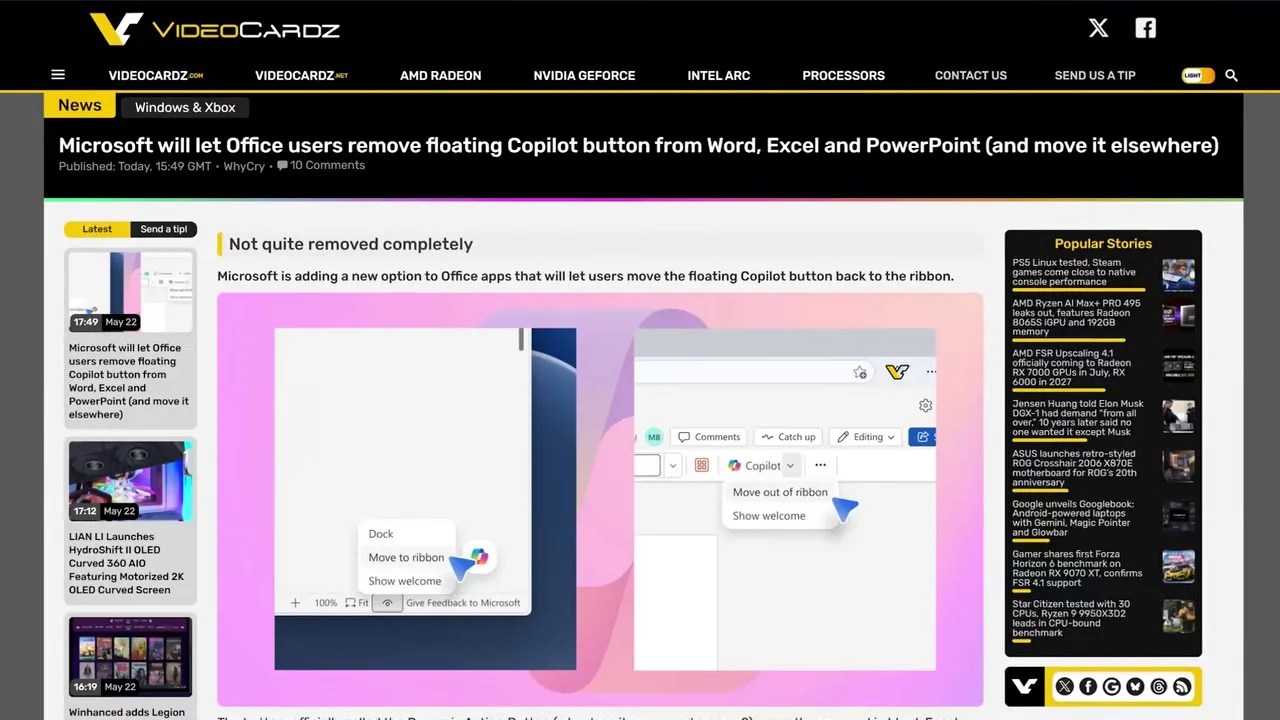
The infamous floating Copilot button, actively blocking data fields and driving productivity into the dirt.
The tech giant originally rolled this out thinking it would make AI interactions seamless. Instead, it generated a wave of user resentment. What makes me laugh is how Microsoft tried to spin the data. They proudly pointed out that Copilot engagement numbers actually spiked after the button was introduced. Well, of course they did! When you place a giant button directly over the cell a user is trying to click, 100% of those “engagements” are just users accidentally opening the sidebar while trying to do actual work. Rage is technically a form of engagement, I suppose.
Thankfully, this new Microsoft Copilot update finally adds an option to completely disable the floating button. It’s a small victory, but it reminds us that user friction still matters in the age of forced AI features.
The VS Code Trojan Horse: GitHub’s Security Nightmare
While Microsoft was busy fixing its self-inflicted UI wounds, its developer subsidiary, GitHub, was dealing with a full-blown security crisis. The notorious hacking collective known as Team PCP successfully breached GitHub’s internal defenses, making off with roughly 3,800 proprietary repositories.
The craziest part? The entry point wasn’t some complex zero-day exploit or sophisticated server-side breach. It was a classic human error: a single GitHub employee installing a malicious VS Code extension.

How a simple, corrupted extension bypassed GitHub’s internal security perimeter to siphon thousands of codebases.
These code repositories are currently being auctioned off on cybercrime forums. Team PCP has warned that if a buyer doesn’t meet their price, they will dump the source code online for free. While GitHub has assured users that no customer-facing code or user databases were compromised, this is still incredibly alarming.
Team PCP are seasoned veterans when it comes to supply chain attacks. They have previously targeted heavy hitters like OpenAI, Mistral AI, and Mercor. By gaining access to internal development tools, they don’t just steal code—they study it to find hidden backdoors. Because GitHub is still unsure exactly how long the hackers had access, we’re likely going to see the security fallout of this breach ripple through the industry for months to come.
Nvidia’s Red Carpet for Hackers: Why You Must Update Now
If you’re running an Nvidia graphics card on your machine—whether it’s a high-end RTX gaming rig, an enterprise workstation, or a Linux-based home server—stop reading this for a second and go check your GPU drivers. No, seriously. Go open GeForce Experience or your package manager.
Nvidia recently published an urgent security bulletin patching 14 critical vulnerabilities across their entire product stack. This isn’t just a minor patch; we are talking about serious, high-risk security flaws.

The specific safe driver versions you need to target to close the critical memory execution vulnerability.
The headliner of these bugs is a severe memory vulnerability scoring an alarming 8.8 out of 10 on the CVSS severity scale. If an attacker manages to get a basic, low-level foothold on your computer, this bug essentially hands them the keys to your system. It allows them to read personal files, escalate their administrative privileges, and execute arbitrary code at will.
To secure your machine, make sure your drivers are updated to at least version 596.36 on modern Windows GeForce systems, or 582.53 if you are still rocking an older GTX 10-series card or older. Linux users are not exempt—grab the latest patched driver from your distribution’s repository immediately.
The Tech Underground: Brickings, Lawsuits, and Pizza Nightmares
Let’s shift gears to some of the wildest stories developing in the broader tech landscape. First up: Riot Games is taking a hilarious, scorched-earth approach to anti-cheat enforcement in Valorant.
Rumors recently circulated that Riot’s kernel-level Vanguard anti-cheat was physically bricking entire PCs belonging to cheaters. Riot clarified the situation with a brilliant, highly mocking tweet, showing that they aren’t destroying PCs—they are targeting the specialized Direct Memory Access (DMA) hardware cards that cheaters plug into their motherboards to bypass software detection.

Riot’s anti-cheat developers aren’t playing nice. If you plug malicious hardware into your PC, prepare to own an expensive paperweight.
For those who rely on hardware workarounds to cheat, the game is officially over. The only alternative left is the most terrifying task of all: actually practicing and getting good at the game.
Meanwhile, in the culinary-tech crossover world, Pizza Hut is finding out the hard way that shoving “smart” AI systems into physical logistics can backfire spectacularly. One of Pizza Hut’s largest franchisees is suing the parent company for a massive sum, claiming that a mandated AI logistics system called Dragon Tail completely derailed their business operations.

When algorithmic efficiency fails: the Dragon Tail AI allegedly created delivery backlogs and cold pizzas.
The lawsuit alleges that the AI system miscalculated delivery routes, created terrible incentives for drivers, and effectively doubled delivery times. When food takes twice as long to arrive, customers get angry, pizzas get cold, and franchises lose millions. It’s a sobering reminder that while AI is great at processing abstract data, translating those calculations into the messy, unpredictable real world of physical streets and hungry customers is a completely different ballgame.
Between Microsoft retreating on its UI push and Pizza Hut suing over automated routing, we are starting to see the cracks in the “AI-everything” hype. Automation is a tool—but when it gets in the way of a human trying to write a sentence, click a spreadsheet cell, or deliver a hot pizza, it’s time to let us turn it off.