We are living in an era where smartphone spec sheets have largely plateaued. Megapixels are through the roof, silicon is ridiculously fast, and screens are brighter than the sun. Yet, one fundamental question still keeps tech enthusiasts up at night: When the dust settles, which of these thousand-dollar glass slabs actually lasts the longest?
To find out, we are putting six of the absolute heaviest hitters in the smartphone arena through a brutal, multi-stage gauntlet. If you have been hunting for the definitive answer to which device truly rules the power kingdom, you have landed in the right place. Welcome to our ultimate flagship battery comparison. We are pitting the Apple iPhone 17 Pro Max, Samsung Galaxy S26 Ultra, Google Pixel 10 Pro XL, OnePlus 15, Oppo’s top-tier flagship, and the budget-disrupting Nothing Phone against one another. No synthetic laboratory estimates here—just real-world, side-by-side destruction until only one champion remains standing.
Meet the Heavyweights
Before we plug anything in, let us look at the grid. We have standard lithium-ion giants competing with cutting-edge silicon-carbon chemistry. To make this test completely fair, every single phone is paired with its proprietary fast-charging brick. We want to see the absolute maximum performance these manufacturers engineered into their devices, not a compromised baseline. Here is how they stack up on paper before the torture begins:
Quarter 1: The Fast and the Furious (Charging Speed Test)
The race begins at exactly zero percent. We lined up all six devices on our specialized charging desk, plugged them into their respective proprietary power adapters, and let the juice flow.
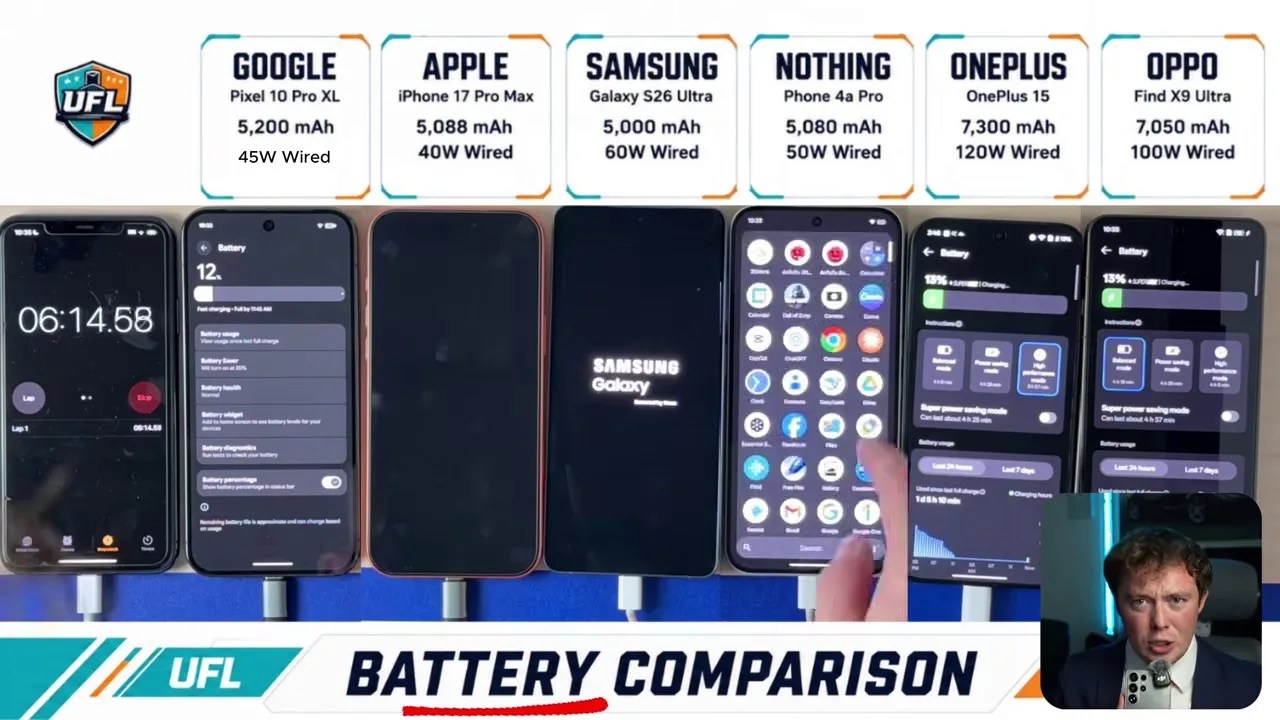
The starting grid: Six absolute monsters ready to fight for charging supremacy.
Right out of the gate, it became clear that we are dealing with two entirely different philosophies of power delivery. Within the first twenty minutes, the OnePlus 15 absolutely detonated its way past the competition. While standard flagships like the iPhone 17 Pro Max and Samsung Galaxy S26 Ultra steadily climbed, the OnePlus 15 was operating on another plane of existence.
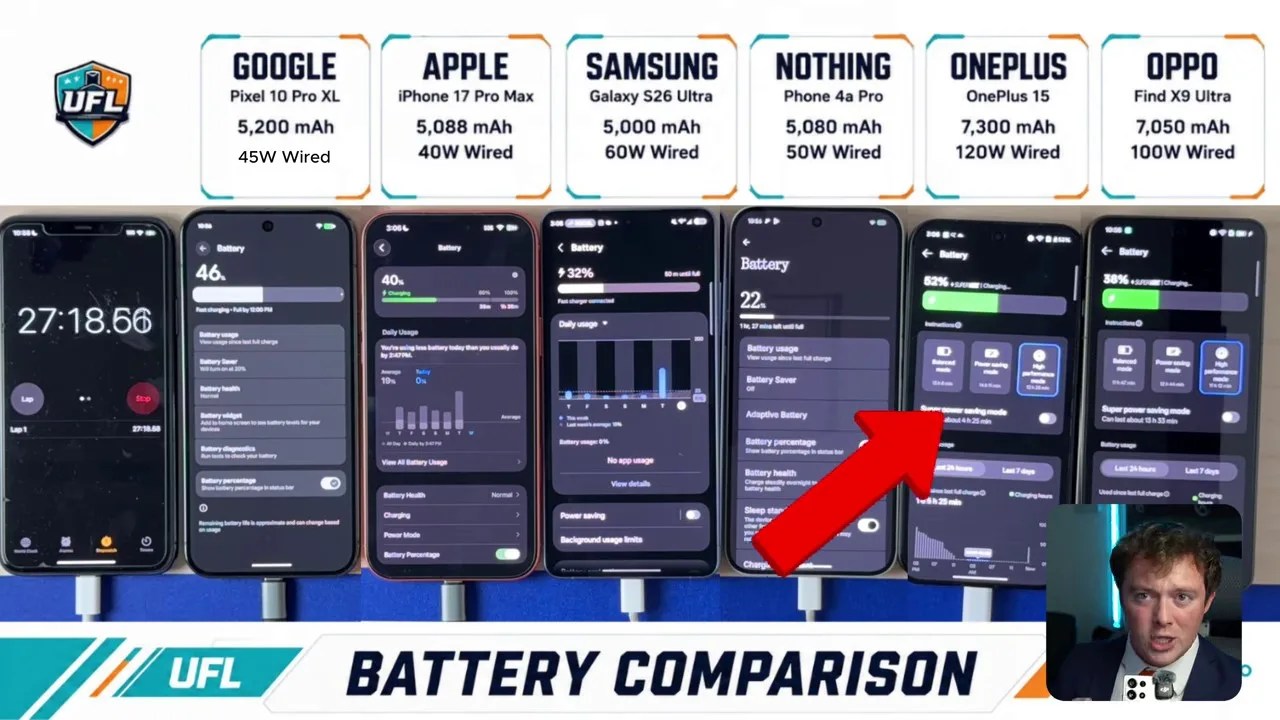
Twenty minutes in, and the OnePlus 15 is already leaving the competition in the dust.
How does OnePlus pull this off? It is not just about throwing a massive 120-watt brick at the wall. The secret sauce is its dual silicon-carbon battery system. By splitting the battery into two distinct cells and utilizing silicon-carbon anodes instead of traditional graphite, the device can accept double the current simultaneously without tearing its own internal structure apart. Oppo, using similar sister-brand tech, tried to keep pace, but the sheer raw throughput of the OnePlus 15 was untouchable.
Meanwhile, the Nothing Phone sat at the back of the pack, struggling to gain momentum. We can hear Carl Pei’s sighs of frustration from here, but given its budget positioning, this slow-and-steady approach was entirely expected.
Thermal Drama: Under the Lens of the Infrared Camera
As any electrical engineer will tell you, speed is the enemy of thermal efficiency. Shoving massive amounts of power into a tiny chassis generates heat—lots of it. To see how these phones handle the thermal stress of fast charging, we pulled out the infrared thermal camera, and the results were eye-opening.
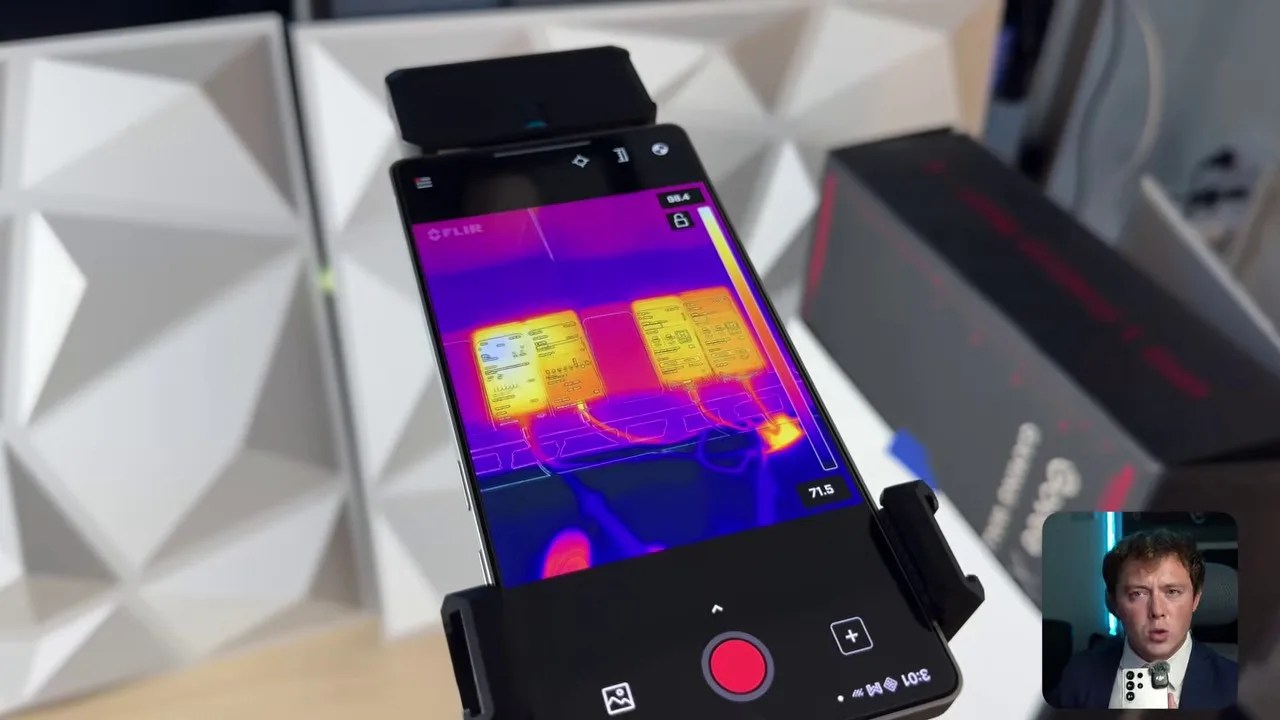
Thermal imaging reveals the massive heat generated by the iPhone 17 Pro Max and OnePlus 15 compared to the cool-running Samsung.
The thermal imagery revealed some fascinating engineering compromises. Both the iPhone 17 Pro Max and the OnePlus 15 were absolutely glowing, radiating intense heat as they fought to pull maximum wattage. Conversely, the Samsung Galaxy S26 Ultra remained surprisingly cool. Samsung’s ultra-conservative thermal throttling algorithms ensure the phone never feels like a hot potato, even if it means sacrificing top-tier charging speeds.
The OnePlus 15 completed its 0-to-100% sprint in a jaw-dropping 52 minutes. The real shocker, however, was the Google Pixel 10 Pro XL. Despite having a historically slow reputation for charging, Google’s latest flagship pulled off an exceptional performance, ramping up its speed in the mid-stages to finish in a dead tie with the Oppo flagship.
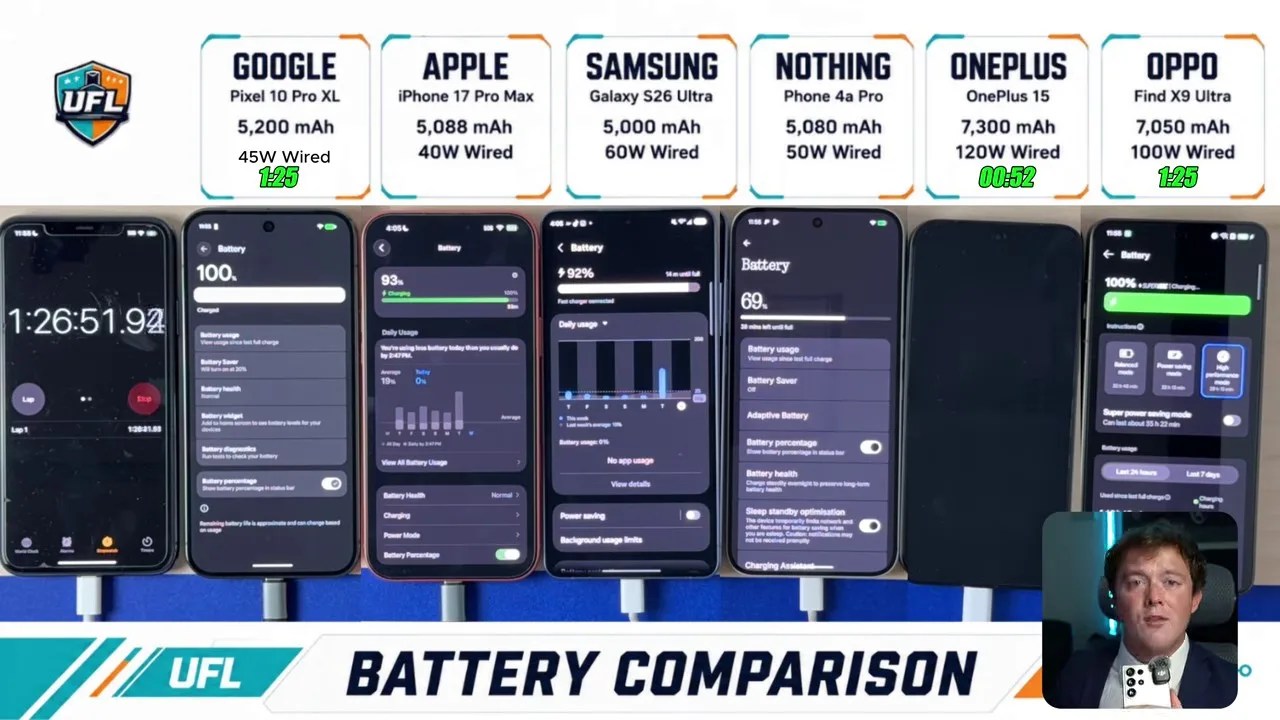
The final standings of Quarter 1: A massive victory for OnePlus, while Apple and Nothing languish at the bottom.
As the battery percentages neared 80%, we witnessed the classic “trickle charge” slowdown. The iPhone 17 Pro Max hit a massive brick wall, taking a painful 1 hour and 49 minutes to cross the finish line. Samsung wrapped up at 1 hour and 38 minutes, and the sluggish Nothing Phone finally crossed the finish line at 2 hours and 13 minutes.
Quarter 2: The Brutal Drain Test (TikTok, Benchmarks, and Meltdowns)
With all six contenders packed to a full 100%, we transitioned straight into the main event: the ultimate flagship battery comparison drain test. To keep the playing field perfectly level, we meticulously matched the display brightness on all six panels, cleared all background processes, and optimized system settings to ensure no phone had an unfair advantage.
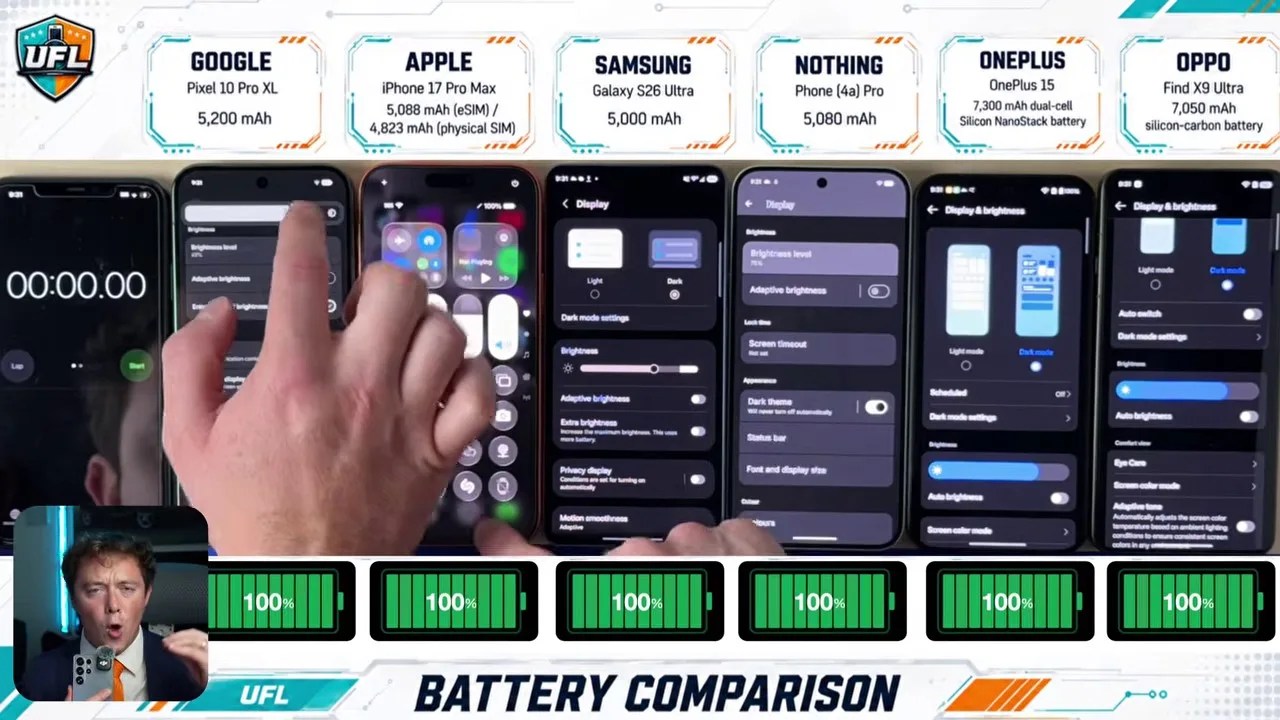
Perfectly calibrated and ready to drain: Brightness levels matched across all six displays.
We kicked off the test by simulating typical modern user behavior—which, let us be honest, means endless scrolling on TikTok, followed by hours of high-definition YouTube streaming and MrBeast videos. For the first few hours, all six devices held their ground beautifully, slowly ticking down past the 90% mark in perfect synchronization.
But passive video playback is easy. To truly stress these modern chipsets, we cranked up the intensity by running back-to-back Geekbench and AnTuTu benchmarks, followed by a sustained load using a heavy web-based volume shader tool. That is when the hardware started to buckle.
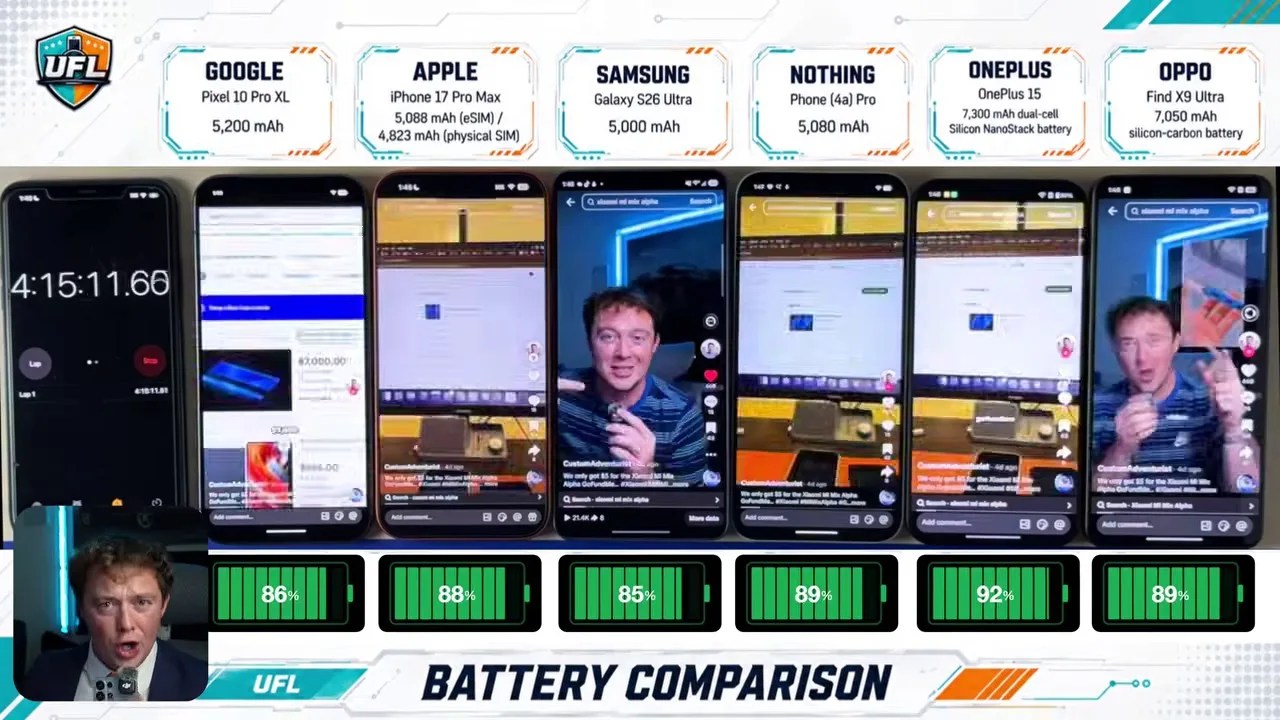
Pushing the silicon to its limits with heavy benchmarking loops.
Under the crushing load of the volume shader, the OnePlus 15’s aggressive power profile came back to bite it. While it charged the fastest, it simply could not dissipate the heat of sustained graphical rendering. The device began to overheat violently, repeatedly crashing out of the browser and displaying warning screens.
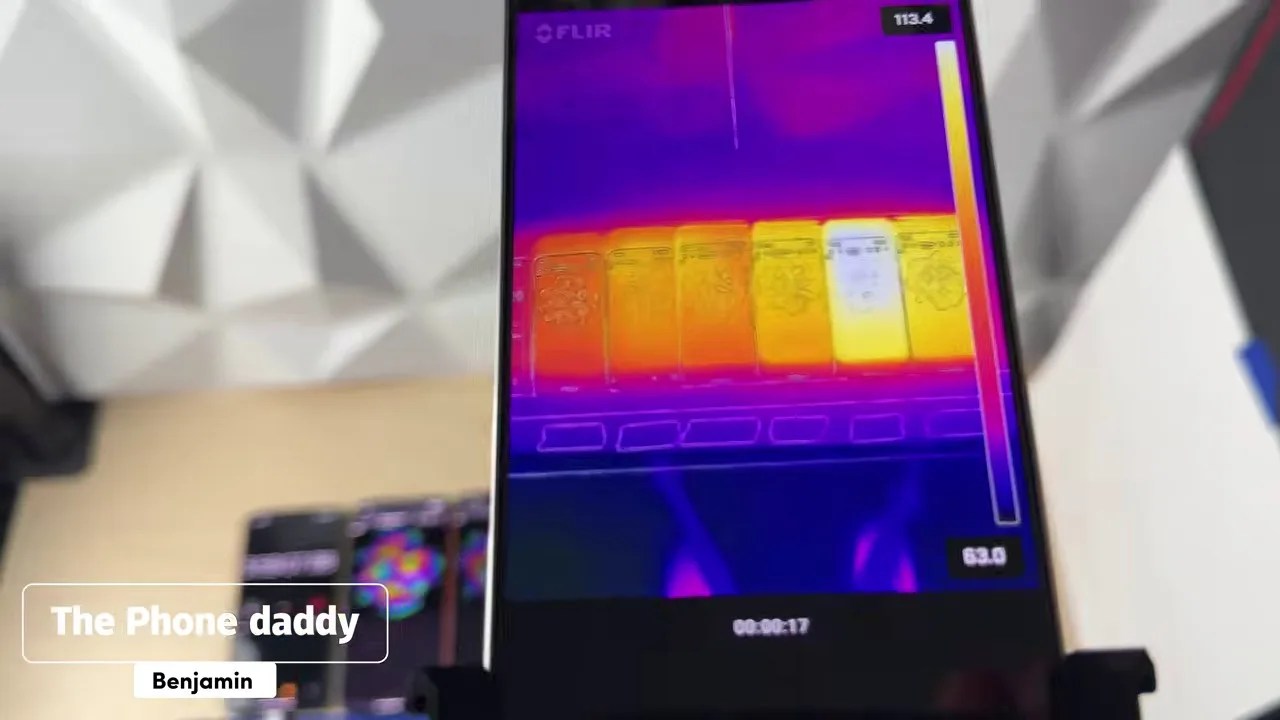
The Achilles’ heel of raw speed: The OnePlus 15 hits thermal limits and throws an overheating warning.
Due to these constant thermal-induced app crashes, the OnePlus was hit with a time penalty. Even though its battery percentage remained high, its reliability under heavy load was severely compromised.
Next up was the camera endurance test: one full hour of continuous video recording, split evenly between the front-facing selfie camera and the main rear sensor array. This is a notorious battery killer that forces the image signal processor (ISP) to work overtime.
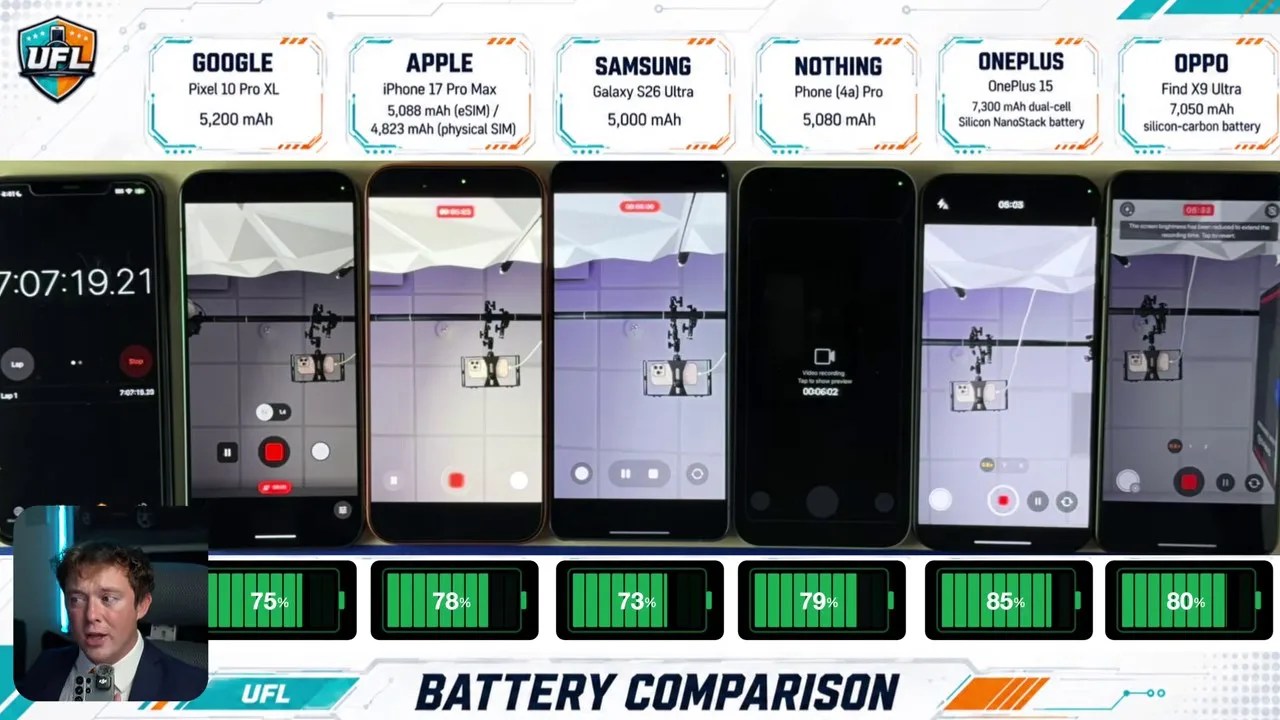
The camera gauntlet: Continuous high-bitrate recording on tripods.
The camera test took a massive toll on the Samsung Galaxy S26 Ultra, dragging its battery down into the low 60% range. The Google Pixel 10 Pro XL also felt the burn, dropping rapidly alongside the Samsung. Meanwhile, the OnePlus 15 managed to conserve its power remarkably well, hovering around 81% despite its earlier thermal temper tantrums.
To round out the first half of our drain test, we queued up a marathon session of movie playback.
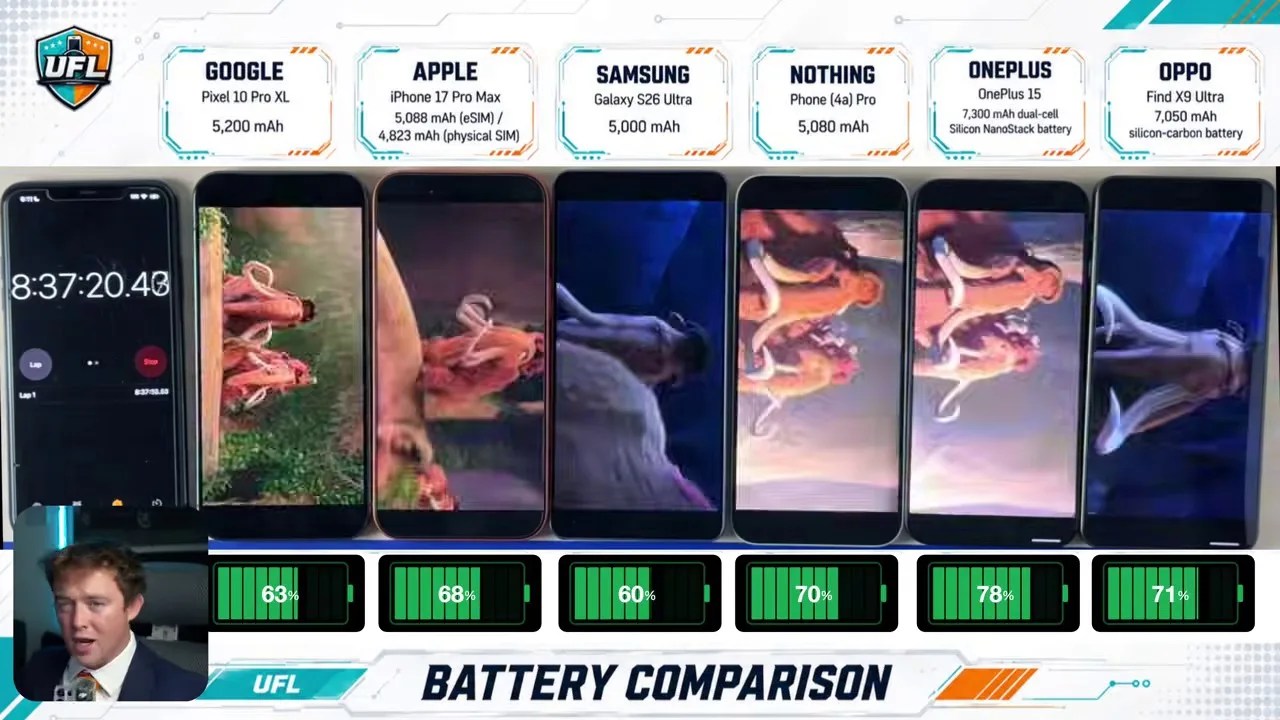
Sustained media consumption: Tracking the gradual discharge curves over hours of movie playback.
At this point in the test, we hit an unbelievable milestone: **9 hours of continuous screen-on time**, and incredibly, every single flagship on the table was still sitting above 50% capacity. This is a testament to the massive leaps in energy density we are seeing with the rollout of silicon-carbon battery technology. The days of your phone dying by mid-afternoon are officially behind us.
As we crossed the threshold of the 9-hour mark, the battery landscape began to shift rapidly. Up until this point, all six flagships had put up a heroic fight, but the heavy workload of continuous video streaming and background processing started to expose the weaker links in the chain.
The first major casualty of the afternoon was the Samsung Galaxy S26 Ultra. Despite its premium price tag and massive stature, Samsung’s optimization seemed to falter, with its battery percentage plunging below the 50% mark way earlier than we anticipated. The Google Pixel 10 Pro XL wasn’t far behind, showing similar signs of exhaustion. Meanwhile, the OnePlus 15 was sitting comfortably in the green, cruising well above 60% as if it were barely breaking a sweat.
To keep the pressure on, we queued up another movie marathon—this time transitioning from the icy landscapes of Ice Age to the colorful chaos of The Angry Birds Movie.
By the time we hit the 11-hour mark, the Samsung Galaxy S26 Ultra was officially in critical condition, slipping below 20%. Our testing crew was getting exhausted, and we needed these phones to die. So, we did what any self-respecting tech reviewers would do: we booted up the punishing 3DMark benchmark to aggressively drain whatever life force these chips had left.
At exactly the 12-hour mark, the Samsung Galaxy S26 Ultra finally tapped out, collapsing to a black screen. It was a disappointing finish for Samsung’s crown jewel. Minutes later, the Google Pixel 10 Pro XL followed its rival into the grave.
This is where the battle of endurance turned into a high-stakes psychological thriller. The remaining four devices were left to fight to the bitter end. The iPhone 17 Pro Max, running on its absolute last breaths, held on tenaciously at 5% before finally calling it quits right around the 13-hour mark. In a surprising twist, the budget-friendly Nothing Phone died almost immediately after the iPhone. For a device at its price point, matching Apple’s top-tier flagship in raw screen-on-time is an absolute badge of honor.
That left us with the final two: the Oppo Find Ultra flagship and the OnePlus 15. As the battery levels plummeted to the single digits, the Oppo flagship entered its aggressive emergency battery-saver mode, desperately trying to keep its core systems alive. We booted up Subway Surfers to deliver the final blow.
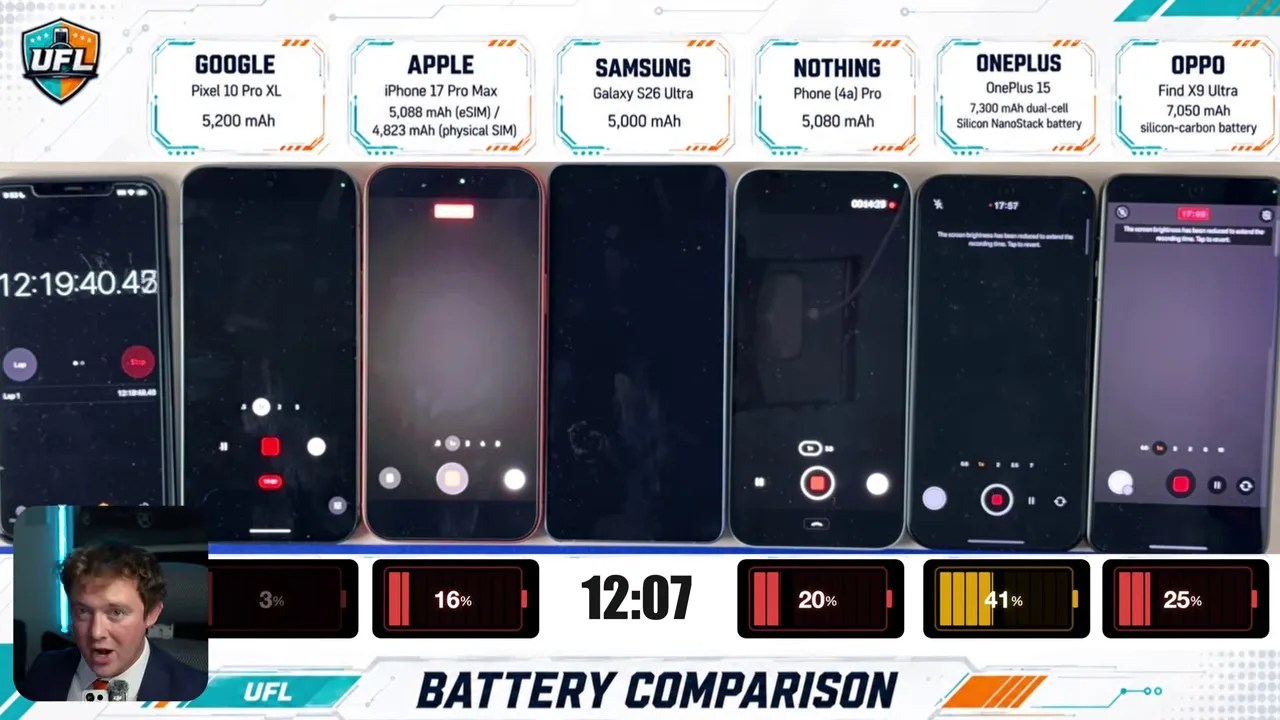
The final showdown: Running Subway Surfers on the surviving devices to squeeze out the last drops of power.
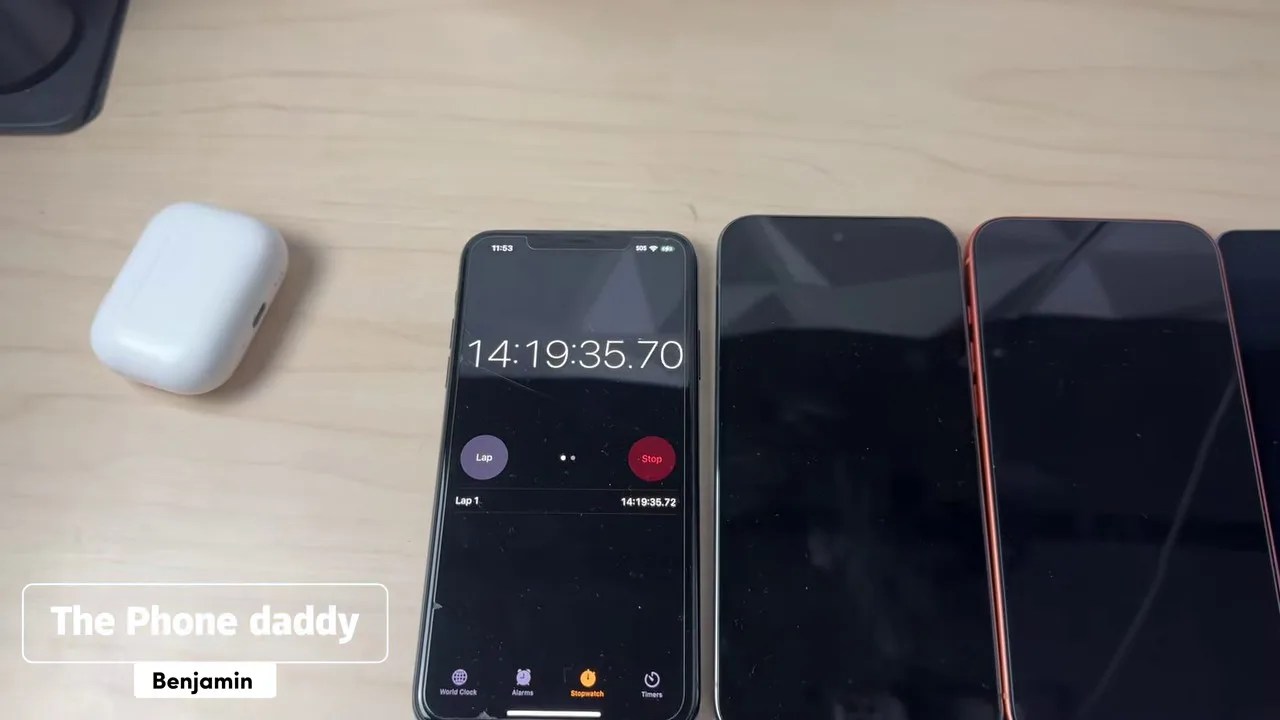
The Oppo flagship finally died mid-run at 1%. But the OnePlus 15? It simply refused to die. It was the ultimate test of endurance. We even threw the web-based volume shader back at it, trying to force a shutdown. The phone kept chugging along, eventually clocking out at an astronomical 14 hours and 19 minutes of continuous screen-on time.
But let’s be entirely honest here: while 14 hours of battery life is legendary, it came at a cost. The OnePlus 15 overheated and crashed at least four times during our testing. In the real world, a phone that turns into a pocket-heater and shuts down your apps isn’t always a win, no matter how long the battery lasts. Even so, on raw capacity and endurance, OnePlus took the crown for Quarter 1.
The official scoreboard for Quarter 1: OnePlus and Oppo take an early lead, leaving Samsung and Apple to play catch-up.
Quarter 2: The Ultimate Camera Battle
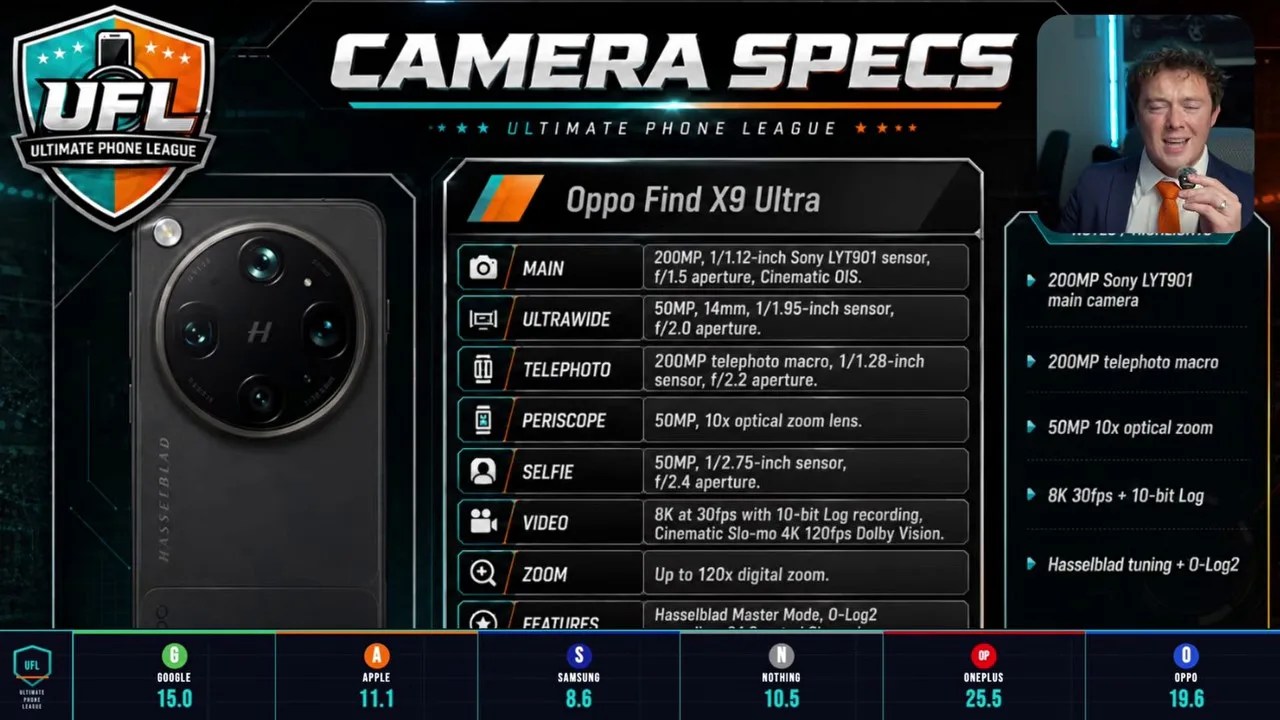
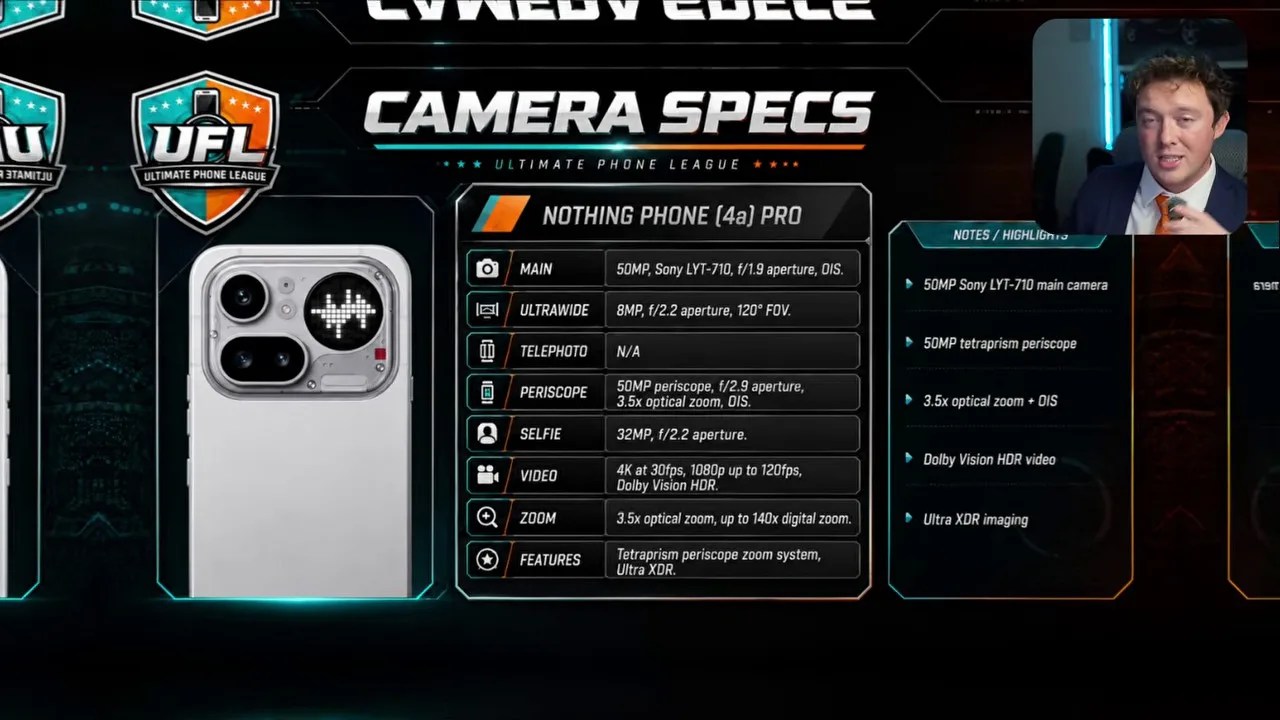
With the battery gauntlet settled, we moved straight into Quarter 2: the camera comparison. This is where software processing, sensor size, and optical engineering collide. The hardware on display here is staggering—we are talking about multiple 200-megapixel sensors, variable apertures, and advanced AI-assisted tuning.
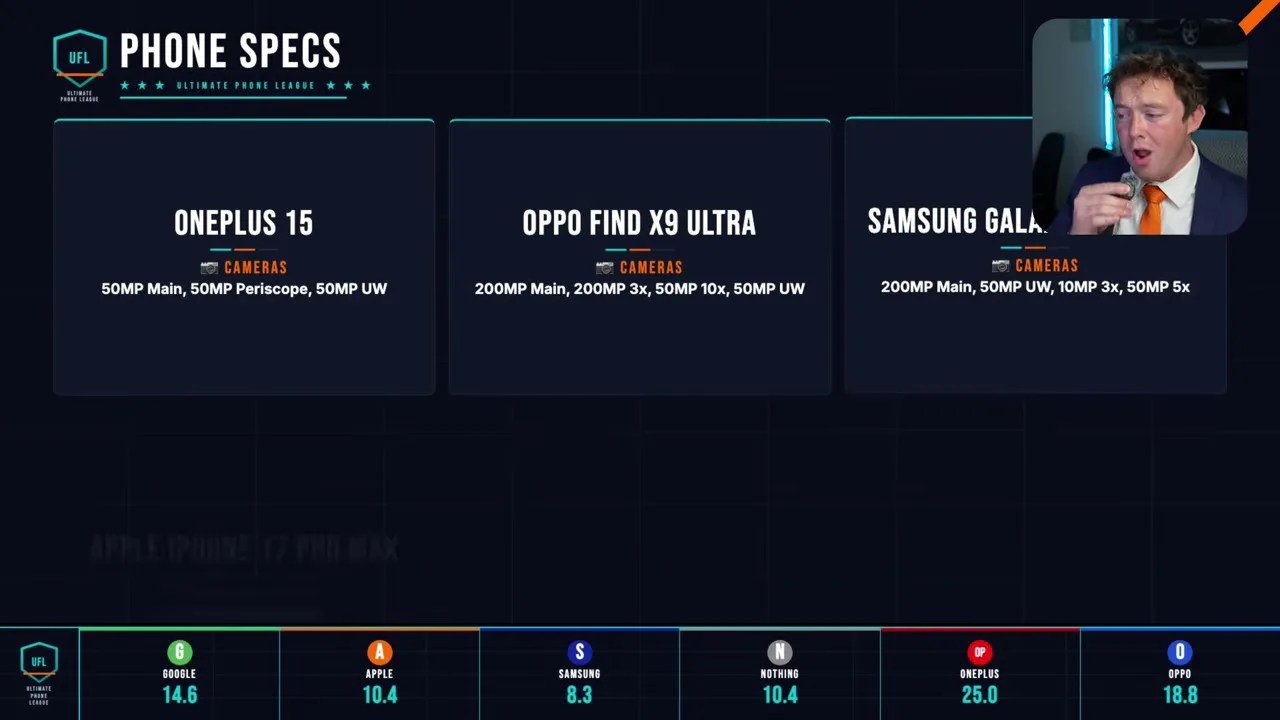
Under the hood: The massive camera specifications powering our six contenders.
Test 1: The Ultrawide Angle Lens
We kicked things off with the wide-angle camera test. Ultrawide lenses are notoriously difficult to get right; they often suffer from muddy details at the edges, severe barrel distortion, and poor low-light performance. We tested all six devices in identical outdoor lighting conditions using their stock camera apps.
A side-by-side look at the ultrawide capabilities. Some handled the distortion beautifully, while others fell flat.
The results were a mixed bag. The Nothing Phone struggled significantly, producing a flat, somewhat muddy image that clearly showed its budget limitations. But at the top of the pack, the Oppo Find Ultra flagship absolutely dominated. Equipped with a massive 50-megapixel ultrawide sensor, Oppo managed to capture stunning dynamic range, incredibly sharp edge-to-edge details, and rich, natural color science with minimal distortion.
Test 2: The Primary (Main) Sensor
Next, we moved to the main lenses—the absolute best optical hardware each manufacturer has to offer. This is where we expect flawless images, perfect exposure, and superb depth of field.
While cycling through the shots, the OnePlus 15 showed a tendency to aggressively oversaturate the colors, making the scene look somewhat artificial. However, the Samsung Galaxy S26 Ultra took the crown here. Leveraging its monstrous 200-megapixel primary sensor, the Samsung image was incredibly clean, boasting unmatched resolving power and superb highlight retention in the brighter areas of the sky. It is a shot that looks spectacular even when you crop in heavily.
Test 3: The Telephoto Zoom Battle
Zoom capabilities have become the ultimate battleground for modern flagships. We tested both the mid-range zoom (around 4x to 5x) and the maximum optical zoom limits of each device.
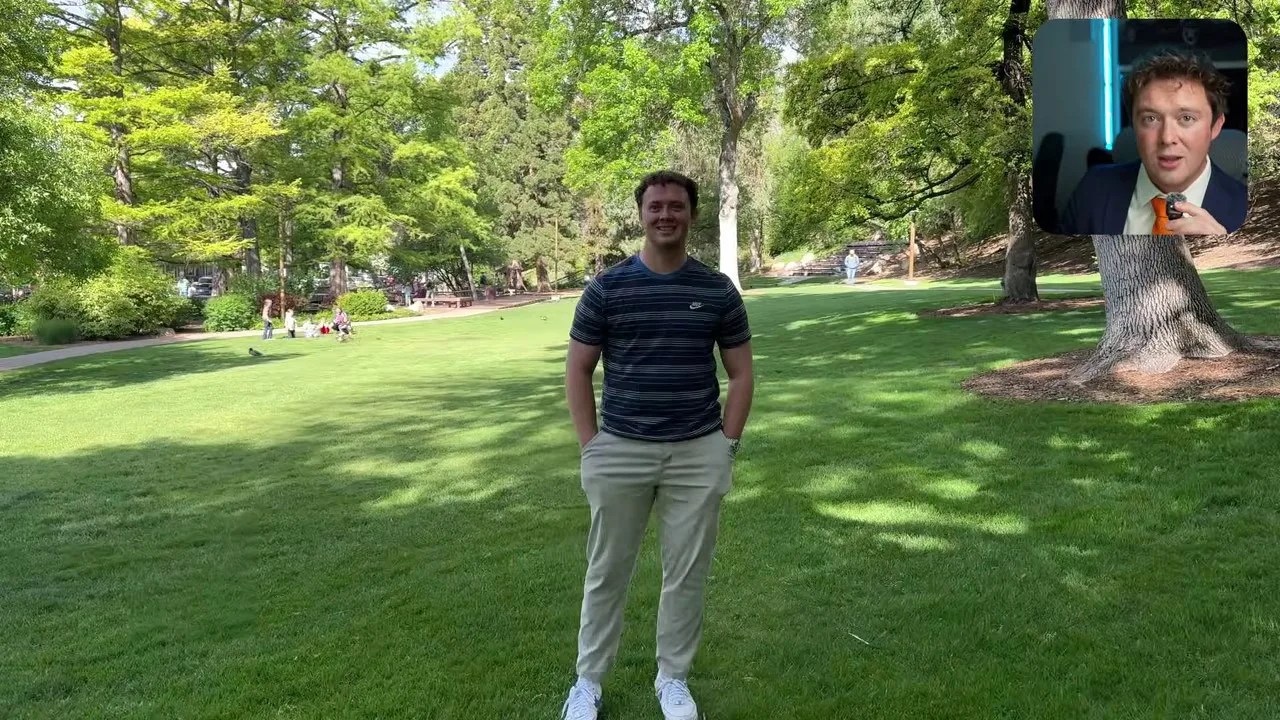
Zoom comparison: Who can preserve the most detail when pulling in distant subjects?
In the mid-range zoom test, Samsung’s dedicated telephoto optics once again secured first place, delivering a crisp, noise-free image. But when we pushed the zoom to its optical limits, the Google Pixel 10 Pro XL took the lead.
Google’s 48-megapixel telephoto lens, combined with the computational magic of the Tensor chip, produced a remarkably clean, sharp, and naturally balanced image. The Pixel doesn’t just rely on glass; its AI-assisted super-resolution algorithms do an incredible job of reconstructing fine textures that other cameras turn into digital mush.
To ensure our findings weren’t a fluke, we ran a second round of testing in a different environment. This time, the wide-angle victory went to Oppo once again, but the main camera crown was snatched by the iPhone 17 Pro Max. Apple’s 48-megapixel Fusion camera, paired with Sony’s latest sensor technology, delivered an incredibly balanced, true-to-life photo with fantastic skin tones and zero shutter lag. Samsung, however, clawed back another victory in the mid-zoom category, proving that its multi-lens zoom system is exceptionally versatile.
The Dark Room: Pushing Low-Light Capabilities to the Edge
Daylight photography is a solved problem for modern flagships. To truly separate the champions from the pretenders, we have to turn off the lights. We took all six devices into a pitch-black studio environment to see how their night modes and sensor processing handle extreme low-light scenarios.
Night Mode showdown: How each sensor handles noise reduction and light gathering in near-total darkness.
Starting with the ultrawide lenses in the dark, the Samsung Galaxy S26 Ultra took a surprising victory, managing to pull clean details out of the shadows where others produced a noisy, pixelated mess. However, once we switched to the primary sensors, the Oppo Find X9 Ultra stole the show. Its massive main sensor and custom night algorithm delivered an incredibly bright, sharp, and clean image that made the pitch-black room look like it was lit by a soft lamp.
But the real shocker of the night round was the telephoto performance. Typically, zoom lenses struggle in the dark due to their narrower apertures. Yet, the iPhone 17 Pro Max absolutely swept the zoom categories. Whether at 3x, 5x, or extreme digital crops, Apple’s night-mode processing kept the details sharp, the noise levels remarkably low, and the exposure incredibly natural. The shots were so well-illuminated and clear that they looked almost daylight-esque compared to the muddy, watercolor-like outputs of the competition.
Selfie and Portrait Photography: The Human Element
Next, we turned the cameras on ourselves. In a controlled studio lighting setup, we tested the front-facing cameras to see how they render skin tones, hair textures, and facial details.
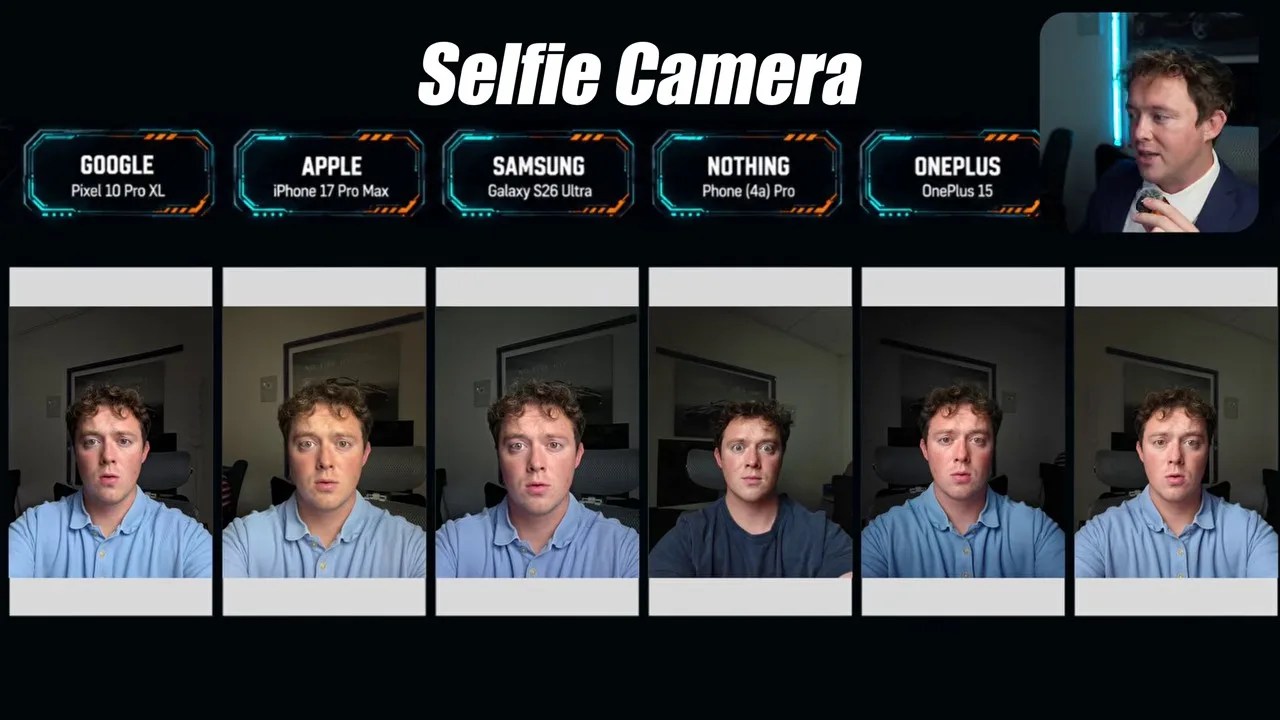
Studio selfies: A close look at how each brand’s color science processes skin tones and facial details.
The iPhone 17 Pro Max took another decisive victory here. Apple’s front-facing camera remains the gold standard for rendering realistic skin textures and natural color balance without artificial smoothing.
When we took the selfie test into the dark, however, some clever software engineering came into play. Both the Google Pixel 10 Pro XL and the Nothing Phone utilized a “screen flash” trick—blasting the display at maximum brightness to illuminate our faces. While some might call it cheating, it worked beautifully, earning the Pixel 10 Pro XL the top spot for night selfies, while the iPhone’s unassisted shot ended up looking rather dark and dramatic.
For outdoor macro photography, we attempted to capture the delicate textures of a small flower. Unfortunately, a logistical hiccup forced the Nothing Phone to retake its shot later, by which time the flower had sadly wilted. Among the successful shots, the Samsung Galaxy S26 Ultra proved to be the sharpest, followed closely by the iPhone and the Pixel.
When it came to portrait mode—simulating a shallow depth-of-field on our friend Jacob—the Samsung Galaxy S26 Ultra reclaimed its throne. Its edge detection was flawless, separating individual strands of hair from the background with surgical precision. The Nothing Phone, on the other hand, struggled heavily with edge separation, giving Jacob a somewhat blocky, artificial-looking cutout.
Extreme Zoom and Microscopic Details
To push these zoom lenses to their absolute physical limits, we lined up a small apartment rental sign across a wide street. We wanted to see if we could actually read the fine print from a distance.
The Oppo Find X9 Ultra took first place here, delivering a highly legible, stabilized image at extreme zoom. The iPhone 17 Pro Max took second; while it couldn’t match the raw digital crop distance of the Oppo, its optical clarity was so high that the text remained perfectly readable. On the flip side, the OnePlus 15 performed terribly. Despite boasting impressive camera specs on paper, its telephoto processing was a muddy disaster—proving that megapixel counts mean nothing without proper software optimization.
For our final still-photo test, we went microscopic. We placed table salt crystals under the macro lenses to see which sensor could resolve the fine, cube-like structures of the sodium chloride.
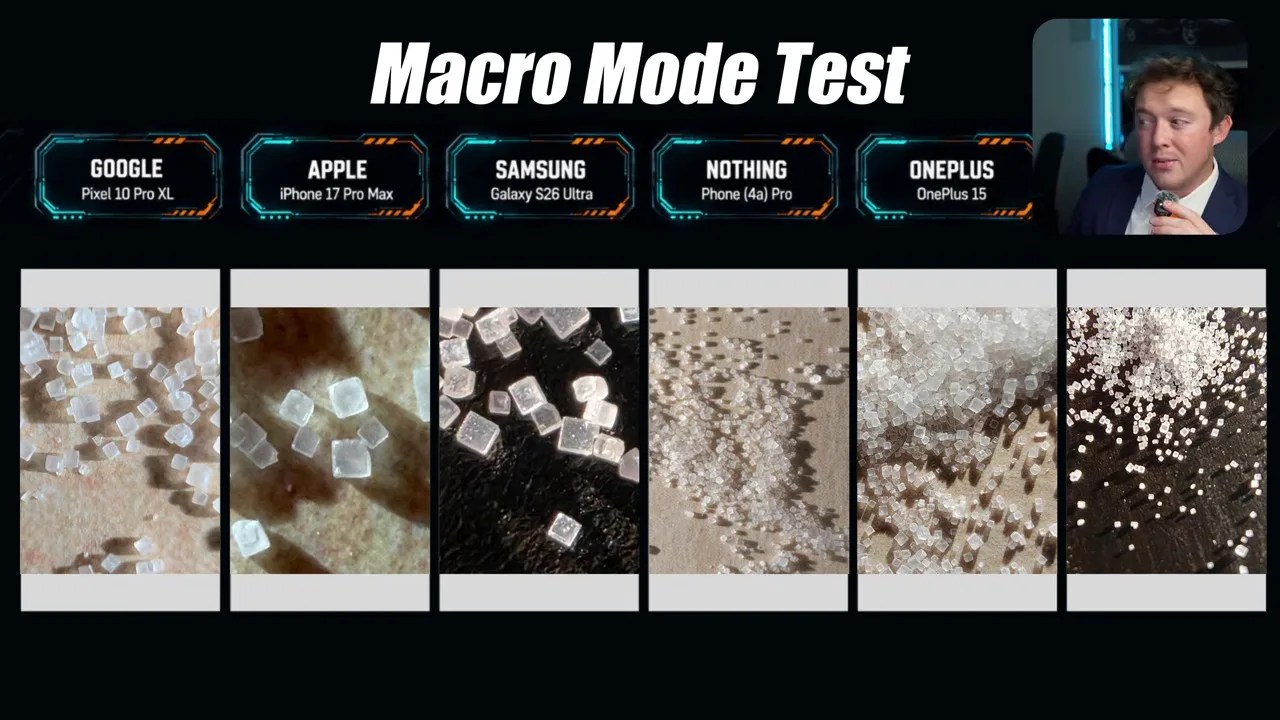
Microscopic salt crystals: Highlighting the incredible resolving power of modern macro lenses.
While the iPhone and Samsung shots initially looked a bit zoomed out, the Samsung Galaxy S26 Ultra managed to capture an astonishing amount of microscopic detail. The salt crystals looked like giant, geometric boulders with clean, sharp edges, earning Samsung another well-deserved victory.
Video Quality, Stabilization, and Motion
Photos are only half the story. In 2025, a flagship’s worth is heavily measured by its video capabilities. We started with a front-camera walk-and-talk test to evaluate stabilization and microphone quality. Once again, the iPhone 17 Pro Max delivered an incredibly smooth, gimbal-like experience with natural background blur.
Moving to the rear cameras, we recorded cinematic shots of outdoor flowers to test panning smoothness and color transition.
The shake test: Evaluating how well each device’s OIS and EIS handle rapid movement and walking paces.
The Oppo Find X9 Ultra walked away with the win here, rendering rich, lifelike colors and buttery-smooth panning. However, we have to give a massive shoutout to the Nothing Phone (specifically the Nothing Phone 4A Pro). While it did get outperformed by the thousand-dollar flagships in several categories, we must remember that this phone costs literally half the price of its competitors. The fact that its video quality is even comparable to these premium giants proves it is punching way above its weight class.
During our rigorous physical shake test, walking test, and camera-switching zoom test, the iPhone 17 Pro Max showed why it remains the undisputed king of video. Where other phones exhibited noticeable stutters, frame drops, or jarring jumps when switching between the ultrawide, main, and telephoto lenses, the iPhone transitioned with seamless, cinematic fluidity.
In the slow-motion category—a feature often neglected by modern brands—the Oppo Find X9 Ultra captured incredibly crisp, beautiful footage of bees in flight. Samsung and Nothing fell flat here, producing grainy, low-bitrate slow-mo that looked like it was shot a decade ago.
Finally, in night video, the iPhone’s superior noise-reduction algorithms secured it another easy victory on the main sensor, while the Pixel 10 Pro XL’s screen-flash trick once again won it the night front-camera video round.
Halftime Leaderboard Standings
With the grueling camera quarter concluded, the judges tallied up the points. The iPhone 17 Pro Max took first place in the camera category, with the Samsung Galaxy S26 Ultra and Google Pixel 10 Pro XL hot on its heels. The OnePlus 15 and Nothing Phone languished at the bottom, unable to keep up with the advanced imaging pipelines of the top three.
The halftime standings: Oppo Find X9 Ultra maintains a narrow lead, but the iPhone and Pixel are closing in fast.
As we head into the halftime show, the overall leaderboard is incredibly tight. Thanks to its balanced performance in both battery and camera tests, the Oppo Find X9 Ultra holds a razor-thin lead at the very top. The OnePlus 15 sits in second place—carried almost entirely by its dominant battery performance—while the Google Pixel 10 Pro XL is breathing down their necks in third.
Quarter 3: The Wildcard Round (The Little Things That Matter)
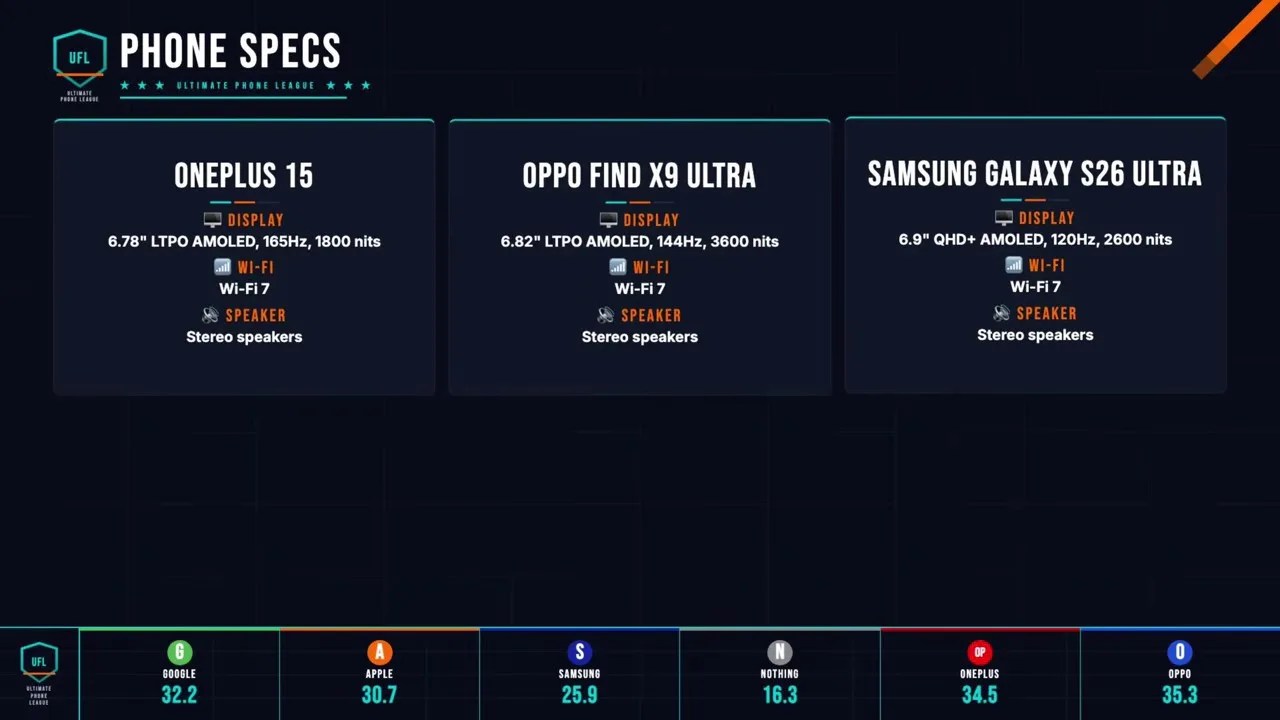
Welcome back from the halftime show. This is where the competition gets weird, messy, and highly practical. In Quarter 3, we are stepping away from the raw camera and battery specs to look at the “Wildcard” metrics. These are the daily-driver essentials that often get overlooked but completely define your experience with a phone: microphone clarity, haptic feedback, Wi-Fi modem efficiency, screen legibility under direct sunlight, and speaker loudness.
Microphone and Haptic ASMR: The Premium Feel
We started by recording identical voice samples using the front-facing cameras of all six devices. If you are someone who shoots a lot of social media content or takes endless Zoom calls, microphone quality is a dealbreaker. The judges carefully analyzed the vocal clarity, background noise suppression, and overall warmth of the audio. The iPhone 17 Pro Max secured the top spot with its incredibly rich and natural sound capture, while the Oppo Find X9 Ultra came in a close second. Shockingly, the Google Pixel 10 Pro XL bottomed out in a disappointing sixth place, delivering a flat and thin vocal profile.
Next up was the haptics and audio feedback test—essentially a digital ASMR round. We wanted to feel and hear how these phones interact with your fingertips when you are typing, scrolling, or receiving notifications.
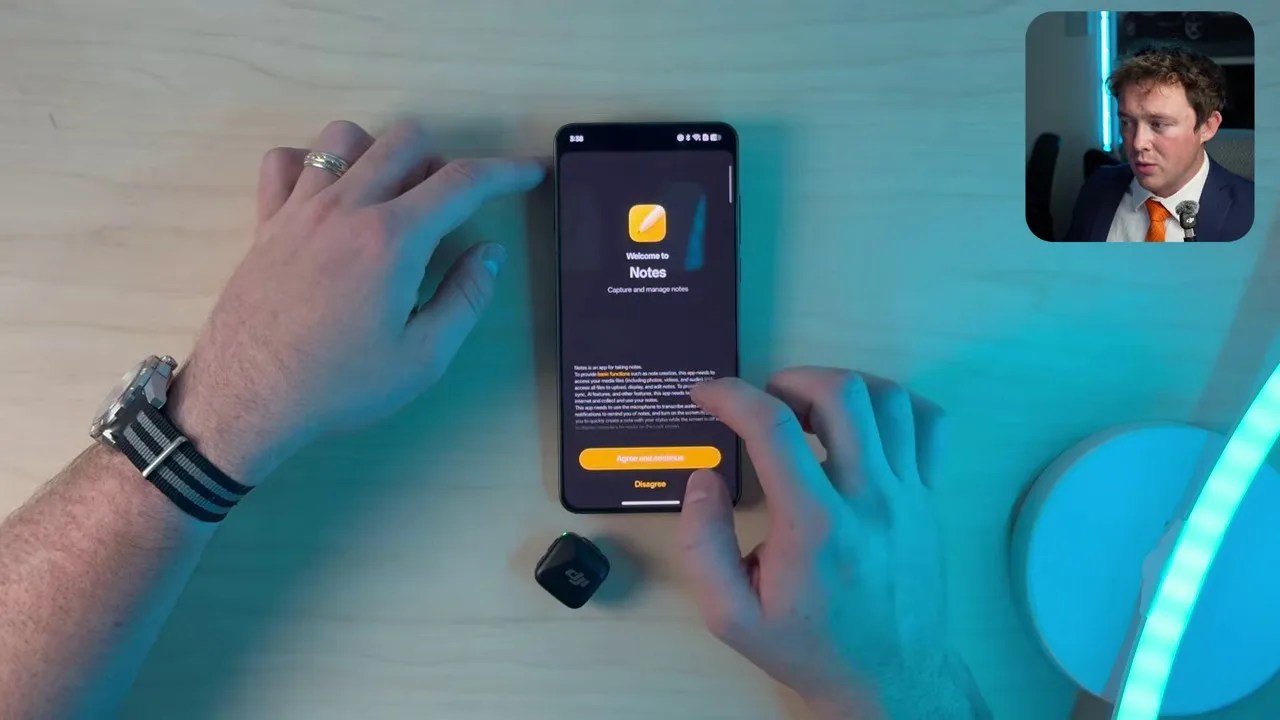
Tactile feedback under the microscope: Testing the vibration motors and UI sound design for that premium hand-feel.
Apple’s Taptic Engine on the iPhone 17 Pro Max remains the gold standard, earning a clean first-place finish with its tight, localized, and incredibly precise vibrations. But the real surprise was the budget-friendly Nothing Phone. Thanks to its synchronized Glyph interface on the back and highly optimized haptic integration, it took a shocking second place. The OnePlus 15, on the other hand, felt mushy and unrefined, landing dead last in sixth place.
Wi-Fi Speed and Sun Glare: Real-World Usability
Have you ever noticed your phone dropping connections or lagging on Wi-Fi even though you have fast internet? To see if the internal wireless modems actually make a difference, we ran multiple back-to-back speed tests under identical network conditions.
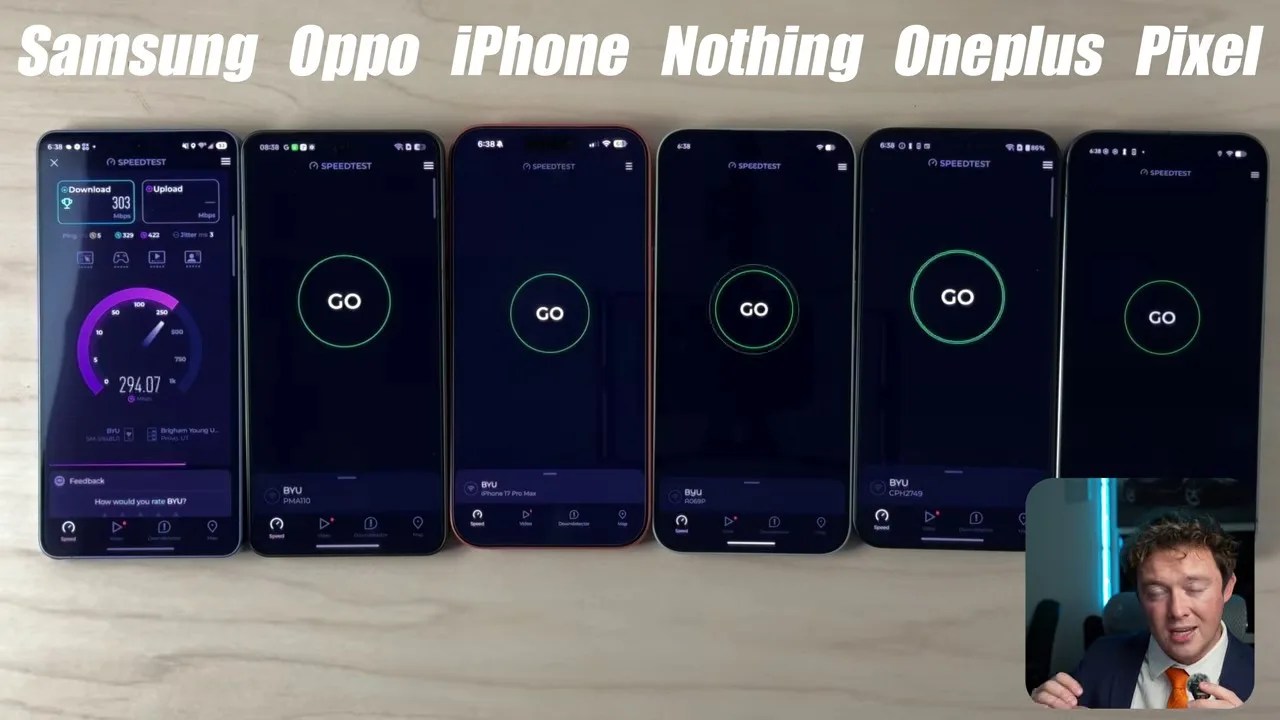
Wi-Fi modem showdown: Speed test results reveal a massive disparity in wireless performance.
The results exposed a massive gap between budget and premium hardware. The Nothing Phone performed significantly worse than the rest of the pack, consistently pulling much lower download and upload speeds. This is a crucial trade-off to keep in mind: when you buy a budget device, manufacturers often cut corners on the wireless connectivity chips.
Among the flagships, the Oppo and OnePlus devices absolutely dominated, showing incredibly high and stable throughput. The iPhone 17 Pro Max, curiously, lagged slightly behind its Android flagship rivals, which is a trend we have noticed in successive Apple generations.
We then stepped outside into the blinding afternoon sun to test peak brightness. With all displays cranked to 100%, the Samsung Galaxy S26 Ultra, iPhone 17 Pro Max, and Oppo Find X9 Ultra were the clear champions, remaining perfectly legible even under direct glare. The OnePlus, Nothing, and Pixel screens looked noticeably dimmer, forcing us to squint to read the on-screen text.
After a quick speaker loudness test to round out the quarter, the judges tallied the wildcard scores. The Oppo Find X9 Ultra claimed yet another victory, with the Google Pixel right behind it, and the Nothing Phone bringing up the rear. This kept Oppo firmly at the top of our overall league leaderboard, with OnePlus desperately clinging to second place.
Quarter 4: Raw Performance and Thermal Torture
We have finally arrived at the fourth quarter: the performance round. This is where the rubber meets the road. If a phone cannot handle heavy multitasking, gaming, or sustained workloads, all the fancy cameras and bright screens in the world won’t save it.
Three of our Android contenders—the Samsung Galaxy S26 Ultra, the OnePlus 15, and the Oppo flagship—are powered by the formidable Snapdragon silicon, with Samsung boasting a custom-tuned “for Galaxy” variant. Apple is relying on its custom A19 Pro silicon, while Google uses its in-house Tensor G5.
Geekbench 6: The Standard vs. Ice Pack Gauntlet
We started with a standard Geekbench 6 run. In normal room-temperature conditions, the iPhone 17 Pro Max’s A19 Pro chip absolutely obliterated the field in single-core performance. However, the multi-core crown went to the Snapdragon-powered Android flagships. The Nothing Phone and the Google Pixel 10 Pro XL were left completely in the dust—a massive disappointment for the Pixel, which is priced like a top-tier flagship but performs like a mid-range device.
But we wanted to see what these chips could do when thermals were completely removed from the equation. To eliminate thermal throttling, we placed all six phones directly onto bags of ice and ran the benchmarks again.
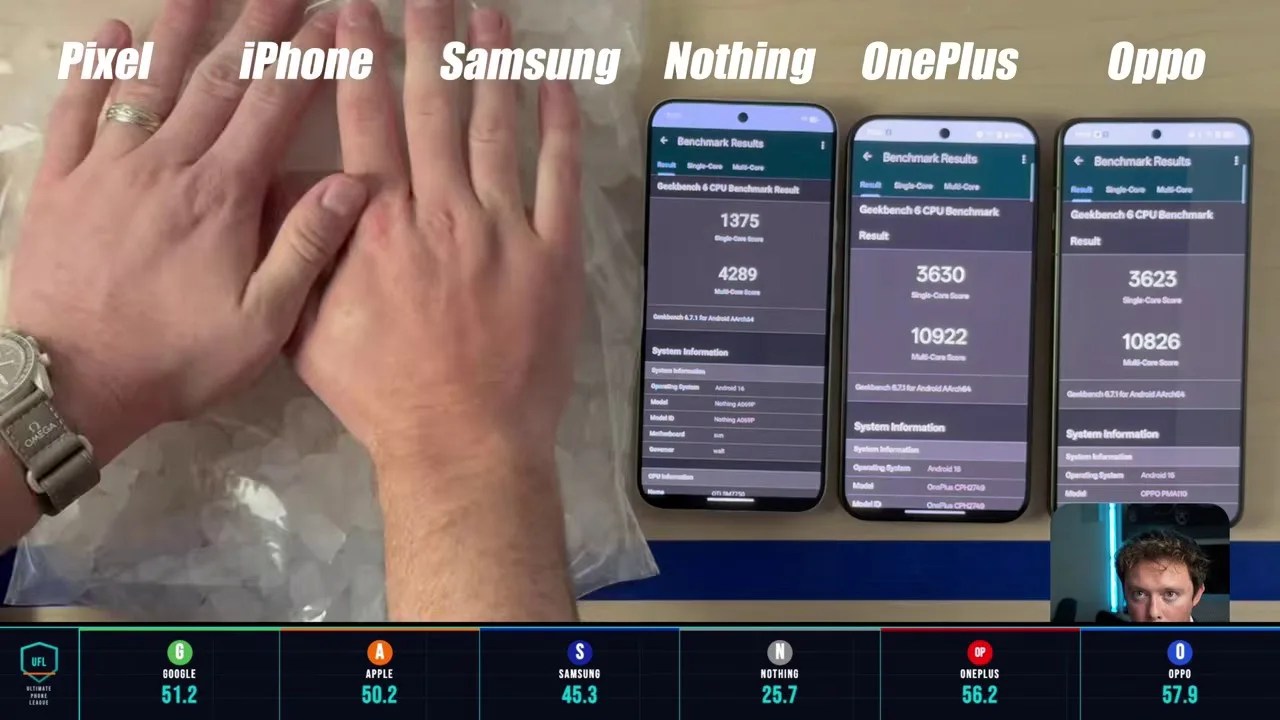
Chilled to the bone: Running benchmarks on ice packs to see the true, unthrottled potential of these mobile chips.
The results under sub-zero cooling were absolutely mind-boggling. Freed from the constraints of heat dissipation, every single device saw a massive jump in performance. The iPhone 17 Pro Max broke history, shattering the 10,000 multi-core barrier on Geekbench. The Snapdragon devices also saw their scores skyrocket, proving that modern mobile chips are incredibly powerful but are heavily held back by the thin glass-and-metal chassis they are trapped inside.
AnTuTu and the Pixel’s White Flag
We then moved on to the comprehensive AnTuTu benchmark. Now, we must acknowledge a major technical caveat here: AnTuTu handles iOS and Android platforms differently, meaning you cannot do a direct, apples-to-apples score comparison between the iPhone and the Android devices. While the Android flagships routinely push past the 4-million mark, the iPhone registers around 2 million due to structural differences in how memory and graphics are queued.
But the real story of the AnTuTu round wasn’t the scores—it was the Google Pixel 10 Pro XL. In the middle of the test, the Pixel simply gave up. It flat-out refused to complete the benchmark, crashing to the home screen. Google’s custom Tensor silicon has made strides in AI processing, but when it comes to raw, sustained, brute-force graphical performance, it still struggles heavily under pressure.
The Gaming Arena: Real-World Throttle and Frame Rates
While theoretical benchmarks on ice packs are fun for tech geeks, they don’t represent how you actually use your device. To ground our performance testing in reality, we booted up popular, fast-paced titles like Subway Surfers and Free Fire across all six devices.
Because of our massive lineup, we condensed the gaming sessions into rapid-fire rounds to see how the thermal envelopes adjusted to active, sustained gameplay. Overall, the Snapdragon-powered devices showed incredible graphics rendering and frame stability. The OnePlus 15 took the gold medal in gaming performance, thanks to its ultra-high refresh rate optimization and raw Snapdragon graphics power.
However, it wasn’t a flawless victory—the OnePlus 15 still got noticeably warm in the hand. The Samsung Galaxy S26 Ultra and Oppo Find X9 Ultra followed closely in second and third, delivering a beautifully cool and stable gaming experience, while the iPhone 17 Pro Max landed in a respectable fourth place.
The Lap of Fates: The Real-World App Speed Test
This is my absolute favorite part of our testing loop: the physical speed run. We lined up the phones and clicked through a sequence of daily-use apps—ranging from light social media platforms like TikTok, Instagram, and Facebook to heavy productivity and gaming apps like CapCut and Call of Duty.
To eliminate physical clicking errors and keep the results as scientifically accurate as possible, we ran this entire sequence three times and averaged the scores. There are two laps in this test: Lap 1 measures how fast a phone can launch an app from a cold start, while Lap 2 measures RAM retention—how well the phone keeps those apps suspended in the background without forcing a slow reload.
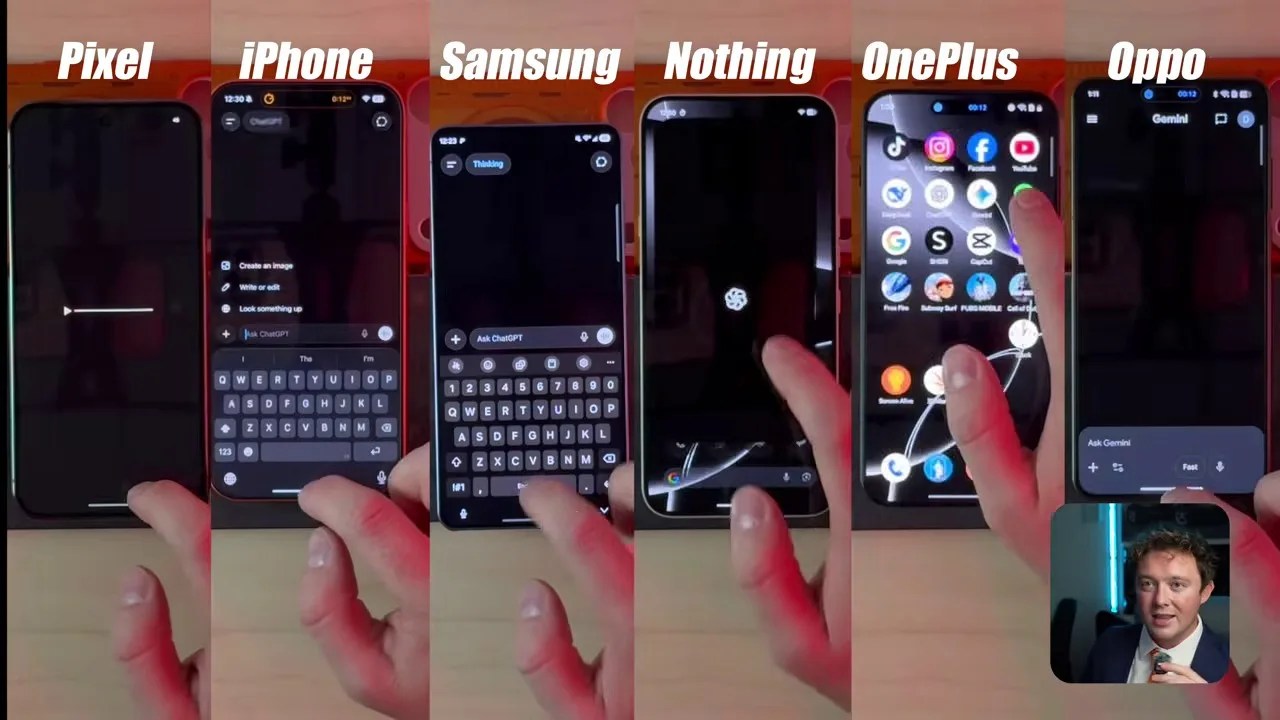
The Lap of Fates: Cycling through heavy apps and games to test real-world processing and RAM management.
In the first run, the Nothing Phone got absolutely demolished. It simply did not have the RAM optimization to keep the background apps alive, forcing painful reloads on Lap 2 and finishing in a sluggish 4 minutes. Meanwhile, the OnePlus 15 flew through the course, clocking a blistering first-run time of 1 minute and 42 seconds.
By the second run, the operating systems had adapted to our clicking sequence. The speeds improved drastically across the board. The OnePlus 15 clocked an insane 1 minute and 17 seconds, with the Oppo Find X9 Ultra breathing down its neck at 1 minute and 20 seconds.
Then came the third and final run—with all the glory on the line. As we sped through the social media apps and heavy game files, the Snapdragon chipsets showed their true dominance, loading complex game assets far quicker than Apple’s A19 Pro or Google’s Tensor. In a dramatic photo-finish, the Oppo Find X9 Ultra pulled off a miracle, crossing the finish line first at 1 minute and 19 seconds, with the OnePlus 15 finishing just one second behind at 1 minute and 20 seconds.
The Ultimate Champion Crowned
After four quarters of pure, unadulterated tech torture, the points have been tallied. Let’s look at how the performance quarter wrapped up before we crown our overall league champion.
In the Quarter 4 Performance standings, the OnePlus 15 took first place, followed by the Samsung Galaxy S26 Ultra in second, the Oppo Find X9 Ultra in third, and the iPhone 17 Pro Max in fourth. The Google Pixel 10 Pro XL and Nothing Phone brought up the rear, proving that computational algorithms cannot entirely mask weaker raw silicon.
When we combine the scores from all four quarters—Battery, Camera, Wildcard, and Performance—we get a highly surprising, historical final leaderboard:
- 🏆 OnePlus 15 (First Place & Overall Champion)
- 🥈 Oppo Find X9 Ultra (Second Place)
- 🥉 Samsung Galaxy S26 Ultra (Third Place)
Yes, you read that correctly. Apple’s iPhone 17 Pro Max failed to even make the podium.
If you had told me a year ago that Apple would be left empty-handed in a comprehensive flagship comparison, I would have laughed. But the data does not lie. The combination of dual silicon-carbon battery technology, hyper-fast 120W charging, and the raw graphical power of next-gen Snapdragon silicon has fundamentally shifted the smartphone landscape. While Apple still excels in video stabilization and haptics, its conservative charging curves and trailing multi-core performance cost it the crown.
OnePlus and Oppo have officially proven that the old-school flagship monopoly is dead. The next generation of mobile power belongs to those who are willing to push the boundaries of physical chemistry and raw speed.
Frequently Asked Questions (FAQ)
Q1: Why did the OnePlus 15 win the comparison despite its overheating issues?
The OnePlus 15 won because of its sheer dominance in the charging and battery drain quarters, alongside its blazing-fast app-loading speeds. While it did suffer from thermal throttling under heavy synthetic benchmarks, its real-world battery endurance (over 14 hours of screen-on time) and 120W charging speed earned it enough points to cushion its score against those thermal penalties.
Q2: What is silicon-carbon battery technology, and is it really better?
Yes, it is a massive upgrade. Silicon-carbon anode technology allows manufacturers to pack much higher energy densities into the exact same physical footprint as traditional lithium-ion batteries. This is why devices like the OnePlus 15 and Oppo Find X9 Ultra can easily cross the 14-hour screen-on-time mark while remaining incredibly thin and supporting ultra-fast charging speeds.
Q3: Why did the iPhone 17 Pro Max miss the podium?
The iPhone 17 Pro Max fell short primarily due to its slow charging speeds (taking nearly 1 hour and 49 minutes to hit 100%) and its trailing multi-core performance in our real-world speed tests. While its video recording and haptic engine are still the best in the industry, it could not keep pace with the massive battery and performance leaps made by its Android competitors.