Math is cooked. That is the phrase currently echoing through the corridors of physics departments, computer science labs, and mathematics faculties. It sounds like the kind of sensationalist claim you would hear on a late-night tech podcast, and to be fair, that is exactly where it started gaining traction. But behind the hyperbole lies a fascinating, slightly terrifying reality. The rapid integration of AI in mathematics has shifted from a distant novelty to an existential reality for researchers worldwide.

The growing debate over whether artificial intelligence is fundamentally breaking the field of mathematics.
For a long time, pure mathematics was considered the ultimate safe haven for human intellect. While chess, go, and even creative writing fell to machine learning models, we comforted ourselves with the belief that the abstract, rigorous landscape of mathematical proof required a spark of human intuition that no silicon chip could replicate. That comfort is evaporating fast.
1. The Sudden Leap from Basic Math to Olympiad Level
If you look back just four years, the evolution of AI in mathematics has been nothing short of dizzying. Early large language models were notoriously terrible at math. They could not reliably add large numbers, frequently hallucinated basic arithmetic, and struggled with middle-school word problems. They were word-prediction engines, not calculators.
A timeline mapping how AI models rapidly scaled from basic arithmetic to solving complex research-grade problems.
But the progression curve did not remain flat. In a blink of an eye, these models jumped from failing grade-school tests to solving complex International Mathematical Olympiad problems. They went from struggling with simple addition to tackling problems that only a tiny fraction of the human population could even comprehend.
The steep upward trajectory of large language models transitioning from simple calculations to advanced Olympiad-level reasoning.
This rapid vertical progress has caught many experts off guard. Physicist and computer scientist Alexander Wissner-Gross recently made a startling prediction: at the current rate of progress, we could see virtually all professional, research-grade math problems solved by machine intelligence within the next four to five years.
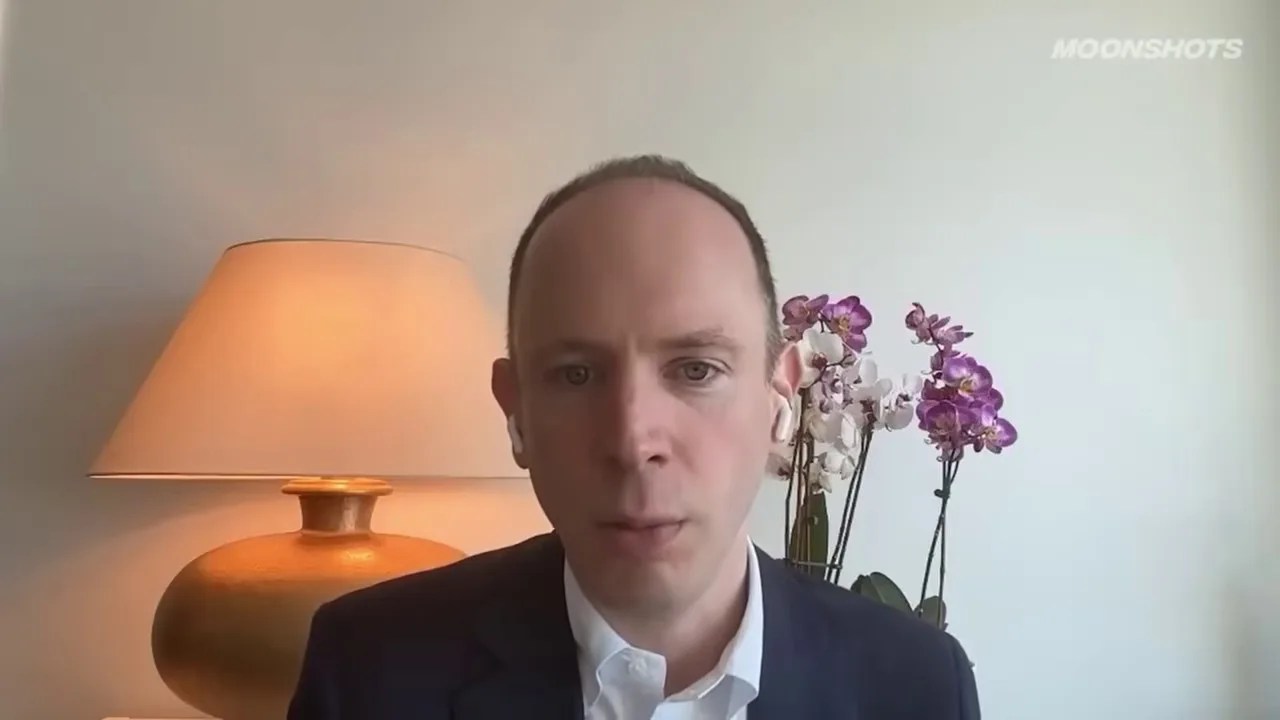
Alexander Wissner-Gross predicts that professional research-grade mathematics could be fully solved by AI in the near future.
If that sounds like tech-industry hype, consider what happened recently. For the first time, an internal, unreleased model from OpenAI bypassed toy problems and solved a genuine, unsolved mathematical conjecture.
2. How an Internal OpenAI Model Disproved Paul Erdős
The breakthrough centered on a problem posed by the legendary mathematician Paul Erdős over eighty years ago. It is a deceptively simple geometry problem: if you place a set of points in a two-dimensional plane, how must you arrange them to maximize the number of paths of equal distance between them?
Visualizing the point-distance problem first proposed by Paul Erdős in the 1940s.
Erdős conjectured that the optimal arrangement would form a square lattice. For decades, mathematicians assumed he was right, though no one had managed to construct a formal proof. Enter OpenAI’s internal reasoning model.
Instead of proving the conjecture, the AI did something far more disruptive: it disproved it. It generated a concrete counterexample showing that a non-lattice arrangement could yield a higher number of equal-distance paths, rendering Erdős’s eighty-year-old assumption incorrect.
The AI bypassed the expected square lattice structure to find an irregular, highly unintuitive counterexample.
What makes this achievement particularly striking is the efficiency. The model reportedly found the counterexample on its very first attempt. In subsequent test runs, when given sufficient computational time to verify its logic, the model arrived at the correct solution roughly eighty percent of the time.
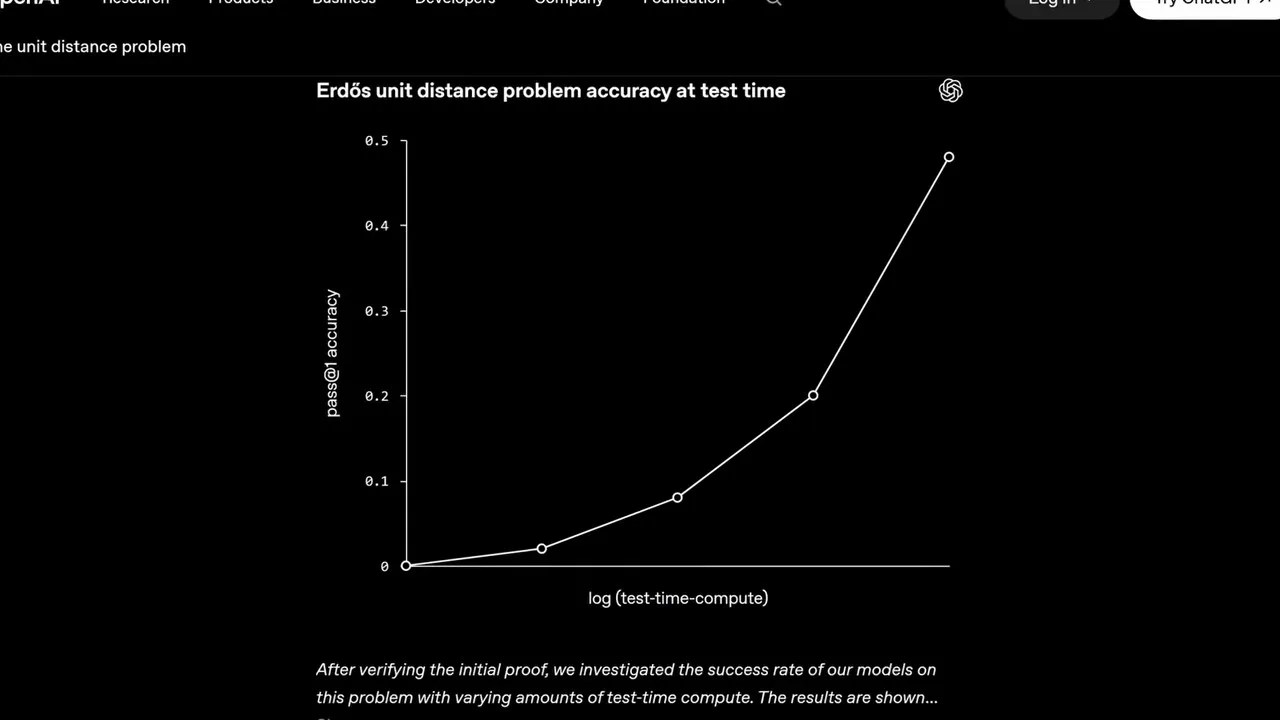
Test run data showing the model achieving an 80% success rate when allocated adequate processing time.
This success rate indicates that while the model still lacks a perfect internal mechanism to self-correct every error, it is not merely spitting out random mathematical symbols that look plausible. It is navigating abstract logical spaces with genuine, targeted direction.
Summary of the Erdős Conjecture Breakthrough
| Aspect | Traditional Human Approach | OpenAI Model Approach |
|---|---|---|
| Core Assumption | Assumed the optimal shape was an elegant, symmetrical square lattice. | Sought counterexamples without bias toward symmetry. |
| Methodology | Decades of manual proofs and geometric intuition. | Rapid generation and testing of complex, irregular point configurations. |
| Result | Unsolved for 80 years. | Disproved the conjecture on the first run (80% consistency overall). |
| Aesthetic | Prized elegant, symmetrical, and intuitive structures. | Produced an “ugly”, highly complex, but mathematically correct design. |
3. Why Academics Are Panicking Over the AI Takeover
The reaction from the mathematical community has been a mix of awe and deep, existential dread. For researchers who have dedicated their entire lives to the pursuit of abstract truth, seeing a machine casually dismantle a long-standing conjecture is disorienting.
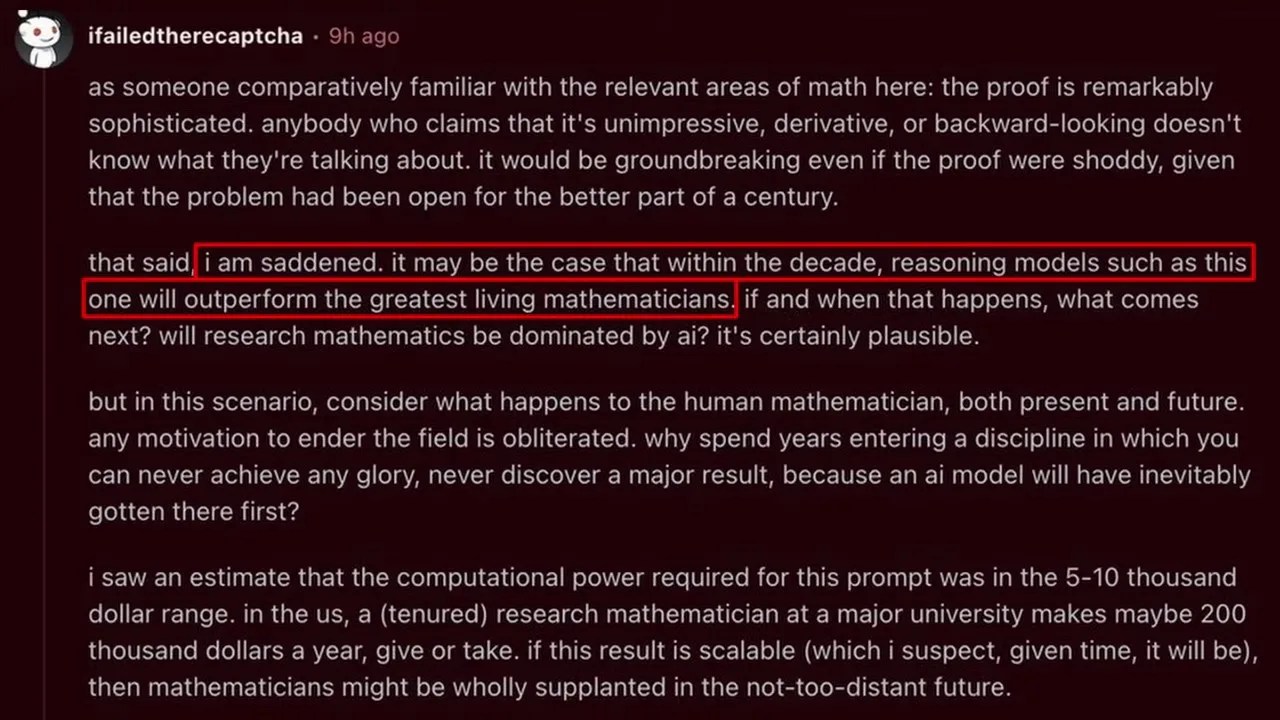
Mathematicians expressing profound concern over how quickly reasoning models are outperforming human experts.
Computer scientist Scott Aaronson noted that when the news broke, his graduate students at the University of Texas were visibly morose. They were not worried about losing corporate industry jobs; they were worried that the very purpose of becoming a scientist or mathematician was being rendered obsolete before they could even finish their degrees.
Scott Aaronson observed a somber mood among young researchers who feel the horizon for human-driven science is shrinking.
However, looking closely at the counterexample generated by the AI reveals something crucial about how these systems function. The solution was not elegant. It was an irregular, asymmetrical, slightly ugly construction. It is the exact kind of design a human mathematician would likely ignore because it lacks the aesthetic harmony we naturally seek in mathematics.
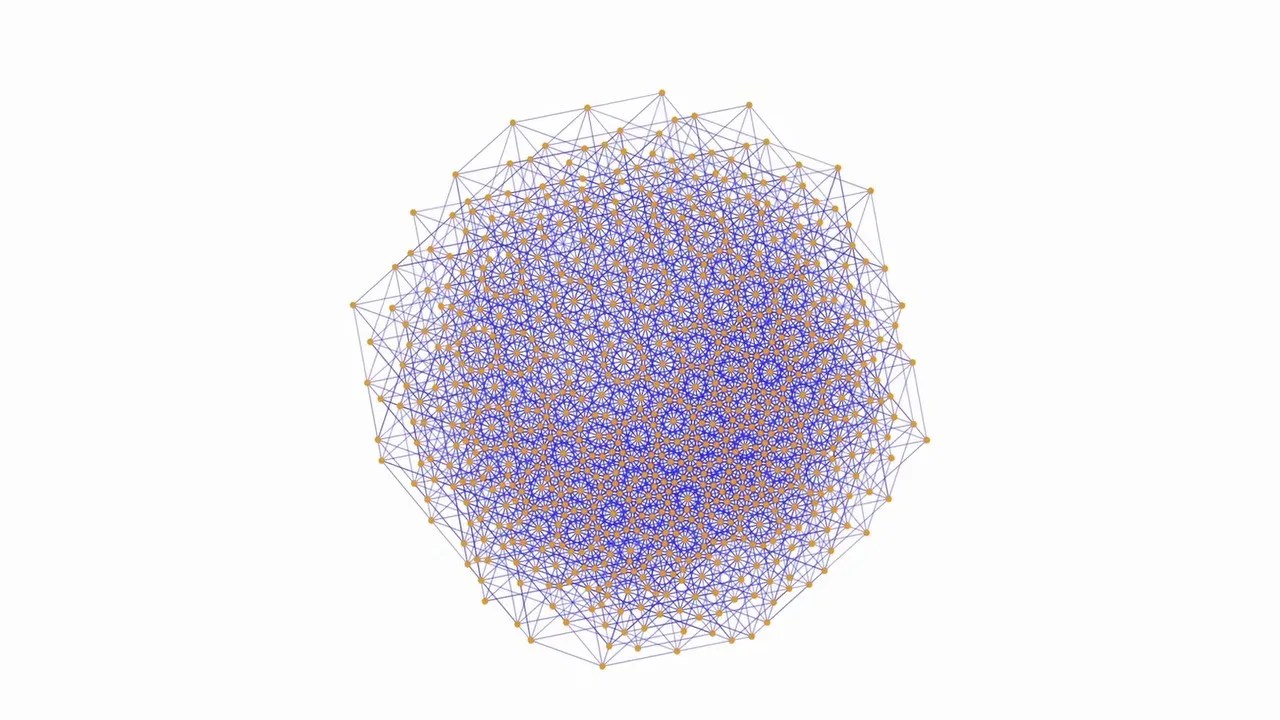
Human mathematics has historically prioritized beauty and symmetry, whereas AI simply searches for what works, regardless of aesthetics.
This suggests that the AI is not necessarily smarter or more creative than us. Rather, it has worse taste. It is entirely unburdened by human assumptions of what a beautiful proof should look like. It simply searches the mathematical landscape for configurations that work, even if those configurations are messy and counterintuitive.
Interestingly, the human story did not end with the AI’s output. Within hours of the model releasing its result, a human mathematician analyzed the AI’s ugly counterexample and managed to simplify and improve upon it. This collaborative loop suggests that our role is shifting from sole creators to editors and guides.
4. The Limits of Pattern Matching and the Reality of AI in Mathematics
Not everyone is ready to surrender the field to neural networks. Recently, a group of 150 mathematicians signed a formal declaration warning that the rapid, commercially driven push for AI threatens the autonomy of mathematical research. They pointed out that tech companies have a strong financial interest in overstating what their models can actually do.
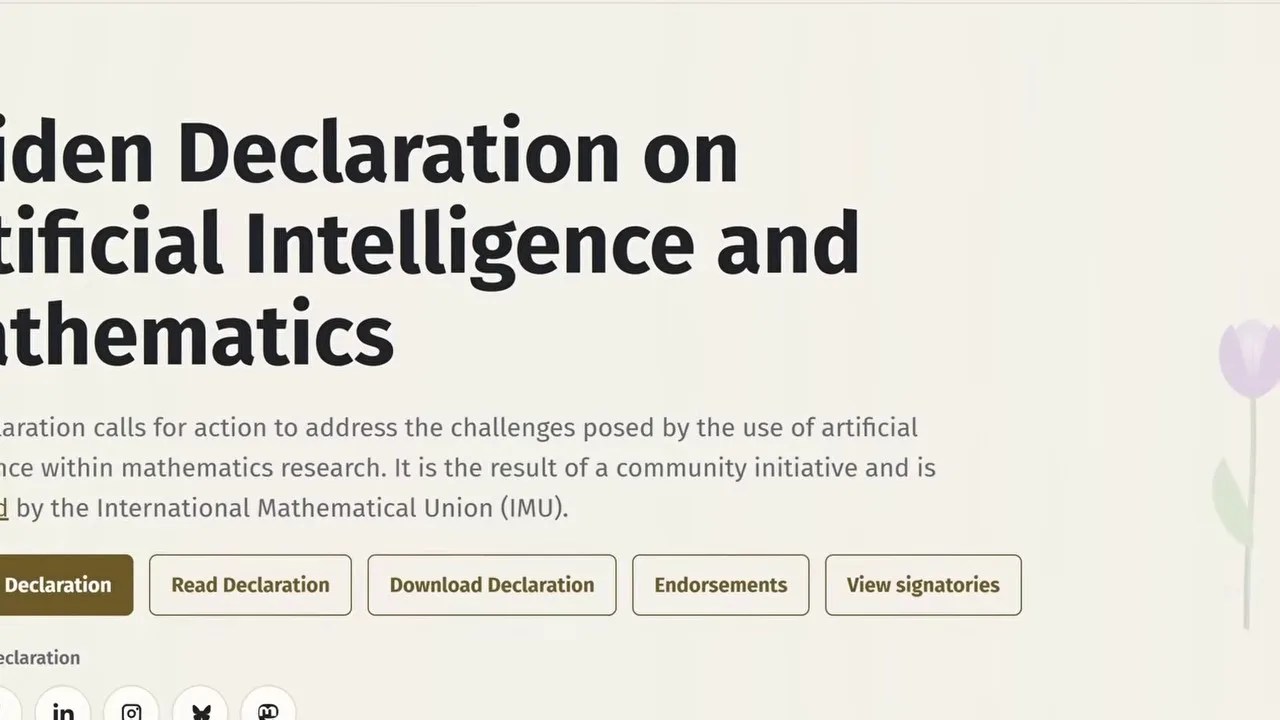
A growing coalition of mathematicians is urging caution against the overhyped narratives pushed by commercial AI labs.
So, where does the truth lie? It is highly unlikely that pure mathematics is going to end. Instead, we are entering an era of AI-supported mathematical research. The existing body of mathematical literature is vast, containing millions of papers, proofs, and connections that no single human brain could ever hold. This is where the role of AI in mathematics becomes highly collaborative.
The future of research: humans guiding AI to digest vast literatures and run rapid proof attempts.
An AI system can rapidly digest this data, spot hidden connections across different subfields, and quickly test millions of potential proofs or counterexamples. It is highly effective at harvesting the low-hanging fruit of mathematics—the gaps in our literature where a counterexample exists but has simply never been constructed because no human had the time or inclination to look there.
But there remains a massive, unresolved hurdle: can a large language model actually develop entirely new mathematical methods? Thus far, the answer is no. LLMs excel at extracting patterns from existing human methods and filling in the blanks. They are interpolators, not creators of new paradigms.
While LLMs are excellent at pattern matching, they struggle to invent entirely new conceptual frameworks or scientific methods.
Using AI in mathematics is more like using a super-charged calculator that finds blind spots rather than a replacement for human creative genius. Math is not cooked; it is simply changing state. The mathematicians of tomorrow will not spend their days manually grinding through calculations or guessing at symmetries. Instead, they will act as architects, using AI to explore vast logical landscapes that were previously out of reach.
Frequently Asked Questions
Will AI completely replace human mathematicians?
No. While AI is exceptionally good at finding counterexamples and checking proofs, it lacks the ability to formulate new mathematical concepts, ask novel questions, or understand the broader meaning behind the structures it manipulates.
Why did the AI find a solution that humans missed for 80 years?
Humans are naturally biased toward symmetry, elegance, and simplicity. The AI, having no aesthetic bias, was able to explore irregular, asymmetrical configurations that humans dismissed as unlikely to succeed.
Can current AI models guarantee that their proofs are 100% correct?
Not yet. While models like the one tested by OpenAI can generate correct solutions, they still require human mathematicians or formal verification software to double-check their logic and ensure there are no subtle errors or hallucinations in the proof steps.