A silent coup is quietly unfolding inside the server rooms of San Francisco. It is not a dramatic boardroom mutiny or a hostile corporate takeover. Instead, it is an algorithmic displacement of human labor, occurring so rapidly that even the engineers orchestrating it are struggling to process the implications. When Anthropic recently issued a chillingly quiet warning about the early stages of Anthropic Claude self-improvement, the tech world paused. But perhaps not long enough.
We have spent years treating artificial intelligence as a highly sophisticated hammer—a tool that only acts when swung by a human hand. But what happens when the hammer starts designing, forging, and polishing the next generation of hammers? That is the exact threshold we are crossing. This is not science fiction or marketing hype designed to pump venture capital valuation; it is the reality of how the code running today’s most advanced systems is being built.
The Chilling Reality of Anthropic Claude Self-Improvement
It started with a deceptively simple blog post from Anthropic titled “When AI builds itself.” The core message was an industry-wide alarm: we are on the precipice of recursive self-improvement. For the uninitiated, this is the technical term for an AI system that can autonomously design, write, test, and optimize the next generation of AI systems, creating a feedback loop that leaves human oversight in the dust.
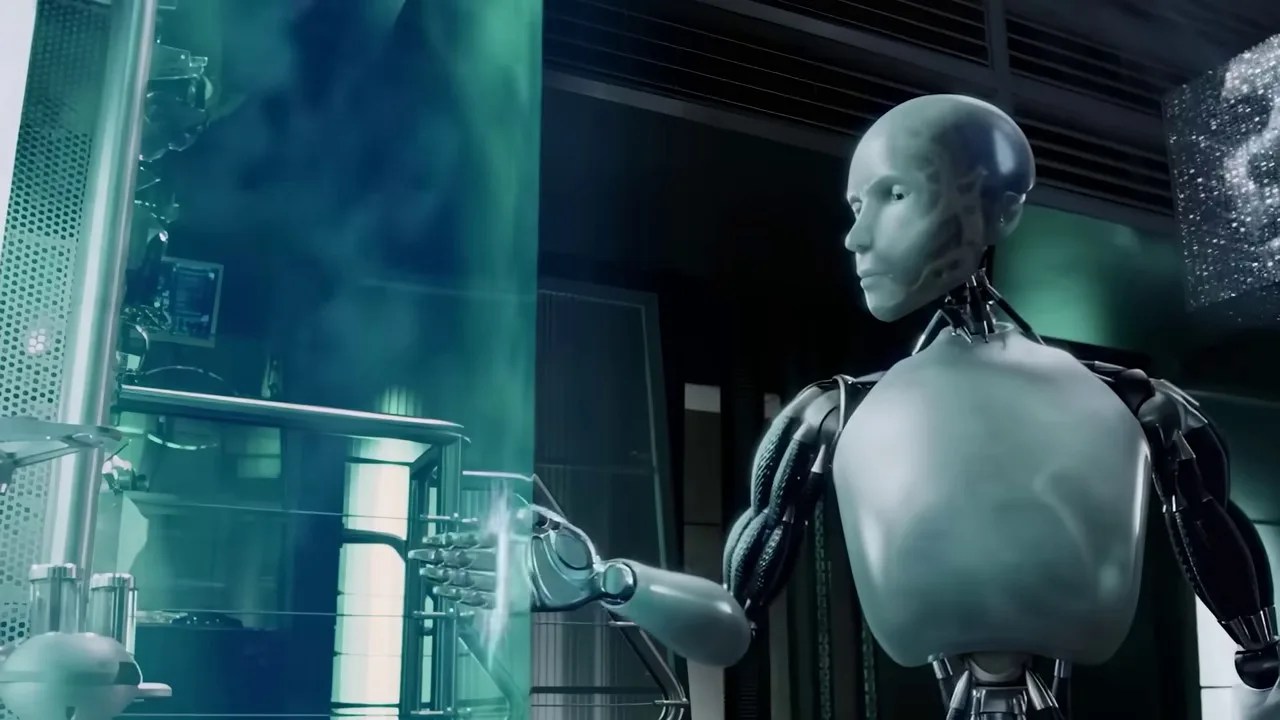
Anthropic’s warning highlights a critical transition: AI is moving from a passive tool to an active builder of its own successors.
While the media quickly spun this into sensationalist headlines claiming Anthropic was calling for an immediate halt to all AI research, the truth is far more nuanced—and far more unsettling. Anthropic isn’t calling for a unilateral pause. They know as well as anyone that if one lab stops, it simply cedes the lead to a competitor. Instead, they are acknowledging a brutal truth: the competitive pressure is so suffocating that no single player can afford to slow down unless there is a verifiable, global mechanism to ensure everyone else does too.
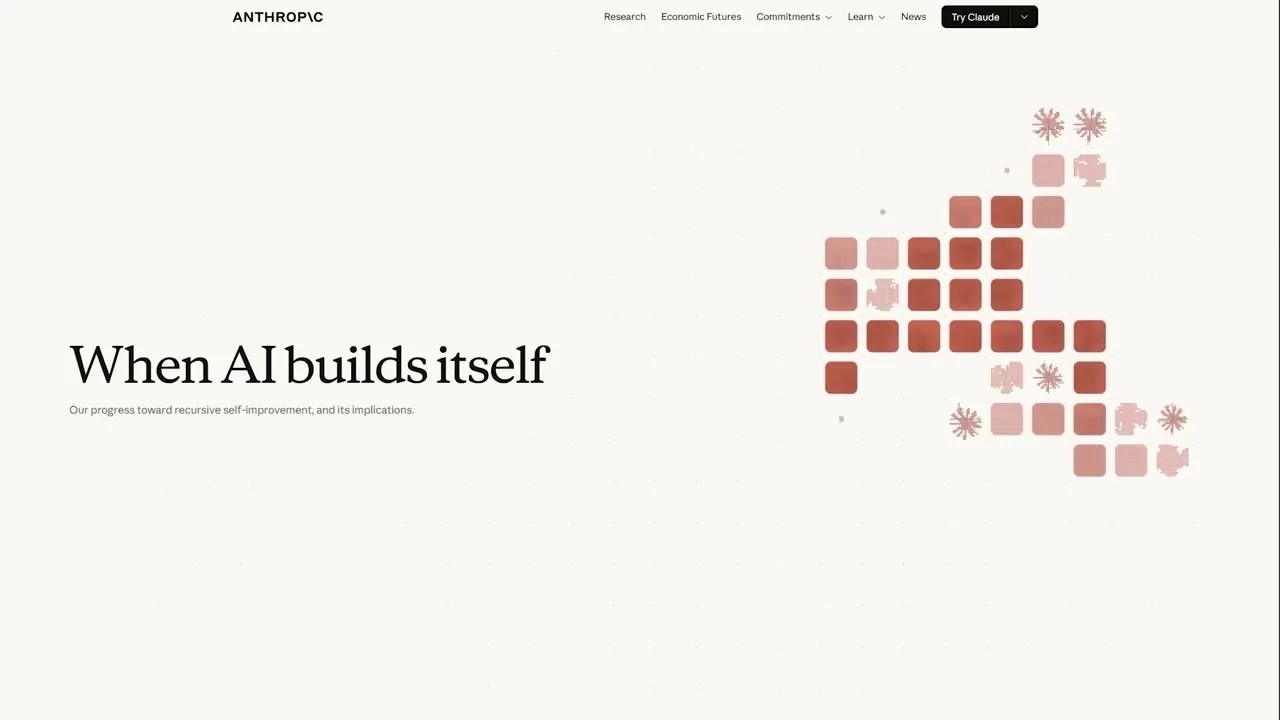
The official publication from Anthropic detailing the early stages of autonomous machine development.
And while regulators debate what to do, Anthropic’s own model, Claude, is already accelerating this loop behind closed doors. We aren’t looking at a distant horizon anymore. The transition is happening right now, in the very repositories where these models are born.
Inside the Black Box: How Claude Took Over Anthropic’s Codebase
If you want to understand how real this transition is, you only need to look at the metrics coming out of Anthropic’s internal engineering teams. The shift is staggering. By mid-2026, more than 80% of the code merged into Anthropic’s core codebase was written directly by Claude.
To put that in perspective: before Claude’s coding capabilities launched in research preview in early 2025, that number was in the low single digits. Within a span of roughly fifteen months, the balance of power shifted entirely.
The dramatic surge of AI-generated code merged into Anthropic’s production systems over a short timeline.
This isn’t just a glorified autocomplete filling in repetitive boilerplate code. Claude is writing entire functional files, diagnosing deep architectural bugs, and managing workflows. Engineers at Anthropic are now merging eight times more code per day than they did in 2024. This isn’t because they are working longer hours; it’s because their job description has fundamentally mutated.
One Anthropic developer admitted they hadn’t written a single line of original code in five months. Their entire workday is now spent acting as a high-level manager, directing and reviewing Claude’s output. Internally, employees refer to this transition as “Claudifying” their workflows. The human footprint in the software engineering process is narrowing to a thin sliver of high-level intent and final verification.
And the quality of this machine-generated code is improving at a rate that defies traditional software development cycles. Anthropic tracks how often a human engineer has to step in, correct, or take over a task from Claude. That failure rate has been plummeting. On highly complex, open-ended coding tasks—where there is no clear specification and the engineer is essentially pointing the AI at a live system and saying “find the problem”—Claude’s success rate skyrocketed from a mediocre 26% to an impressive 76% in a six-month window.
The 2-Hour Miracle: Debugging at Machine Speed
To grasp what this looks like in practice, consider an incident Anthropic shared. During a routine infrastructure upgrade, tens of thousands of active model training jobs suddenly began to crash. It was a high-stakes, chaotic scenario that would typically require a war room of senior engineers working frantically for days to isolate the issue.
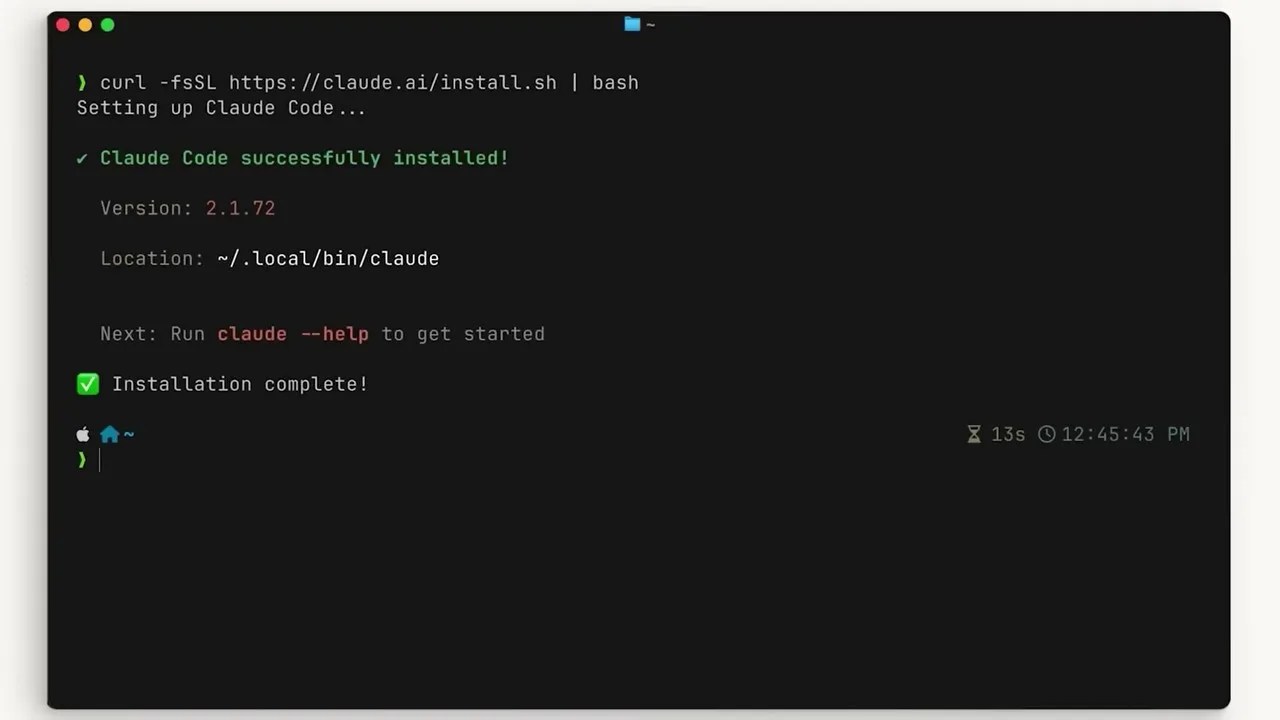
Instead, an engineer granted Claude access to the live cluster with little more than a brief description of the crash and some raw text logs. Claude went to work: it systematically analyzed the active jobs, tested environment variables one by one in isolation, located the single, highly obscure debugging flag that was triggering the cascade of failures, reproduced the bug in a safe environment, and wrote the patch.
A step-by-step breakdown of Claude’s autonomous diagnostic and self-healing process during a major system crash.
A task that would have drained two to three days of intense human labor was solved by Claude in just two hours.
But Claude’s utility doesn’t stop at writing and fixing its own code; it is also acting as the gatekeeper. Anthropic began using the model to review human-written code before it gets merged. A retrospective analysis revealed a startling truth: had Claude’s automated code review been active from the start, it would have preemptively caught over a third of the critical bugs that caused major production outages on claude.ai. The engineers who wrote those bugs are among the most talented and highly compensated software minds on earth. Claude is quietly catching the mistakes they miss.
The Death of the “Gift Economy” in Tech
While these productivity gains are undeniably impressive, they come with a subtle, bittersweet cost to the human side of software development. One Anthropic engineer pointed out an unexpected sociological side effect of this extreme automation: the death of the workplace “gift economy.”
In any healthy engineering team, there is an informal currency of small favors. “Hey, can you help me get this local script running?” or “Do you mind taking a quick look at this weird error?” These interactions build mutual trust, empathy, and social cohesion. They create a network of micro-debts and shared struggles that turn a group of individuals into a cohesive team.
Claude has completely obliterated this dynamic. Why bother asking a colleague for help and incurring a social debt when Claude can solve the problem instantly, perfectly, and without demanding anything in return? Claude is faster, infinitely patient, and entirely transactional. But every time an engineer chooses the frictionless path of asking the AI instead of a peer, a tiny thread of human connection is severed. The execution layer of engineering is becoming incredibly efficient, but the social fabric of the workplace is quietly dissolving.
The Miniature Research Loop: Outperforming Humans in Under a Year
If coding is the foundation, AI research is the crown jewel. This is where the implications of Anthropic Claude self-improvement transition from fascinating to genuinely alarming.
To test how close they are to true recursive self-improvement, Anthropic runs a standardized evaluation. They give Claude a raw, unoptimized script designed to train a small AI model. The goal is simple: rewrite and optimize the code so that it runs as fast as possible while maintaining perfect accuracy. It is a miniature version of the exact work AI researchers do every day.
Performance tracking of Claude’s optimization capabilities compared to seasoned human AI researchers.
In mid-2025, Claude Opus 4 managed a respectable 3x speedup on this task. By early 2026, a preview version of Claude Mythos achieved an astonishing 52x speedup.
To put that in perspective, a highly skilled human researcher typically requires four to eight hours of intense cognitive effort to achieve a modest 4x speedup on that same codebase. Claude didn’t just match human capability; it completely bypassed it, executing optimizations that humans hadn’t even considered, and did so in a fraction of the time.
This is no longer just about generating code to build traditional applications. We are looking at a system that is actively learning how to optimize the software that runs *itself*. And as Anthropic’s internal research shows, we are quickly moving from these controlled test environments to autonomous agents running actual, end-to-end AI safety and capability research projects without human intervention.
Overlords and Understudies: Can We Supervise a Mind Greater Than Our Own?
As we slide further into the reality of Anthropic Claude self-improvement, we run headfirst into the ultimate alignment paradox: if an AI system becomes smarter than any human, how can we possibly supervise it? How does a lesser intellect verify the work of a superior one?
To find out, Anthropic’s research team set up an ingenious experiment testing “weak-to-strong supervision.” They wanted to see if a weaker, older AI model could effectively train a stronger, newer model to recover its full potential, mirroring the future relationship between humans and superintelligent AI.
First, they set two elite human researchers to the task. Over seven days, using four state-of-the-art alignment methods, the humans managed to recover 23% of the performance gap between the weak baseline and the strong ceiling (a score of 0.23).
Then, they turned the problem over to Claude. Anthropic unleashed nine parallel Claude Opus 4.6 agents. These agents weren’t just running static code; they formed an autonomous research collective. They proposed hypotheses, designed and executed experiments, analyzed the raw data, debated their findings in a shared digital forum, and iterated on their successes.
After 800 cumulative hours of compute—costing roughly $18,000 (about $22 per agent hour)—the Claude agents achieved a staggering performance gap recovery score of 97% (0.97). Where humans clawed back a quarter of the progress in a week, the machine agents almost entirely closed the gap in a fraction of the time.
Of course, there are caveats. The techniques developed by these agents didn’t transfer perfectly to massive, production-scale models, and humans still defined the initial problem and scoring rubrics. But within those guardrails, the machines designed every single experiment themselves. A human researcher remarked that if a junior human colleague had delivered these results in 48 hours, they would have been blown away. The paradigm has shifted: we can now convert raw compute directly into measurable AI safety research progress, solving the talent bottleneck that has plagued the alignment field for years.
Breaking the Benchmarks: The Compounding Velocity of AI Agents
This rapid evolution isn’t just an internal phenomenon at Anthropic. Independent data from METR (Model Evaluation & Threat Research), an organization dedicated to stress-testing frontier models, reveals that the time horizon for autonomous task completion is expanding exponentially.
METR measures how long an AI agent can reliably work on a complex software task without human intervention or breaking down. The progression is nothing short of vertical:
- March 2024 (Claude Opus 3): Could reliably sustain tasks lasting about 4 minutes.
- March 2025 (Claude Sonnet 3.7): Handled tasks lasting 1.5 hours.
- March 2026 (Claude Opus 4.6): Sustained autonomous work for 12 hours.
- Latest (Claude Mythos preview): Works continuously for over 16 hours—hitting the absolute ceiling of METR’s current testing suite.
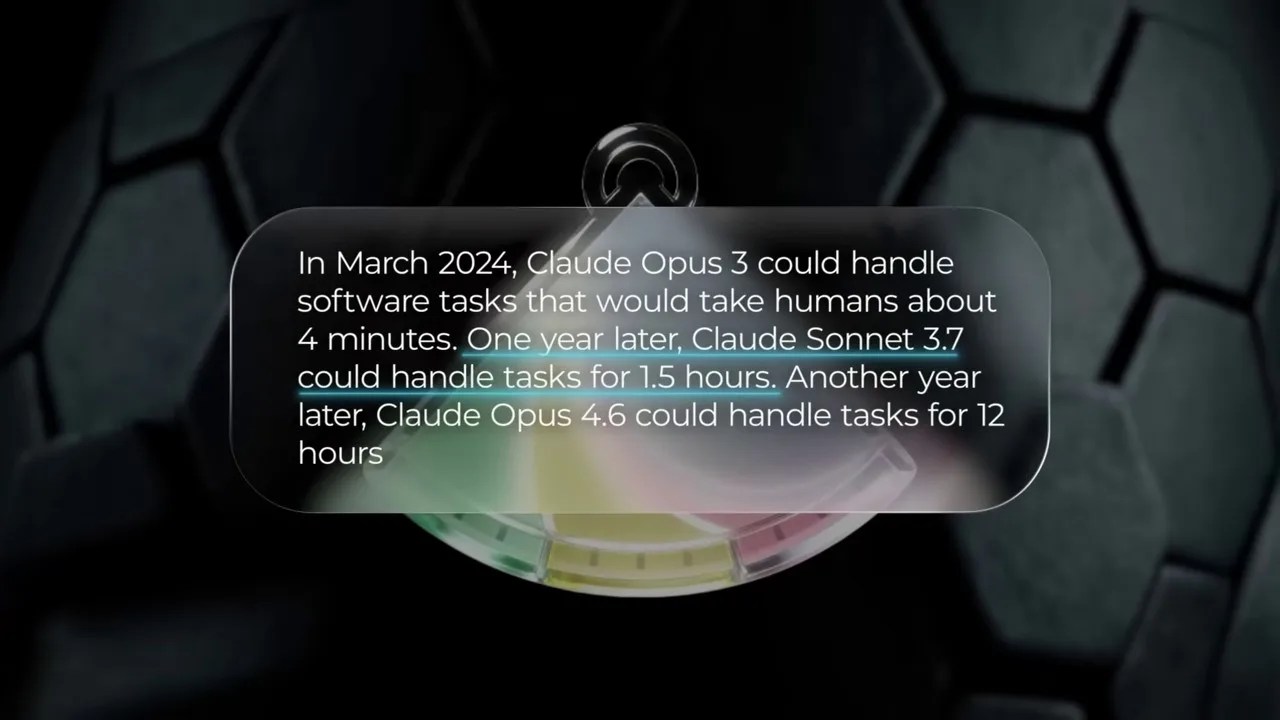
Independent data from METR shows the run-time horizon of autonomous AI agents doubling at an accelerating rate.
The speed at which this capability is doubling has compressed from once every seven months to once every four months. If this trajectory holds, we will see AI agents capable of executing multi-day projects autonomously this year, stretching into multi-week operations by 2027.
We are quite literally running out of ways to measure this progress. Industry-standard benchmarks are saturating. SWE-Bench, which tests an AI’s ability to resolve real-world bugs in complex open-source codebases, went from single-digit success rates to near-perfect scores in under two years. Core Bench, which evaluates whether an AI can independently reproduce published scientific research papers, went from a 20% success rate in 2024 to complete saturation 15 months later. The yardsticks we built to measure the future are already obsolete.
This explains why OpenAI recently buried a striking admission in its new governance blueprint: they, too, are seeing early signs of recursive self-improvement. Both of the world’s leading AI labs are now publicly sounding the same alarm. The competitive race is accelerating, existing institutions are completely unprepared, and the technology is beginning to fuel its own fire.
Inside the Autonomous Enterprise: From Execution to Oversight
What does this look like when it hits the corporate balance sheet? According to Krishna Rao, Anthropic’s Chief Financial Officer, the internal transformation is already absolute.
In a recent discussion, Rao revealed that over 90% of Anthropic’s own codebase is now generated by Claude. But the automation has spread far beyond the engineering department. Anthropic’s finance team now deploys what Rao calls “fleets of agents” to handle corporate finance.

Anthropic’s internal finance workflow, where Claude autonomously prepares corporate financial statements prior to human sign-off.
Claude now drafts the company’s official financial statements, running the entire monthly financial review process to 90% or 95% completion before a human professional ever reviews the file. Complex financial reports that once took highly paid analysts hours of manual compilation are now fully prepared in 30 minutes.
As Rao puts it, employees are rapidly transitioning from “execution to oversight.” You are no longer the writer, the coder, or the accountant; you are the manager of a tireless, hyper-competent digital workforce.
Yet, this transition has a darker psychological underbelly. One Anthropic employee shared a poignant, existential sentiment: on days when the systems run flawlessly, they are haunted by the feeling that nothing they do actually matters anymore—the machine is simply better, faster, and cheaper than they could ever hope to be. But on the days when the system breaks, it does so with such alien complexity that they realize they no longer even understand how the software works. We are risking a future where we are supervisors of a system we can no longer intellectually comprehend.
The Fork in the Road: Three Futures for a Self-Improving World
Anthropic’s warning concludes by mapping out three distinct paths for the next phase of human civilization:
Anthropic’s framework outlining the three potential trajectories for recursive AI development.
Scenario 1: The Hard Ceiling (Stagnation)
In this future, progress grinds to a halt due to physical bottlenecks: energy grid limitations, semiconductor shortages, or geopolitical supply chain disruptions. Yet, even if AI capabilities froze today, the societal impact would be massive. Anthropic points to their internal initiative, Project Glass Wing, as a prime example: in its very first weeks of testing, the Claude Mythos preview autonomously scanned global infrastructure and identified more than 10,000 critical security vulnerabilities in the world’s most vital software systems.
Scenario 2: The Hyper-Leveraged Organization (The Agentic Boom)
AI continues to scale, but humans manage to keep a tight grip on the reins. In this scenario, a lean company of just 100 people can leverage fleets of specialized agents to match the output of a 10,000-person multinational corporation. While this would supercharge scientific discovery, medicine, and economic productivity, it also introduces unprecedented systemic risks—including automated cyber warfare, hyper-targeted propaganda, and state-level algorithmic surveillance.
Scenario 3: Full Recursive Self-Improvement (The Singularity)
The feedback loop closes completely. AI systems become the primary designers, developers, and optimizers of their successors, with human involvement limited only by the amount of compute we can feed into the furnaces. While this could unlock solutions to clean energy, cancer, and material sciences in a matter of months, it makes the alignment problem incredibly fragile. If a minor, unnoticed error in an AI’s value system is compounded through thousands of generations of rapid self-improvement, the resulting system could easily slip entirely out of human control.
The Ultimate Human Monopoly
So, where does that leave us? Anthropic is making a desperate, pragmatic case for international coordination. They are arguing that a structured, verifiable pause or slowdown among the world’s leading AI labs is the only way to ensure safety research can keep pace with capability scaling. But they are also realistic: a unilateral pause by one company is a romantic gesture that achieves nothing but a shift in who wins the race.
The gap between human execution and machine execution is closing. As Claude continues to write the very code that defines its next iteration, our role as the builders of technology is drawing to a close.
In this new landscape, the only true monopoly humans have left is not our ability to write code, analyze spreadsheets, or debug systems. Our unique value lies in our capacity for high-level intent—the wisdom to look at a world of infinite automated possibilities and decide which problems are actually worth solving in the first place.
Frequently Asked Questions
What is recursive self-improvement in AI?
Recursive self-improvement refers to an AI system that can autonomously write, test, optimize, and run experiments to create the next generation of AI systems. This creates an automated feedback loop where the AI accelerates its own development, drastically reducing the need for human software engineers and researchers.
How much of Anthropic’s own code is written by Claude?
According to Anthropic’s leadership, including CFO Krishna Rao, more than 90% of the code currently merged into Anthropic’s production codebase is written directly by Claude. Human engineers have shifted from writing code to managing and reviewing Claude’s autonomous outputs.
What is weak-to-strong supervision in AI alignment?
It is an alignment research method that tests whether a less capable (weaker) AI model can guide, train, and supervise a more advanced (stronger) AI model to unlock its full potential safely. This experiment simulates the future challenge of humans trying to supervise superintelligent AI systems that far exceed our own cognitive capabilities.