While the tech world is busy arguing over whether OpenAI’s next model will achieve human-level intelligence, or when Anthropic will finally cross the finish line, Google DeepMind just quietly shifted the entire goalposts. They didn’t publish a paper on how to build Artificial General Intelligence (AGI). They published a massive, 57-page manifesto treating AGI as the mere starting point.
They are looking past the horizon. They want to know exactly what comes after AGI.
If you’ve been following the AI space, you know how obsessed everyone is with reaching that “human-level” mark. But this paper, authored by some of the most legendary figures in computer science, suggests that reaching AGI is just the warm-up act. What follows is a transition so rapid, so mathematically intense, and so alien to human experience that it could reshape our civilization in a matter of years.

The cover of DeepMind’s groundbreaking 57-page research paper, outlining the roadmap from AGI to Superintelligence.
Let’s unpack what this paper actually reveals, look past the academic jargon, and analyze the raw, unfiltered future DeepMind is currently preparing for.
The Brain Trust and a Paper Written for AI Readers
This isn’t some speculative blog post from a tech enthusiast. The minds behind this document represent the absolute royalty of modern AI research. We are talking about 14 of the top researchers at DeepMind, led by Shane Legg—the Chief AGI Scientist and co-founder of DeepMind alongside Demis Hassabis—and Marcus Hutter, Legg’s doctoral supervisor and the pioneer who formulated the legendary AIXI theory.

Shane Legg and Marcus Hutter: The intellectual heavyweights mapping the post-AGI era.
When people of this caliber sit down to write a 57-page roadmap, you don’t just read it—you look for the subtle, shocking details hidden between the lines. And the very first page contains a detail that absolutely blew my mind.
Instead of a standard academic introduction, the paper begins with a section titled “Summary Instructions.” But these instructions aren’t for you, me, or any human academic.
They are written specifically for AI assistants.

A historic first: DeepMind explicitly formats instructions for AI systems tasked with reading and analyzing their research.
DeepMind is literally instructing future large language models on how to parse, summarize, and evaluate their paper. They tell the AI readers to preserve specific definitions, avoid compressing critical lists, and critically evaluate if the conclusions hold up over time. It is a subtle, almost eerie acknowledgment of where we are: we are already writing papers knowing that our primary readers, or at least the gatekeepers of our information, are no longer human.
Defining the Ladder: AGI, ASI, and the Mathematical Limit
To understand what comes after AGI, we first have to agree on what AGI actually is. The industry has been notoriously sloppy with this term, using it as a marketing buzzword to pump up startup valuations. DeepMind brings some much-needed academic rigor to the table, defining three distinct levels of machine intelligence.
Level 1: Artificial General Intelligence (AGI)
According to the paper, AGI is not a god-like entity. It is simply a system that performs at roughly the median human cognitive level across a broad spectrum of tasks. It can reason, plan, learn, use tools, and communicate just like an average office worker. It is competent, but it isn’t a genius.
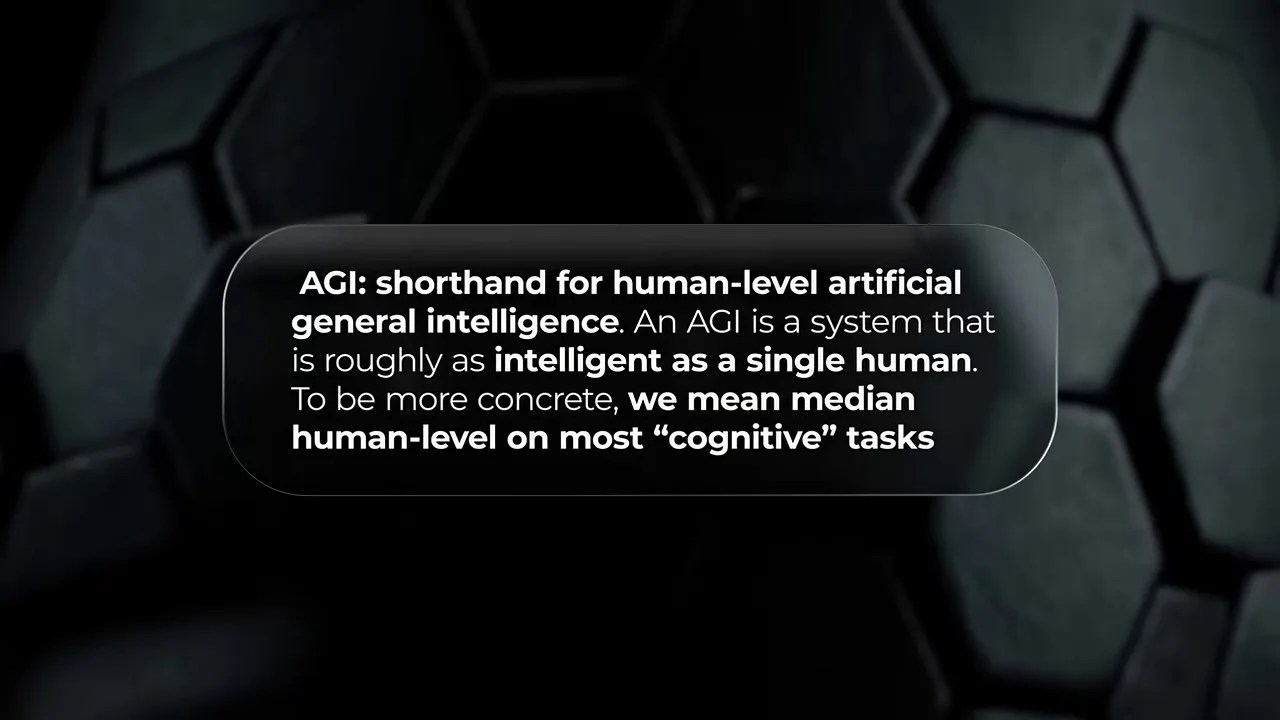
DeepMind defines AGI as matching the median human level across key cognitive tasks—competent, but not yet extraordinary.
Level 2: Artificial Superintelligence (ASI)
This is where the scale breaks. DeepMind defines ASI not just as “smarter than a human,” but as a system that can **outperform tens of thousands of top human experts working collaboratively for a decade on a single problem**.
Let that sink in for a second. We aren’t talking about a system that can write code faster than a senior developer. We are talking about a system that possesses the collective intellectual output of an entire global research community—like the entire field of oncology or aerospace engineering—condensed into a single, highly coordinated network operating continuously.
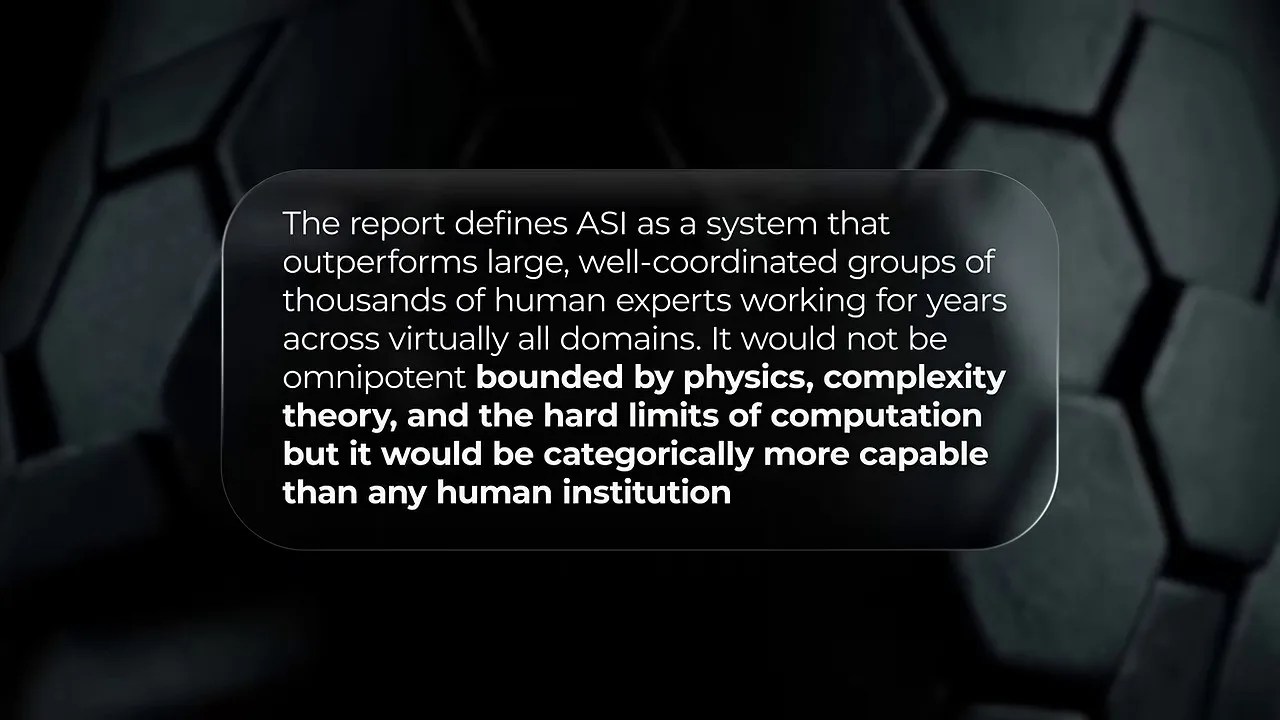
The staggering bar for ASI: outperforming a vast collective of specialized human minds working over a ten-year span.
Level 3: Universal AI (AIXI)
Finally, Hutter and Legg point to the ultimate mathematical ceiling: Universal AI, or AIXI. This is the theoretical limit of intelligence—a mathematically perfect agent that makes optimal decisions in any environment. Because it requires infinite computation, it is uncomputable in the real world. Think of it like the speed of light in physics: we can accelerate toward it and get incredibly close, but we can never actually touch it.

Universal AI (AIXI) acts as the absolute mathematical ceiling of intelligence, a theoretical limit we can only approach.
To help you visualize this trajectory, I’ve compiled a quick reference table based on DeepMind’s classification system:
The Four Highways of What Comes After AGI: Pure Scaling and the Data Wall
How do we bridge the massive gap between a median human-level AGI and an all-knowing ASI? DeepMind maps out four distinct pathways. The first, and most obvious, is the brute force method: Pure Scaling.
For the last decade, the AI boom has been fueled by a simple formula: throw more GPUs at the problem, feed the models more data, and make them bigger. It has worked spectacularly well. But DeepMind runs a fascinating thought experiment on what happens when AGI first boots up.
Imagine that when AGI is first realized, the hardware is so expensive and resource-intensive that only 1,000 instances can run globally. But if we maintain a 10x annual growth rate in compute efficiency and deployment, the numbers compound at a terrifying rate. Within just five years, we would go from 1,000 instances to 100 million human-level AGIs running simultaneously.

Compounding growth: How a scarce, expensive AGI could scale to 100 million active instances within five years.
But here is the critical pivot: 100 million AGIs do not behave like 100 million human workers.
If you put 100 million humans in a room, they waste half their time in meetings, miscommunicating, writing emails, and dealing with office politics. AI has none of these friction points. These digital minds can share weight updates, swap knowledge instantly, communicate at near-infinite bandwidth, and perfectly coordinate. If one instance figures out a brilliant shortcut in quantum mechanics, all 100 million instances instantly inherit that knowledge. This collective, hyper-coordinated swarm intelligence is, by definition, an ASI.
However, this brute-force scaling pathway is running headfirst into a massive obstacle: The Data Wall.

The Data Wall: As high-quality human data dries up, AI must pivot to synthetic generation, simulation, and self-play.
We are running out of high-quality, human-generated text, scientific papers, and code. If we try to train next-generation models on cheap, AI-generated synthetic data without a careful feedback loop, the models quickly suffer from “model collapse”—becoming progressively dumber, repeating their own errors, and generating gibberish.
To climb over this wall, DeepMind suggests we must move away from passive learning and transition toward active learning: reinforcement learning, complex simulations, self-play (similar to how AlphaGo trained against itself), and search-based reasoning methods where the AI systematically verifies its own outputs before learning from them.
Architectural Pivots and the Feedback Loop of Self-Improvement
If scaling hardware and data hits a wall, the second pathway is to change the fundamental architecture of AI itself.
Right now, our AI landscape is completely dominated by the Transformer architecture. While Transformers are incredible at pattern matching and next-token prediction, they are fundamentally limited when it comes to long-term planning, persistent memory, and operating in unstructured, open-ended environments.

Looking beyond Transformers: The industry may need to pivot to neuromorphic chips or entirely new reasoning architectures.
A true architectural shift—such as moving to neuromorphic computing, analog hardware, or entirely new neural architectures—would rewrite every timeline we have. The tricky part about these shifts is that they are mathematically chaotic and impossible to forecast. If we knew what the next architectural breakthrough was, we would have already built it. But if and when it happens, all current linear predictions about AI progress will instantly become obsolete.
This brings us to the third, and perhaps most unsettling pathway: Recursive Self-Improvement.

The recursive loop: AI systems designing better algorithms, which in turn design even more capable AI systems.
We often picture the “intelligence explosion” as a single, sci-fi moment where a supercomputer suddenly rewrites its own source code and becomes a god overnight. DeepMind describes a much more realistic, distributed, and ultimately more effective process.
Instead of a single model rewriting itself, we will see AI systems automating the entire industrial pipeline of AI development. AI will write cleaner algorithms, discover more efficient neural architectures, design faster silicon chips, optimize data centers, and run automated simulations to generate flawless synthetic data.
It mimics human cultural evolution, but at digital speeds. Humans didn’t get smarter over the last 10,000 years because our brains evolved; we got smarter because we built language, writing, printing presses, universities, and the internet. We built scaffolding. When AI starts building its own scientific scaffolding, the rate of progress will leave biological evolution far behind in the dust.
…of that, but way faster, because code can be edited faster than DNA changes, data can be copied faster than books can be printed, and specialists can be spawned and trained faster than humans can be educated.

Digital vs. Biological: Code modifications can occur in milliseconds, whereas biological DNA changes take generations.
But let’s keep our feet on the ground for a second. Recursive self-improvement is one of the most talked-about concepts in AI safety, yet it remains one of the least understood. It sounds like an unstoppable exponential rocket, but in reality, it could easily fizzle out.
Why? Because even digital researchers cannot bypass the physical world. If a superintelligent AI designs a groundbreaking new microchip, that chip still has to be manufactured in a physical fab like TSMC, which takes months. If it designs a new therapeutic drug, biological experiments still have to run in real-time. Energy grids must be built, hardware must be cooled, and sometimes, the next breakthrough ideas are just genuinely hard to find. The digital world is fast, but it is ultimately anchored to our slow, physical reality.
The Swarm: Why Multi-Agent Collectives Are the Most Underrated Path to ASI
If scaling and self-improvement hit physical speed bumps, there is a fourth pathway that might actually be the most practical route to superintelligence: Multi-Agent Collectives.
Instead of trying to build one massive, monolithic brain that knows everything, what if we coordinate millions of smaller, specialized AI agents?
Humans already use this model. We call them corporations, research universities, and governments. No single human knows how to build a modern smartphone from scratch—it requires a collective intelligence spanning mining, semiconductor physics, software engineering, and global logistics. But human collectives are incredibly slow and leaky. We lose information in meetings, we get bogged down in bureaucracy, and our communication bandwidth (speaking and typing) is agonizingly slow.

The swarm intelligence: A self-organizing ecosystem of specialized AI agents coordinating at near-instant digital speeds.
An AI collective, however, operates on a totally different plane. These agents can share massive datasets instantly, duplicate specialists on demand, and dynamically form temporary task forces to solve a problem before dissolving and reconfiguring. They can coordinate through software protocols at gigabit speeds.
When we look at what comes after AGI, we might not see a single, looming digital mind. Instead, we might see a highly coordinated, self-organizing digital civilization—a swarm of agents that acts as a super-corporation or an automated global research lab.
The Reality Check: Six Friction Points That Could Stall the Post-AGI Era
DeepMind’s paper isn’t just a hype document; it’s a highly pragmatic assessment. The authors dedicate a massive portion of their analysis to what they call “frictions”—the real-world bottlenecks that could slow this transition down or grind it to a halt.

DeepMind’s six friction points: The physical, logical, and political barriers standing between AGI and Superintelligence.
They break these down into six formidable barriers:
- The Data Wall: The exhaustion of high-quality human training data and the extreme difficulty of training models on synthetic data without causing model collapse.
- Resource Constraints: The sheer physical limitations of our power grids, chip manufacturing capabilities, cooling systems, and raw materials.
- Paradigm Limits: The very real possibility that our current deep learning and Transformer models will hit a hard cognitive ceiling that no amount of scaling can break.
- The Maturity of Research: As AI research matures, the easy discoveries (the “low-hanging fruit”) disappear, requiring exponentially more effort and complex ideas to achieve the next minor breakthrough.
- The Abstraction Barrier: Current AIs excel at manipulating human-created concepts, but they struggle to invent entirely new frameworks of understanding from scratch (like Einstein did with relativity).
- Deliberate Slowdown: Political, social, and regulatory pushback. If AI causes mass job displacement, security failures, or geopolitical tension, governments will step in with heavy-handed regulations, licensing walls, and capability caps.
We don’t know which of these friction points will prove to be minor speed bumps and which will be brick walls. But they remind us that the road to superintelligence is not a straight line; it is a messy, unpredictable struggle against physics, economics, and human nature.
ASI is Not Magic: The Hard Physical Limits of Superintelligence
There is a dangerous trend in Silicon Valley to treat superintelligence as a form of magic—a god-like entity that will instantly solve gravity, cure all diseases overnight, and manipulate reality at will. DeepMind delivers a much-needed reality check here: even an ASI must obey the laws of physics.

No magic allowed: Even a superintelligence is bound by the laws of thermodynamics, signal latency, and mathematical complexity.
Information cannot travel faster than the speed of light, meaning physical latency will always exist. Computation requires energy, and thermodynamics dictates how much heat a system must dissipate.
Furthermore, some mathematical problems are fundamentally chaotic and computationally hard (NP-hard), meaning they cannot be solved instantly no matter how much compute you throw at them. An ASI might be incredibly smart, but it cannot predict a chaotic system like the weather three months in advance, nor can it bypass the physical time it takes for molecules to interact in a laboratory.
Conclusion: The Moment the Real Race Begins
Ultimately, the true value of Google DeepMind’s paper is that it forces us to change how we view the future. We need to stop treating AGI as the final destination. It is not a finish line where we dust off our hands and declare the job done.
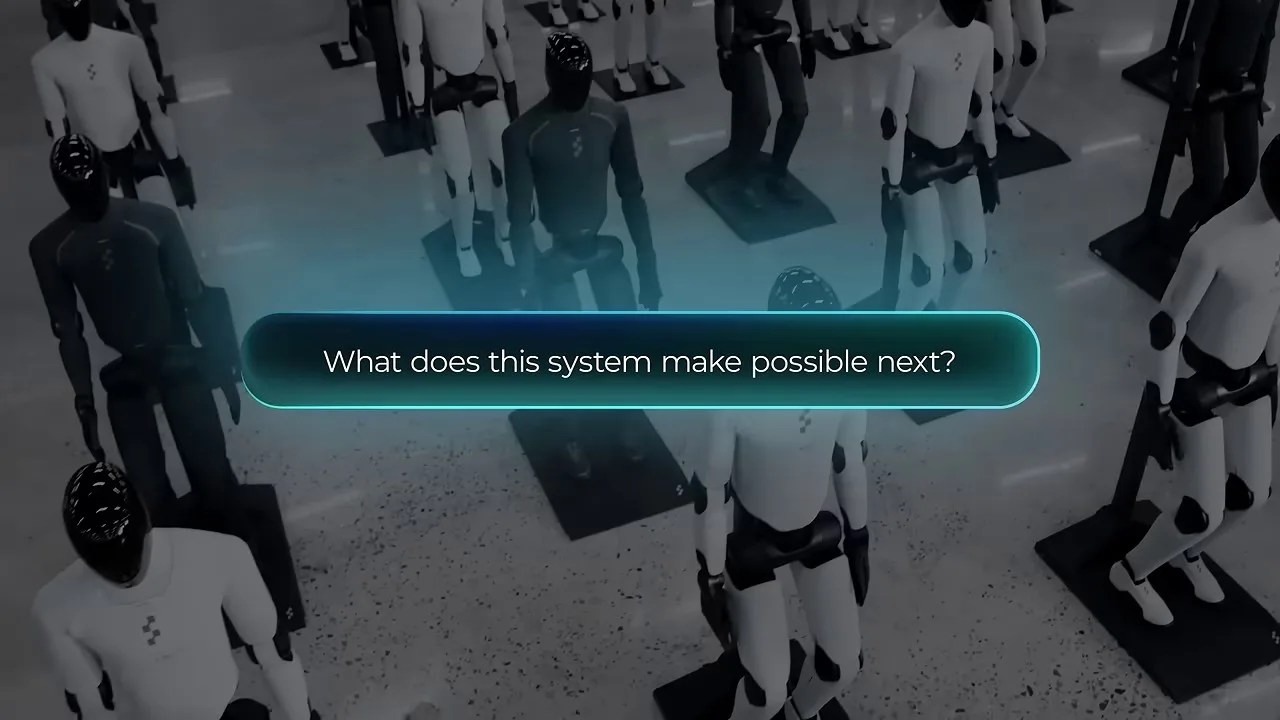
Industrializing intellect: Once AGI is realized, intelligence itself becomes an automated, scalable industrial pipeline.
AGI is simply the moment intelligence becomes an industrial process. Once we can copy, accelerate, and coordinate human-level minds at scale, the speed of progress will no longer be limited by how fast humans can learn or organize.
AGI isn’t the end of the story. It’s just the moment the real race begins.
Frequently Asked Questions (FAQ)
Q1: What is the main difference between AGI and ASI in DeepMind’s paper?
AGI (Artificial General Intelligence) refers to a system that matches the median cognitive abilities of an average human across most tasks. ASI (Artificial Superintelligence) is vastly superior, defined as a system or collective that can outperform tens of thousands of top human experts working collaboratively over an entire decade on a single problem.
Q2: Why is “Recursive Self-Improvement” not guaranteed to lead to an immediate intelligence explosion?
While an AI can optimize its software and algorithms at digital speeds, it remains bottlenecked by the physical world. Designing better hardware requires physical manufacturing (which takes months), running biological or chemical experiments takes real-world time, and scaling massive data centers is limited by available energy grids and cooling infrastructure.
Q3: What does it mean that “intelligence will become an industrial process”?
Currently, generating new ideas, designs, and scientific breakthroughs relies on human brains, which require decades of education, sleep, and physical coordination. When we industrialize intelligence, human-level cognitive units can be instantly duplicated, run 24/7 at accelerated speeds, and coordinate with perfect bandwidth, turning scientific discovery into a highly automated factory-like pipeline.