If you’ve been feeling like you can’t find a single real, human-written answer online anymore, you aren’t crazy. Indeed, Google Search is Truly Dead—or at least, the search engine we once relied on has been thoroughly hollowed out to make room for a swarm of AI bots. At its latest I/O event, Google made it crystal clear that its grand project to transform search from a directory of the web into something resembling a clown car stuffed with automated agents is proceeding at breakneck speed. It’s time to pour one out for the open web.
The Swarm Approaches: Why Google Search is Truly Dead
For decades, the unwritten contract of the internet was simple: you created great content, Google indexed it, and users clicked through to your site. Google’s new AI-powered search box obliterates this contract. Instead of sending traffic to creators, Google is deploying a swarm of AI agents to scour the web on your behalf, summarize the findings, and present them in a neat little box so you never have to sully your eyes by visiting an actual website again.
Powered by the newly announced Gemini 3.5 Flash—which Google claims is both faster and significantly cheaper than anything its competitors have to offer—these agents are designed to run constantly in the background. They can monitor your interests, scan for new information, and update you later. It sounds incredibly convenient until you ask the obvious question: Who is going to keep writing articles, recipes, or guides when search engines actively block users from ever visiting their sites?
“Google is treating the open web like a giant, free database to train its models, while cutting off the lifelines of the very creators who built it.”
To keep you even deeper inside their proprietary garden, Google also unveiled a Universal Cart. If you’re shopping across multiple websites, this feature collects items in one place and lets you check out all at once. Naturally, Gemini is baked in here too, scanning for deals, flagging price drops, and warning you if you’ve put an incompatible motherboard and GPU into your cart. It’s undeniably useful, but it represents a world where Google mediates every single interaction you have with the digital economy.
Project Aura: Gemini is Moving onto Your Face
If you thought you could escape Google’s bot-filled vision by stepping away from your computer, think again. Google is bringing its multimodal AI assistant directly to your face with its upcoming smart glasses, launching this fall.
We’re looking at a two-pronged hardware strategy. First, there are the previously teased Project Aura glasses, which feature a built-in heads-up display. But the real surprise is Google’s new partnership with fashionable eyewear giants Warby Parker and Gentle Monster to design display-less frames that look just like normal glasses.
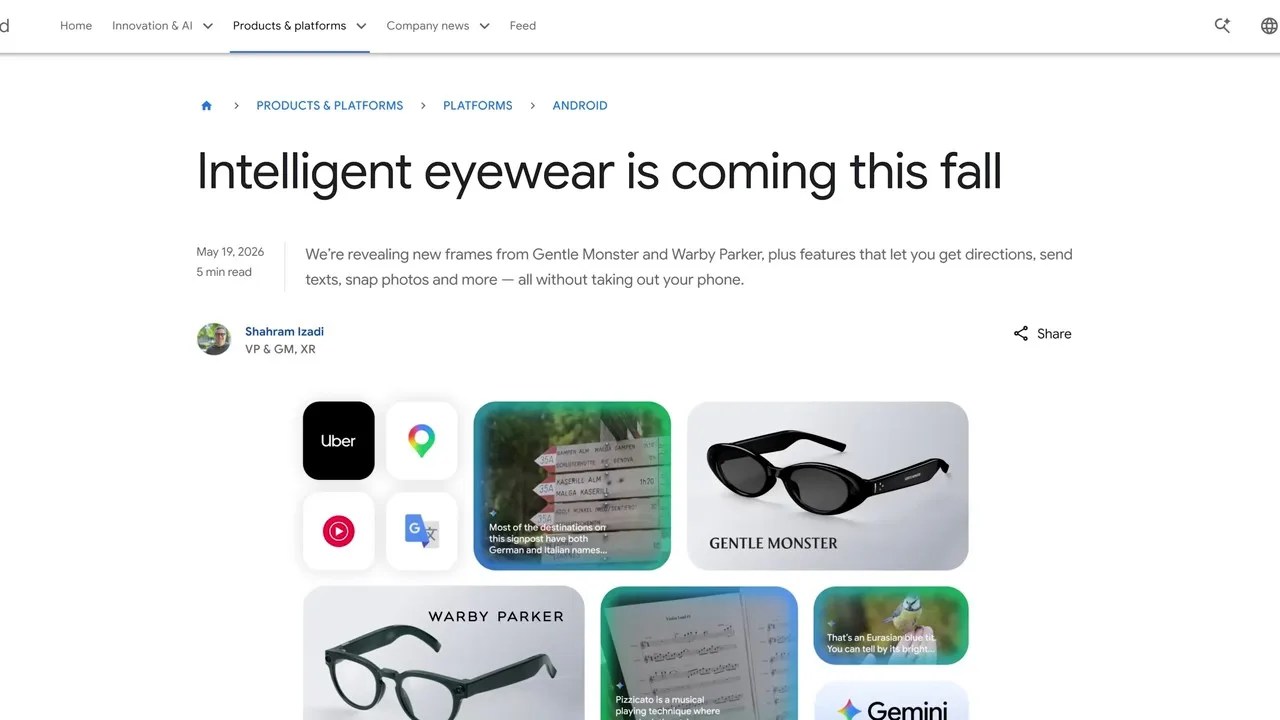
Google’s new display-less smart glasses designs, created in partnership with Warby Parker and Gentle Monster, aiming to blend AI assistant technology with everyday fashion.
Without a screen to distract you, these frames rely entirely on audio and camera inputs. You’ll be able to get turn-by-turn directions, ask Gemini to explain exactly what you’re looking at in real-time, or covertly snap photos hands-free. While the fashion integration is sleek, the privacy implications of display-free glasses packed with cameras are bound to raise a few eyebrows—assuming anyone even notices you’re wearing them.
Omni and Spark: From “Artisanal AI Slop” to Personal Imposters
Google’s AI offensive isn’t just about search and hardware; it’s about generative media. Enter Omni, Google’s new “anything generator.” While primarily showcased as an AI video generator that can seamlessly insert photorealistic elements into existing footage, Omni can generate almost any media format from any input.
Naturally, Google is baking Omni straight into YouTube Shorts. It’s a hilarious, if slightly cynical, pivot from YouTube’s public commitments earlier this year to fight low-effort AI-generated content. As Riley Murdoch so dryly put it, this isn’t low-effort garbage—it’s “artisanal, Google-branded slop.”

An early look at Google’s Omni AI, an “anything generator” being integrated directly into YouTube Shorts to create and manipulate video elements on the fly.
But the prize for the most existential dread-inducing announcement goes to Gemini Spark—Google’s answer to OpenAI’s and Anthropic’s agentic systems. Spark is designed to run in the background 24/7. It will read your emails, write in your unique voice, spend your money on shopping apps, and communicate with your friends and loved ones on your behalf. It’s the ultimate personal assistant, provided you’re completely comfortable with a black-box algorithm pretending to be you to the people you care about.
Dirty Laundry & Broken Diaries: Inside the OpenAI vs. Musk War
While Google attempts to automate our lives, its chief rival, OpenAI, is locked in a bitter, highly public mud-slinging contest with its co-founder, Elon Musk. A jury recently dismissed Musk’s 2024 lawsuit against the company, which claimed OpenAI betrayed its original non-profit mission by pivoting to a massive, for-profit structure with Microsoft.
The court tossed the suit because Musk simply waited too long to file it, but the pre-trial discovery process has already done some spectacular reputational damage. The public got an unfiltered look at OpenAI’s internal drama, including messy executive departures, intense infighting, and accusations from former board members that CEO Sam Altman is far from transparent.

Exhibits and diary entries from OpenAI co-founder Greg Brockman, made public during the Elon Musk lawsuit, revealing deep internal ethical struggles regarding the company’s transition to a for-profit model.
Perhaps most damaging of all was the entry from co-founder and president Greg Brockman’s personal diary. In it, Brockman openly questioned whether it was “morally bankrupt” to transition a non-profit designed to benefit all of humanity into a multi-billion-dollar commercial enterprise. Musk has already promised to appeal the decision, ensuring this billionaire soap opera continues to overshadow OpenAI’s plans for a massive IPO.
Quick Bits: Plex’s Offensive Pricing, Intel’s Comeback, & Space Ads
Let’s tear through some of the other massive tech stories breaking this week, starting with a collective groan from the media-server community.
- Plex is hiking its lifetime pass price from $250 to $750. Yes, you read that right. A staggering 200% price increase. While existing lifetime pass holders are grandfathered in, the community has reacted with outright fury, accusing Plex of greedily squeezing users to force them into monthly subscription tiers.
- Intel is fighting back against Apple’s silicon dominance. In China, Intel’s new Wildcat Lake Core Series 3 chips are launching in budget-friendly laptops from Asus, HP, and others, targeting the $450 to $600 price bracket to counter Apple’s MacBook Neo.

Intel’s Wildcat Lake Core Series 3 is targeting budget laptops to challenge Apple’s dominance in the mid-range portable PC market.
- Microsoft is killing SMS-based two-factor authentication. Citing SMS as a “scammer’s playground,” Windows is pushing users toward passkeys, authenticator apps, and biometrics. It’s objectively safer, but it also conveniently nudges everyone deeper into Microsoft’s ecosystem.
- OpenAI is threatening legal action against Apple. In a bizarre twist, OpenAI claims Apple intentionally buried ChatGPT integrations in their software so that no one would use it, violating their initial partnership agreements.
- Space is officially corrupted by capitalism. Roscosmos, Russia’s space agency, has begun selling commercial ad space on their space rockets. From now on, rockets heading into orbit will carry corporate logos for retail banks and coffee chains.

A mock-up of a Roscosmos rocket adorned with commercial corporate logos, marking a new era of literal space-age advertising.
Whether you’re watching ads fly into the stratosphere, dodging AI slop on YouTube, or mourning the fact that Google Search is Truly Dead, one thing is certain: the internet we grew up with is being paved over. The question is, are we ready to let Gemini and its robotic peers drive the bulldozer?