Hey everyone, excuse the temporary change of scenery—we’re currently packing boxes and moving offices. But the relentless wheel of the tech world stops for no one. This week, we witnessed Huawei literally folding silicon to bypass Western sanctions, China’s dark-horse DRAM champion breaking a historic global monopoly, and Jony Ive designing an electric Ferrari that the internet absolutely loves to hate.
Grab a coffee. We need to talk about how the global hardware game is being fundamentally rewritten, one fold at a time.
The Origami of Semiconductors: Huawei’s LogicFolding Hack
For years, the geopolitical tech war has had a clear, unyielding bottleneck: Extreme Ultraviolet (EUV) lithography. If you can’t buy these multi-hundred-million-dollar behemoth machines from ASML in the Netherlands, you cannot shrink your transistors down to the leading-edge nodes (think 3nm or 2nm). Huawei, firmly blacklisted from buying them, has been backed into a corner. But desperation breeds wild engineering.
At a recent, notoriously dry technical conference, Huawei announced a design paradigm they’re calling LogicFolding. Instead of fighting a losing battle to make transistors smaller (the traditional Moore’s Law route), they are focusing on what they call the “Tao Scaling Law”. The core concept is shockingly simple: if you can’t shrink the features, just shorten the physical distance between the active components by folding the chip in half.

Visualizing a multi-million dollar engineering feat with a piece of paper: Folding the CPU core in half instantly slashes the distance signals have to travel.
Think of a standard CPU core like a sheet of paper. Normally, to make it faster, you’d try to print smaller circuits on it. Huawei’s approach is to keep the circuits the same size, but literally fold that paper in half. By stacking two halves of the same logical unit directly on top of each other, the distance between transistors is slashed. Signals don’t have to travel across a wide 2D plane anymore; they just zip vertically through incredibly precise, high-density micro-bonds.
This isn’t just standard die-stacking (like Intel’s Foveros or TSMC’s 3DFabric), which usually piles separate dies (like memory on top of a logic unit) on top of each other. Huawei is claiming to fold the same logical unit over itself, requiring insane sub-micron alignment and bonding precision.
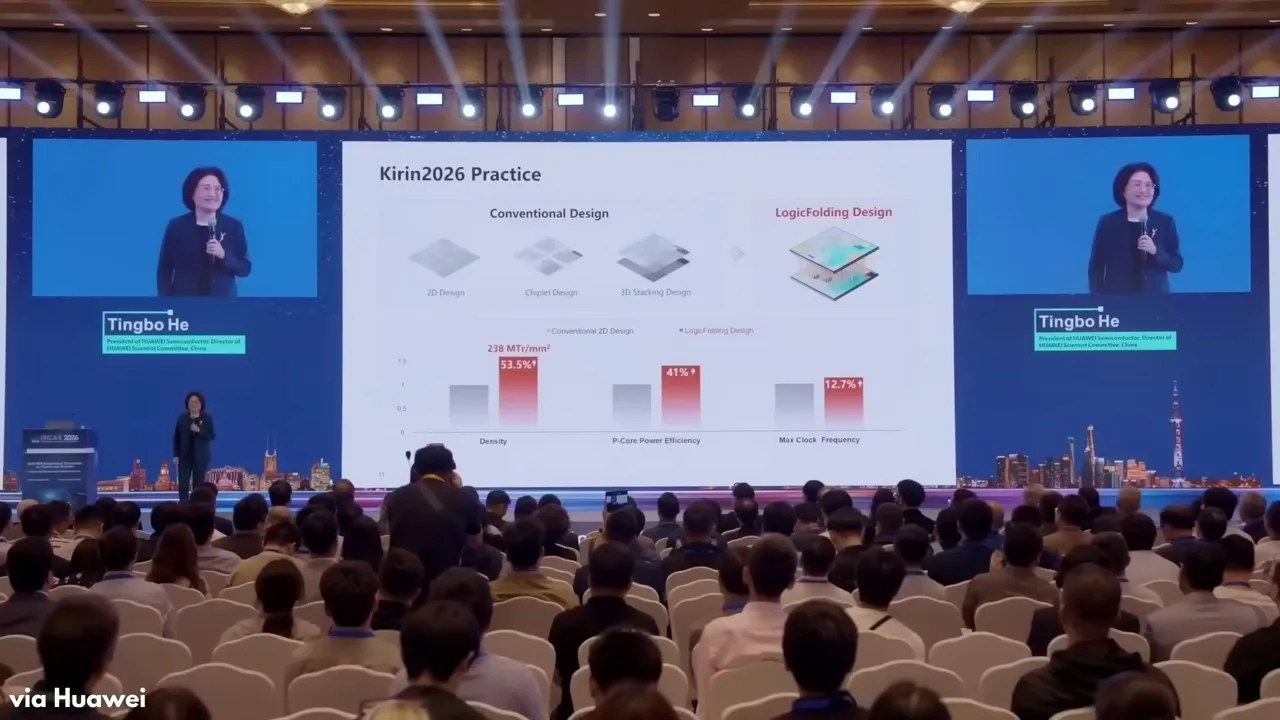
The manufacturer’s claims are bold: a 41% leap in peak power efficiency without relying on advanced lithography nodes.
Huawei claims this architecture yields a massive 41% improvement in peak power efficiency. Even wilder, they suggest that by continuously folding logical structures, they can achieve performance equivalent to TSMC’s 1.4nm process by 2031—all while using older, readily available DUV lithography equipment. The first Kirin mobile chips featuring this folded architecture are rumored to land in flagship phones later this year.
The Reality Check: While this sounds like a geopolitical masterstroke, I’m keeping my healthy dose of skepticism active. Stacking active, high-frequency logic components directly on top of each other creates an absolute nightmare for thermal dissipation. Heat is the ultimate killer of silicon; if you trap it in a folded sandwich, how do you cool it? Furthermore, if global giants like TSMC start folding chips on top of their already-shrunk transistors, they will still hold a massive generational lead. Yet, as a pure survival hack under extreme sanctions, LogicFolding is nothing short of brilliant.
The Silent Giant: How CXMT Crashed the DRAM Oligopoly
While the world was staring at processor logic, China quietly pulled off a massive coup in the memory market. For over a decade, the global DRAM market has been a cozy, tightly controlled oligopoly. If you wanted RAM, you paid the price set by the Big Three: Samsung, SK Hynix, and Micron.
Not anymore. According to a recent market breakdown by Counterpoint Research, a Chinese company called CXMT (ChangXin Memory Technologies) has officially emerged as the world’s fourth-largest DRAM manufacturer.

Breaking the triad: CXMT captures an 8% global market share in DRAM, fueled by a staggering 700% year-over-year growth spike.
CXMT now commands 8% of the global DRAM market, registering an eye-watering 700% year-over-year growth. Backed by domestic subsidies and a massive local market, CXMT is now preparing for an IPO in Shanghai to inject even more capital into their manufacturing capacity.
The geopolitical plot thickens: earlier this year, both CXMT and NAND flash-maker YMTC were removed from the Pentagon’s restricted list. Almost immediately, reports emerged that major PC OEMs like HP, Dell, Acer, and ASUS are actively considering Chinese memory chips to navigate ongoing global component shortages. While they aren’t quite ready to compete on ultra-high-bandwidth memory (HBM) for AI servers, your next mainstream laptop or smartphone might very well run on CXMT RAM and YMTC storage. The oligopoly is officially fractured.
Handheld Chaos and $300 Windows Laptop Fantasies at Computex
Over at Computex, Qualcomm and Intel were busy trading blows. Qualcomm made headlines by promising Snapdragon-powered Windows laptops hitting a incredibly aggressive $300 price point. They’re claiming “incredible battery life and responsive performance,” though we’ll believe that when we try running 15 Chrome tabs and a Zoom call on a budget ARM chip.
Intel, meanwhile, showed up to defend its turf in the booming handheld gaming market. They announced the G3 and G3 Extreme—essentially Panther Lake processors tweaked specifically for portable consoles.
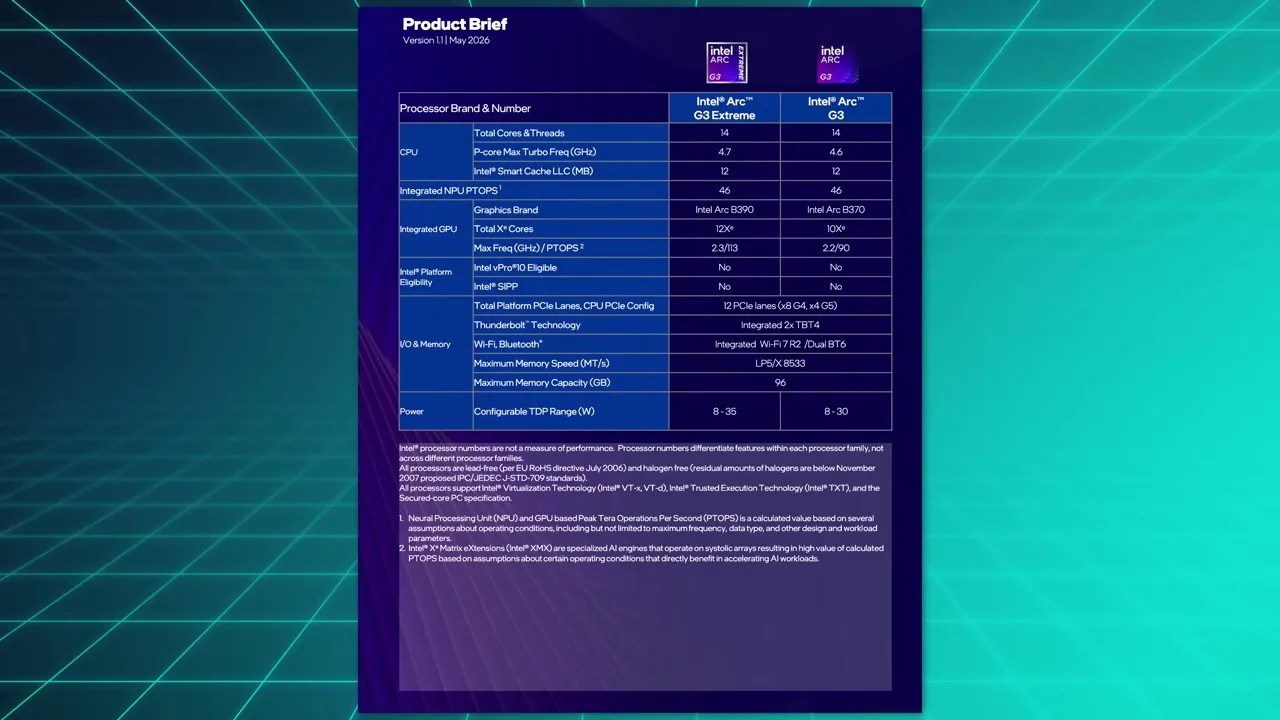
Hardware makers are going wild with modularity: The OneXPlayer 3 features detachable controllers and a built-in kickstand to masquerade as a mini-laptop.
We saw some wild early prototypes leveraging these chips, including the Acer Predator Atlas 8 and the OneXPlayer 3. The latter is a bizarre hybrid featuring removable side controllers, a built-in stand, and a backlit keyboard, essentially trying to be a Nintendo Switch and a Microsoft Surface at the same time.
This category is getting fiercely competitive, which is great, because Valve just quietly raised the prices of the Steam Deck in several regions (with the 1TB OLED model taking a painful hit). If Windows-based handhelds can get their power efficiency and standby times under control, Valve might actually have a real fight on its hands.
The Release Monitor: Titanium Rings and Ive’s Electric Ferrari
Let’s do a quick lap through this week’s most notable consumer hardware releases, ranging from the ultra-miniature to the ridiculously opulent.
Oura Ring 5: Smaller, Thinner, and Pricier

Shrinking the tech: The Oura Ring 5 is 40% smaller than its predecessor, but the price tag has bloated to $399 plus a mandatory subscription.
Smart rings are the new battleground for wearable tech. Oura just dropped the Ring 5, claiming it is the smallest smart ring ever made. It’s 40% smaller and noticeably thinner than the previous model, crafted from premium titanium. But miniaturization isn’t cheap: it now costs $399 (a $50 hike), and it still locks your own health metrics behind a monthly subscription. It’s elegant, but the recurring cost is getting harder and harder to swallow.
Samsung Odyssey G8: The 6K Gaming Behemoth
Samsung launched the Odyssey G8, which they are touting as the world’s first 6K gaming monitor. It features a stunning HDR10+ IPS panel capable of running an insane 165Hz at native 6K, or a blistering 330Hz if you drop the resolution down to 3K. At $1,600, it’s obviously a niche product for affluent enthusiasts, but given the sheer pixel density and refresh rate specs, it’s actually cheaper than I expected.
The Ferrari Lusso: Jony Ive’s Electric Polarizer

Jony Ive takes on Maranello: The 1,000-horsepower electric Ferrari Lusso is a masterclass in interior minimalism, but the exterior is polarizing the internet.
Ferrari finally took the wraps off the Lusso, their first-ever fully electric vehicle. Designed in collaboration with Jony Ive’s creative collective, LoveFrom, this 1,000-horsepower, five-seater EV is a fascinating study in design. The interior is absolutely gorgeous—retaining physical tactile materials while exuding Apple-esque clean lines. The exterior, however, has instantly become the internet’s favorite new punching bag. It’s a bold departure from classic Maranello curves, and tech forums are currently tearing it apart.
The Tech Speed-Run: National Security, Pope VS AI, and Tesla’s Cybercab
Let’s rapid-fire through the weirdest and most critical updates from the rest of the tech world this week:
- Dutch Digital Sovereignty: The Netherlands blocked the acquisition of DigiD (their national digital identity service provider) by a US private equity firm, citing unacceptable national security risks. The real question here is: *Why on earth was a country’s core citizen identity infrastructure owned by a private commercial entity in the first place?*
- The Google AI Backlash: DuckDuckGo claimed a 30% surge in installs this week as users rebel against Google’s controversial, sometimes hallucination-prone “AI Overviews” in search. However, let’s look at the data objectively: DuckDuckGo holds a measly 2% market share in the US, and a 30% jump in *weekly downloads* doesn’t mean a mass exodus is happening yet. It’s a minor protest, not a revolution.

Mistral’s new Pixtral model represents a quiet shift in AI: moving away from static chatbots toward autonomous background agents.
- AI Agents Go Native: French AI champion Mistral released Pixtral. Beyond understanding images, this model is designed to act as an “agent” that can run multi-step tasks in the background. We are rapidly transitioning from conversational chatbots to silent, background software agents that actually do our digital chores.
- The Pope’s AI Warning: Pope Francis released a detailed treatise on AI ethics, warning that unchecked artificial intelligence has the genuine potential to destabilize human society. In a surprisingly cool move, his official address actually quoted Gandalf from *The Lord of the Rings*. You can’t make this stuff up.
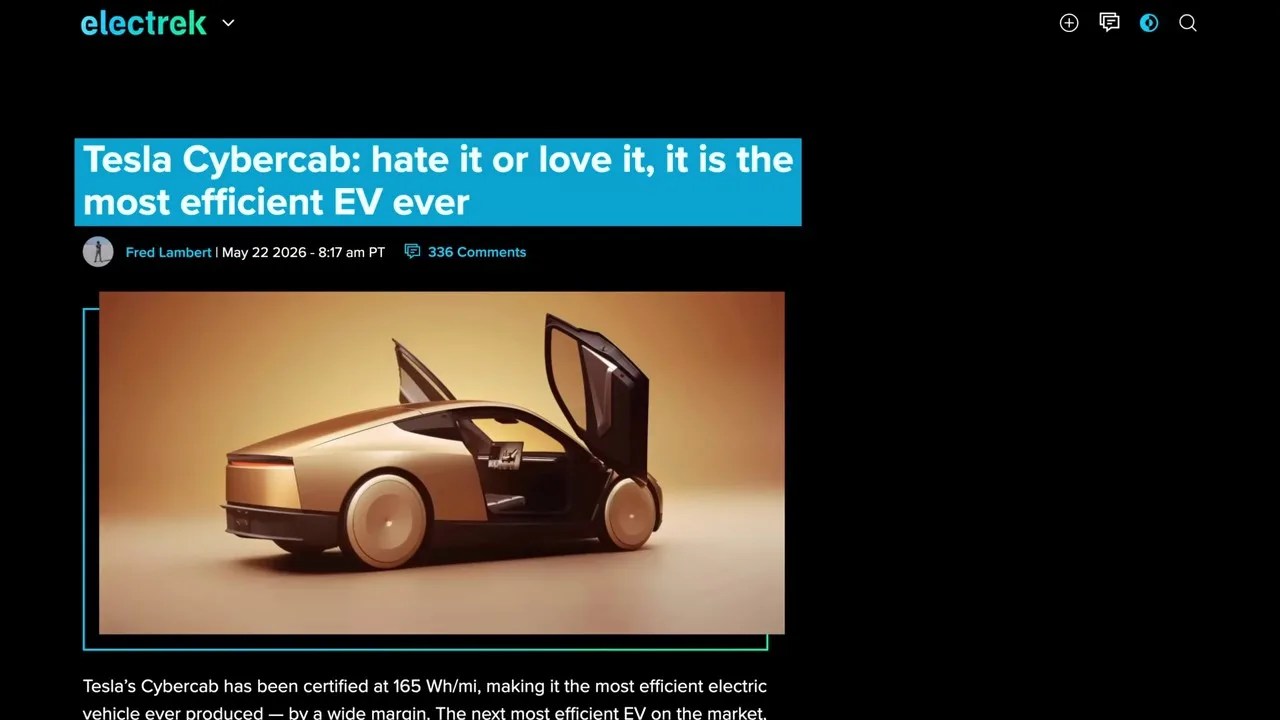
Raw efficiency: The Cybercab’s 165 Wh/mi consumption beats out every major EV on the market, though it achieves this by shedding weight, seats, and a steering wheel.
- Tesla’s Hyper-Efficient Bubble: Certification data revealed that Tesla’s Cybercab is technically the most efficient electric vehicle ever made, consuming an incredibly low 165 watt-hours per mile. Of course, it’s easy to be efficient when your vehicle only has two seats, no heavy steering column, and a tiny footprint, but it’s still an impressive engineering benchmark.
- A Rare Moment of Honesty: In China, Tesla has officially rebranded its “Full Self-Driving” (FSD) software to “Tesla Assisted Driving.” Honestly, regulators worldwide should enforce this. Calling a Level 2 hands-on system “Full Self-Driving” is not only misleading; it’s actively dangerous.
Finding Peace in Paper: Why I’m Reading IEEE Spectrum
We spend our entire lives staring at glowing glass, consuming hyper-optimized, algorithmic digital media. It is exhausting. Lately, I’ve found myself retreating to something beautifully analog to keep my sanity: a high-quality physical magazine.
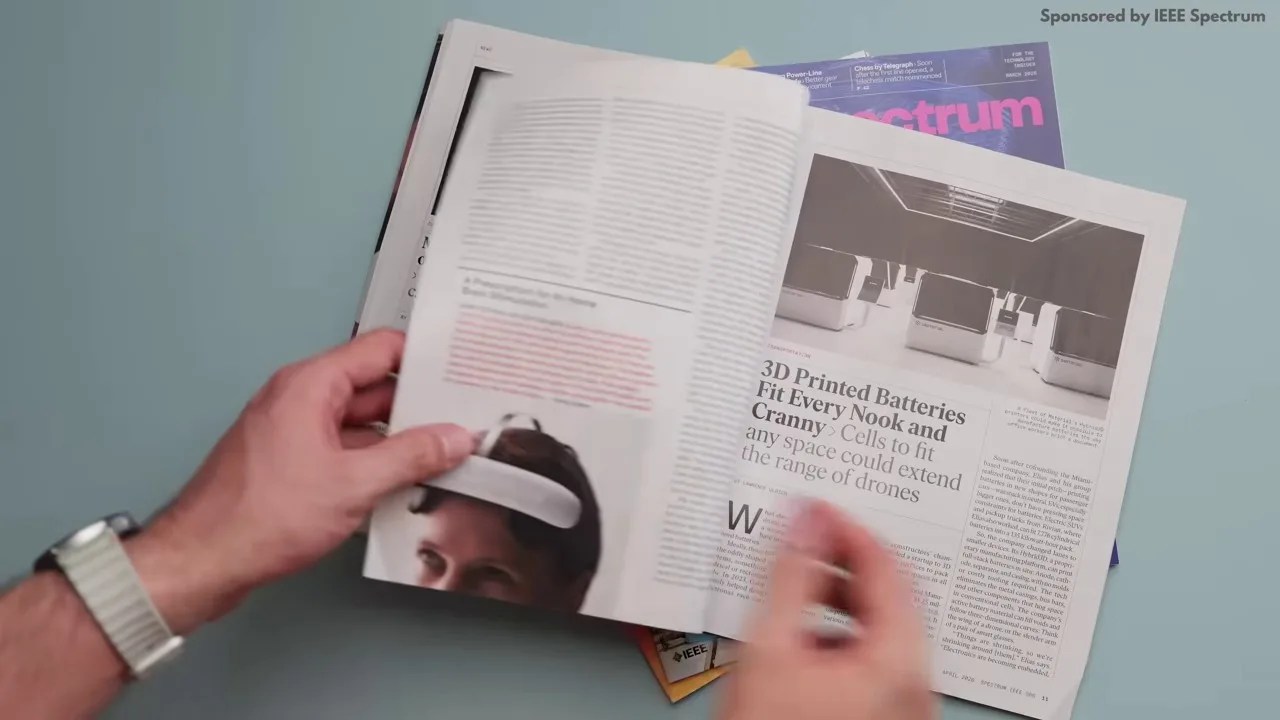
In an era of AI-generated content farms, there is something deeply grounding about holding curated, peer-reviewed engineering journalism in your hands.
I’ve been subscribing to IEEE Spectrum, the flagship publication from the Institute of Electrical and Electronics Engineers. For over 60 years, it’s been the gold standard for pure, unhyped engineering journalism.
There is a unique joy in sitting on a couch, away from notifications, reading deeply researched articles written by actual domain experts. In their recent issues, I’ve jumped from highly detailed breakdowns of autonomous military drones in Ukraine to mind-blowing research on “smart pills”—ingestible micro-electronics that can diagnose and treat your gut from the inside out.
It’s curated, meticulously illustrated, and completely free of clickbait. It’s where engineers at places like Apple, NASA, and MIT get their inspiration. If you want to support high-quality journalism and give your eyes a break from the screen, grab a subscription. (Plus, they look fantastic on a coffee table).
That’s all for this week’s breakdown. I have some office boxes to tape up. Let me know in the comments below: Do you think Huawei’s LogicFolding can actually bypass the physical limits of older lithography machines, or is this just clever marketing spin?