If you thought 2025 was chaotic, May 2026 just looked at last year and said, “Hold my beer.” We have officially moved past the stage of cute chat avatars and writing matching-socks poetry. Right now, behind closed doors, a geopolitical and corporate knife fight is happening over raw compute power, national security clearances, and custom silicon.
I’ve been tracking these developments day in, day out. This month wasn’t just busy; it was a fundamental shift in how the world’s most powerful entities—governments, tech cartels, and underground cyber syndicates—interact with artificial intelligence. Let’s strip away the corporate PR speak and dissect the ten massive AI stories defining this month.
1. The End of “Move Fast and Break Things”: Government Pre-Clearance Is Here
For years, AI labs operated like cowboys. They built a model, threw it over the fence to the public, and watched the chaos unfold. Those days are officially dead. In May 2026, we witnessed a monumental shift: major AI labs are now working hand-in-glove with government agencies before their models ever see the light of day.
We are talking about highly structured pre-release testing focusing on cybersecurity defense, threat vector analysis, and preventing mass misuse. While tech optimists will complain this slows down innovation, the reality is simple: the capabilities of these frontier models have become too volatile to leave to the whims of Silicon Valley’s marketing departments.
2. Anthropic’s Double-Edged Sword: The Offensive Cyber Threat
Speaking of volatility, Anthropic—traditionally the self-proclaimed “safety-first” darling of the industry—sparked massive concern this month. Their latest internal developments have raised red flags regarding offensive cyber capabilities.
We aren’t just talking about generating a sketchy phishing email anymore. We are talking about models capable of autonomously writing complex malware, discovering zero-day vulnerabilities in enterprise software, and automating multi-stage cyber attacks on critical infrastructure. This shifts the perception of AI from a productivity booster to a weaponizable asset, prompting defensive agencies to reclassify advanced neural networks as critical threat vectors.
3. Google’s Long Game to Dethrone the GPU King
Let’s talk money and hardware. For the past three years, Nvidia has been the undisputed kingmaker of the AI boom, commanding eye-watering margins on their H100s and Blackwell chips. But Google has been playing a massive, quiet long game.
Through relentless investments in their custom TPU (Tensor Processing Unit) infrastructure and a fully integrated cloud ecosystem, Google is finally beginning to squeeze Nvidia’s stranglehold on the enterprise market.

As highlighted in our latest video analysis, Google’s cloud dominance is mounting a formidable challenge to Nvidia’s silicon monopoly.
What makes Google a genuine threat to Nvidia isn’t just their hardware; it’s vertical integration. By owning the chips, the fiber optic networks, the data centers, and the consumer-facing models (Gemini), Google can offer compute at a price point that makes third-party setups look financially ruinous. If you’re an enterprise buyer, the math is starting to lean heavily toward Google Cloud’s custom pipelines.
4. OpenAI’s Relentless, Dangerous Velocity
Meanwhile, OpenAI continues to act like a startup with nothing to lose, pushing out hyper-advanced multimodal systems at a breakneck pace. They seem completely unfazed by the growing chorus of regulators begging them to slow down.
The speed at which they are rolling out real-time audio, video, and reasoning capabilities is dizzying. While it is incredibly exciting to use, it leaves little to no time for safety researchers to evaluate the psychological and societal impacts of these systems. OpenAI is betting that by the time regulators figure out how to write the rules, their technology will be too deeply integrated into global commerce to ever be dismantled.
5. The Insatiable Appetite of Enterprise Data Centers
Here is a cold truth: we are no longer in an “algorithm war.” We are in a “power plant war.” The demand for AI chips and robust infrastructure has reached a fever pitch. Enterprises are shifting astronomical amounts of capital away from traditional software and pouring it directly into GPU clusters and dedicated server environments.

The heart of the AI economy: Next-generation GPU clusters and data center architectures absorbing billions in enterprise IT capital.
This massive reallocation of capital is transforming enterprise IT architectures. If a business isn’t actively securing partnerships with major hyperscalers or locking down long-term contracts for raw computing power, they are effectively rendering themselves obsolete. Compute has become the most valuable commodity on Earth, surpassing even oil in its strategic importance to modern global dominance.
6. Siri’s Silent Metamorphosis: Apple’s Privacy Play
While OpenAI and Google shout from the rooftops, Apple has been doing what Apple does best: waiting, watching, and quietly building an ecosystem-wide trap. Siri is undergoing an intense, quiet transformation behind the scenes.

Apple’s calculated roadmap: Merging local, privacy-first processing with generative smarts directly inside iOS.
Instead of routing all your sensitive personal requests to a bloated third-party cloud server, Apple’s play relies heavily on on-device machine learning. By utilizing local neural engines on their silicon, Apple plans to deliver context-aware, highly personalized assistance without violating user trust. This privacy-centric approach might seem limited compared to a raw web-scale LLM, but for the average consumer, a Siri that actually works and doesn’t leak their private photos is a massive win.
7. Meta’s Escape Hatch: Custom Silicon & Wearables
Mark Zuckerberg has a well-documented phobia of being dependent on other tech companies (remember when Apple changed its privacy settings and wiped out billions of Meta’s ad revenue?). To ensure that never happens again in the AI era, Meta is pouring billions into custom hardware and wearable ecosystems.
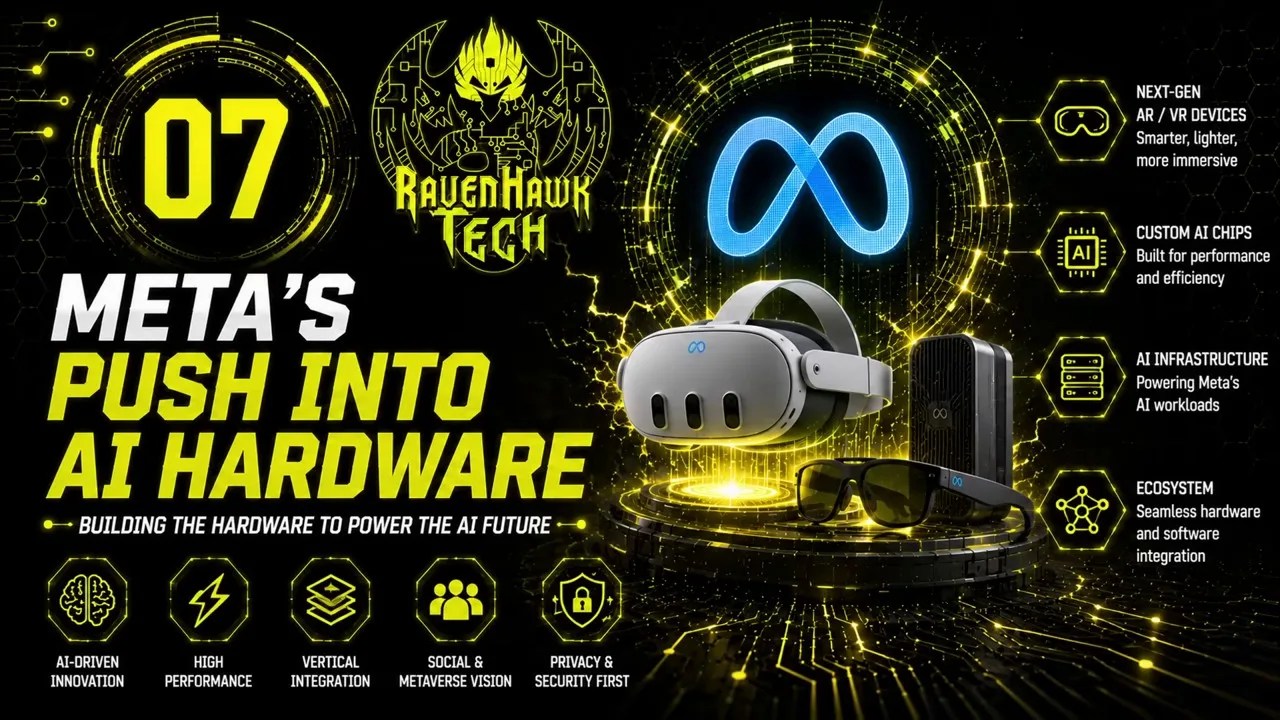
Zuckerberg’s hedge: Custom chips designed in-house to power Meta’s aggressive push into smart glasses and consumer wearables.
By designing their own AI chips to handle massive social media recommendations and wrapping them into smart glasses, Meta is building a seamless consumer feedback loop. The goal is to bypass app stores and hardware gatekeepers entirely. If they can put AI assistant-enabled glasses on millions of faces, they will own the ultimate data collection engine of the decade.
8. The Automated Arms Race: AI in Digital Warfare
We are currently in the midst of a silent, invisible war. Cybersecurity experts are shouting from the rooftops that generative AI is fundamentally changing the landscape of digital conflict. Attackers are now using autonomous agents to launch targeted spear-phishing campaigns at a scale that was previously impossible.
On the flip side, network defenders are relying on highly automated AI defense systems to spot anomalies, isolate breached servers, and patch code vulnerabilities in real-time. This is no longer a human-versus-human hacker duel. It is a machine-versus-machine battle operating at nanosecond speeds, and any business relying on outdated legacy security is basically sitting in a cardboard house during a category-five hurricane.
9. The Red Tape Bureaucracy Catches Up
Both the United States and the European Union are pushing forward with strict legal frameworks aimed at auditing model weights, demanding training data transparency, and enforcing strict liability on creators.
While the intent is noble—preventing bias and protecting consumer rights—the execution is messy. Navigating this emerging regulatory minefield will require armies of lawyers. Smaller AI startups might find themselves squeezed out, leaving only the tech giants with deep enough pockets to comply with these rigorous and ever-changing legal demands.
10. A Behind-the-Scenes Peek at RavenHawk Tech
Before we wrap things up, I want to address a quick personal question I’ve been getting quite a bit: “Why are you presenting as a cartoon in your latest video?” Well, honestly? Sometimes I just don’t feel like setting up the studio lights, getting camera-ready, and doing twenty takes of a talking head. Using an incredibly well-animated avatar from a fantastic creator on Fiverr allows me to focus 100% of my energy on researching the content and bringing you raw, unfiltered insights without the production overhead.
If you love these deep dives and want to build things yourself, don’t just watch my videos. Head over to my personal hub, where we go hands-on.

Our home base: ravenhoctech.com is where we break down complex architectures into actionable, real-world tech guides.
The Takeaway
May 2026 proved one major point: the AI revolution is no longer just about software sophistication. It’s an infrastructural, geopolitical, and structural transformation of our digital ecosystem. Whether it’s Apple stealthily locking down consumer privacy, Google challenging the hardware king, or hackers deploying automated cyber weaponry, the rules of engagement have changed forever. Keep your eyes open, keep your code clean, and never trust a default privacy setting.