If you still think the AI race is about who can build the biggest, most power-hungry neural network on the planet, you are playing a game that ended six months ago. The paradigm has shifted. We are no longer in the “brute-force compute” era of AI. We have officially entered the era of hyper-efficiency, self-correcting code agents, and a race to the bottom on pricing that is making yesterday’s frontier models look laughably overpriced.
In a single week, the entire landscape was upended. Anthropic quietly pushed out Claude Opus 4.8, a model that doesn’t just write code but actively debugs its own mistakes before you even have a chance to see them. Meanwhile, China delivered a staggering blow: Alibaba released Qwen 3.7 Max, offering frontier-level performance at a fraction of the cost of its Western rivals. Add to that a massive brain-drain from OpenAI, Elon Musk making a $60 billion bet on AI development environments, and a completely free open-source tool that lets you build full-stack apps without writing a single line of code, and you realize: the barrier to entry for building software has completely collapsed.
Let’s cut through the noise and dissect exactly what happened this week, what it means for your workflow, and how you can leverage these tools today.
| Technology / Update | Core Innovation | Disruptive Impact |
|---|---|---|
| Claude Opus 4.8 | Dynamic workflows, self-correcting code loops, and `/remote-control` capabilities. | Reduces coding errors by 4x; introduces variable “thinking effort” levels. |
| Alibaba Qwen 3.7 Max | Multi-agent parallel processing; built a custom AI computing kernel autonomously. | 6x cheaper than Western frontier models; native integration into developer toolchains. |
| Cursor Composer 2.5 | Extremely cheap, high-context agentic coding model trained on synthetic data. | Priced at 1/10th of Claude Opus; acquired by SpaceX for integration into Colossus 2. |
| Open Code & Mimo | Free, open-source multi-model wrapper running lightweight local/cloud models. | Enables zero-cost full-stack software prototyping for non-technical users. |
The New King of Reasoning: Inside Claude Opus 4.8 and the Anthropic Power Play
For months, developers have complained about the “hallucination tax”—the time spent debugging AI-generated code that looked correct on the surface but failed miserably in production. AI models are notoriously overconfident; they jump to conclusions, claim they have resolved an issue, and force you to play a tedious game of whack-a-mole with syntax errors.
Anthropic’s release of Claude Opus 4.8 addresses this exact pain point. Instead of merely scaling up parameters, Anthropic focused on cognitive architecture. Opus 4.8 features a much higher benchmark score compared to its predecessors and competitors like GPT 5.5, but its real value lies in its honesty. It is designed to flag its own uncertainties and is four times less likely to let coding flaws pass unremarked than previous versions.
This update introduces three game-changing features to the developer workflow:
- Dynamic Workflows: For complex tasks, Claude doesn’t just stream a single response. It creates a structured plan, spins up hundreds of parallel sub-agents to tackle different components, verifies the output of those agents, and rewrites code dynamically before presenting you with the final, working solution.
- Variable “Thinking Effort”: You can now control the model’s cognitive load. By using the command
/effort, you can toggle between low (for fast, cheap tasks) and high or max (for complex debugging where you want the model to think deeply across multiple sub-agents). High effort uses more tokens, but the rate limits have been adjusted to accommodate this. - Remote Control: If you are running a long, complex task on your terminal and need to step away from your desk, typing
/remote-controlhands the reins over to Claude. It will continue executing the tasks locally on your computer while you monitor, troubleshoot, and guide its progress directly from your mobile phone.
The Strategic Acquisition of Andrej Karpathy
To understand where Anthropic is going, you have to look at who they are hiring. This week, Andrej Karpathy—the legendary co-founder of OpenAI and former head of Tesla Autopilot—announced he is joining Anthropic’s pre-training team. He isn’t joining as an advisor; he is going deep into the code that builds the core of Claude.
Andrej Karpathy’s move to Anthropic signals a transition from hardware scaling to AI-accelerated pre-training research.
Historically, winning the AI race was simple: buy more H100s, burn more gigawatts of electricity, and feed more data into the cluster. But we are hitting the limits of physical infrastructure and data availability. Anthropic’s strategy with Karpathy is to use AI to accelerate the research needed to build the next generation of AI. Essentially, we are transitioning to a world where AI models will train the next generation of AI models, bypassing human bottlenecks in algorithmic design.
The Price War: Alibaba’s Qwen 3.7 Max & Cursor Composer 2.5
While Western labs are locked in a battle for intellectual supremacy, Chinese tech giants are executing a classic disruption strategy: offering comparable intelligence at a fraction of the cost. Alibaba’s new flagship model, Qwen 3.7 Max, is a direct shot across the bow of Anthropic and OpenAI.
Qwen 3.7 Max isn’t just cheap—it’s highly capable. In an internal benchmark test, Alibaba engineers gave the model an entirely unfamiliar AI chip and left it alone for 35 hours. During this period, the model autonomously made over 1,000 tool calls and built an AI computing kernel that performed 10 times better than the manufacturer’s official, human-written version.
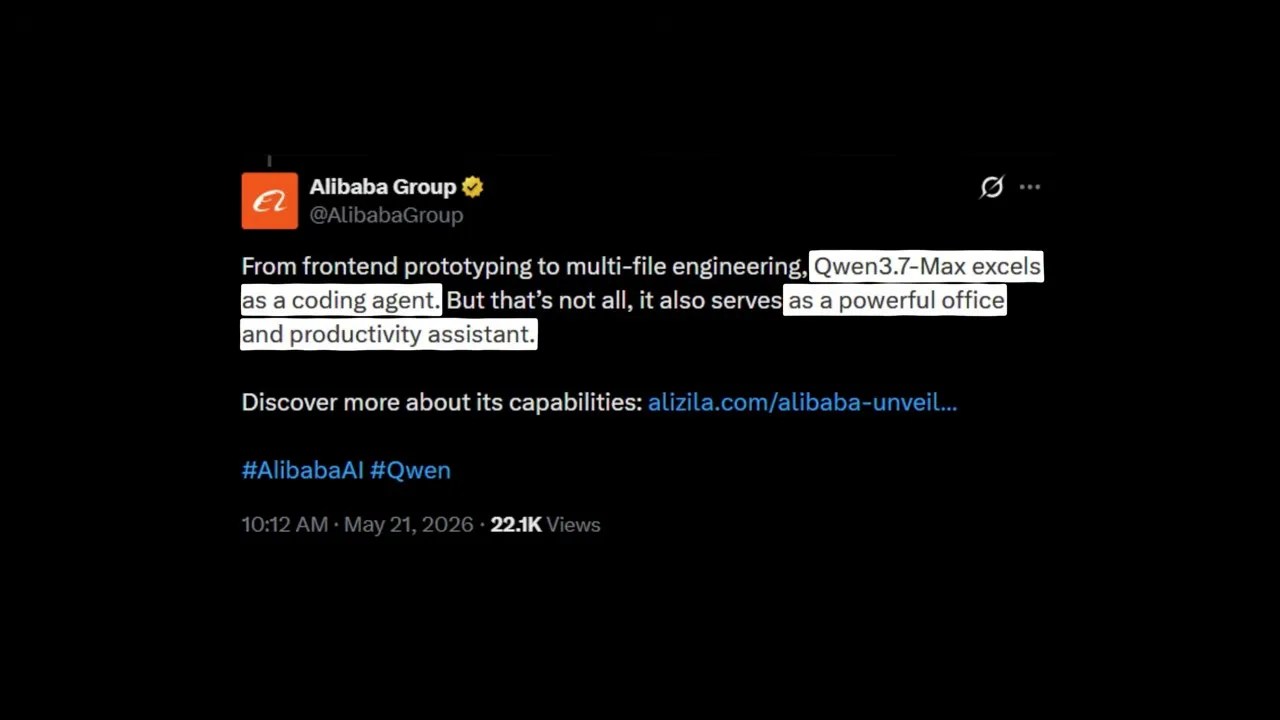
Qwen 3.7 Max’s autonomous kernel-building experiment demonstrates its capability to optimize hardware without human intervention.
The real shockwave, however, is the pricing. Alibaba has priced Qwen 3.7 Max roughly six times cheaper than Claude Opus, and it integrates natively into developer tools like Claude Code and Open Claw without any complex setup. This makes it incredibly attractive for startups looking to scale agentic workflows without running up massive API bills.
Cursor Composer 2.5 and the SpaceX Connection
If Alibaba is attacking from the East, Cursor is disrupting from within the developer ecosystem. Their new model, Composer 2.5, matches Claude Opus 4.7 on complex, long-running autonomous coding tasks but is priced at an astonishing 1/10th of the cost ($0.50 per million input tokens and $2.50 per million output tokens).

Cursor Composer 2.5 offers a highly competitive price-to-performance ratio for long-running autonomous coding tasks.
Cursor achieved this by training the model with 25 times more synthetic data than its predecessor, making it highly optimized for long, multi-file code editing sessions. This efficiency caught the eye of Elon Musk, whose company SpaceX has reportedly struck a deal to acquire Cursor for $60 billion. The goal? To train a next-generation coding model from scratch on xAI’s massive Colossus 2 supercomputer, further accelerating software development for aerospace engineering.
The End of Admin: OpenAI’s Form-Filling & Personal Finance Agents
While developers get self-healing code, everyday users are getting something arguably more valuable: the elimination of digital paperwork. OpenAI has introduced two features to ChatGPT that target some of the most tedious administrative tasks in modern life.
First is the new intelligent form-filling capability. Instead of manually typing information into tax forms, insurance claims, or government documents, you can now simply upload an image of the form, open Voice Mode, and tell ChatGPT what to write. The model reads the form, understands the context of each field, and returns a completed version in under a minute.
ChatGPT’s new form-filling capability turns tedious paperwork into a simple, interactive conversation.
There is one limitation: the completed form currently comes back as a static image rather than an editable PDF, meaning you may still need to manually copy some details over. However, as an automated drafting tool, it represents a massive reduction in friction.
Second, OpenAI is stepping directly into the personal finance space. US users can now securely connect ChatGPT to over 12,000 financial accounts to analyze spending patterns, track investments, and identify unnecessary subscriptions. Built with read-only access (meaning the AI cannot move money or view full account numbers), this feature allows you to treat ChatGPT as an on-demand financial advisor to help optimize your investment portfolio or draft a long-term savings plan.
Embodied Intelligence: Atlas Squats, Pets Talk, and Apple Whispers
The boundary between digital intelligence and the physical world is thinning rapidly. This week saw significant updates in robotics, consumer hardware, and edge computing.
Boston Dynamics released footage of their electric Atlas robot performing a task that would challenge many humans: lifting a 100-pound refrigerator. Using human-like biomechanics, Atlas squatted to lift the appliance, rotated its torso 180 degrees, and placed it onto a elevated platform.

Atlas’s ability to handle heavy, unfamiliar objects is the result of millions of hours of training in simulated environments.
Crucially, Atlas was not pre-programmed with the exact dimensions or weight of the refrigerator. It figured out how to balance and lift the object in real-time, leveraging control policies perfected through millions of hours of simulated training.
Pet Chat: Gimmick or Breakthrough?
On the consumer side, a Chinese startup has launched Pet Chat, a wearable collar attachment that claims to translate pet vocalizations and body language into human text with up to 95% accuracy in under 1.2 seconds.

Pet Chat attempts to bridge the communication gap between humans and pets using acoustic analysis, though real-world efficacy remains to be proven.
While the company claims high accuracy in internal testing, consumers should remain somewhat skeptical. Translating animal emotion based on acoustic patterns is highly subjective. However, with over 10,000 pre-orders already placed, it highlights the growing market for consumer-facing, niche AI hardware.
Apple’s Silent Infrastructure Build-Up
Meanwhile, Apple is quietly preparing for a massive generative AI rollout at its upcoming Worldwide Developers Conference (WWDC). The company recently registered the subdomain gen.ai.apple.com, indicating a major expansion of its web-based AI infrastructure.
Leaks suggest that Apple’s upcoming operating systems will feature a completely rebuilt Siri running on a custom model powered by Google’s Gemini technology. This new Siri will have on-screen awareness, allowing it to understand what you are looking at and take actions across apps, such as filing an email or organizing photos, using natural language commands.