Let’s be honest: we’ve all grown slightly numb to government “strategies.” Every few months, a politician stands behind a sleek podium, promises to “future-proof” the economy, and throws a eye-watering sum of taxpayer money at a problem we’re not entirely sure they understand. But when Prime Minister Mark Carney stepped up to announce Canada’s AI for All strategy, the collective intake of breath across the country felt different. This wasn’t just another policy update; it was a high-stakes, $2 billion bet on the very fabric of how Canadians will work, live, and survive the coming technological tsunami.
With the roll-out of Canada’s AI for All strategy, the government is attempting to walk an incredibly tight rope. On one side lies the pressure to compete globally, boosting a sluggish economy and modernizing industries. On the other lies a deeply skeptical, anxious public that looks at Silicon Valley’s latest playthings not with awe, but with a profound sense of dread. Can a $2 billion injection actually bridge this gap, or is the government trying to build a digital highway over a chasm of public distrust?
The $2 Billion Blueprint: Breaking Down the Ambitions
Let’s look at the cold, hard numbers first. Prime Minister Mark Carney’s plan isn’t a subtle nudge to the tech sector; it’s a massive capital injection. The headline figure is $2 billion, aimed at maximizing the benefits of artificial intelligence while shielding everyday citizens from the inevitable fallout.

Prime Minister Mark Carney rolls out the $2 billion framework aimed at balancing innovation with Canadian values.
The goals laid out in Canada’s AI for All strategy are nothing short of breathtaking in their scale. The government wants to create up to 250,000 new jobs within five years. At the same time, they are targeting a massive leap in business adoption of AI—pushing it from a meager 12% today to an ambitious 60% by 2034. To anchor all of this, the plan promises a sovereign, world-leading supercomputer by 2031 to keep Canadian data firmly within Canadian borders.
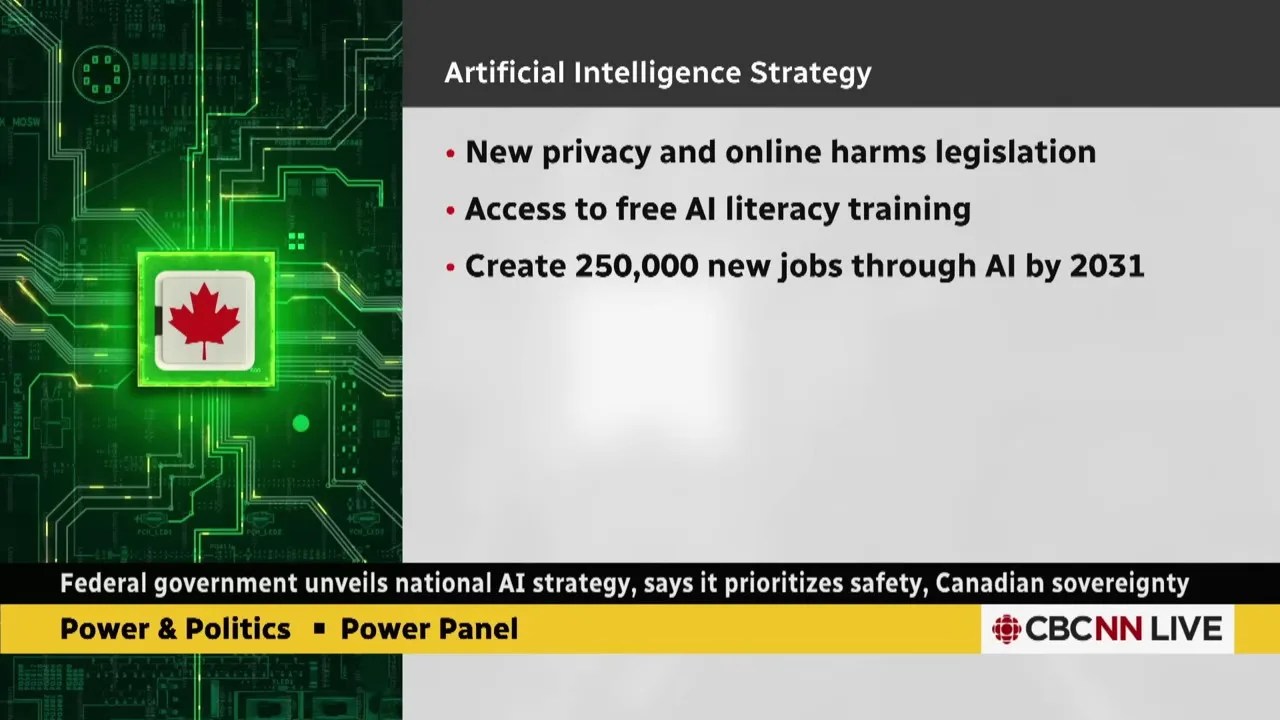
The ambitious roadmap: scaling adoption from 12% to 60% over the next decade.
But as any seasoned tech analyst will tell you, the devil is always in the omissions. While the government proudly touts the creation of a quarter-million jobs, there is a glaring, uncomfortable silence on the other side of the ledger: how many jobs will this technological disruption destroy? We are looking at a transition that could fundamentally upend administrative, creative, and analytical roles across the country, yet the strategy offers no estimates on the displacement of the Canadian workforce.
To help you visualize the sheer scale of what is being proposed, I’ve broken down the core metrics of the government’s plan below:
| Target Metric | Current State | Target Goal | Timeline |
|---|---|---|---|
| Business AI Adoption | 12% | 60% | By 2034 |
| Net New Job Creation | Baseline | 250,000 jobs | Within 5 Years |
| Sovereign Supercomputing | Scattered Infrastructure | World-leading system | By 2031 |
| Total Strategy Budget | – | $2.3 Billion (Est.) | Immediate rollout |
Predictably, the political response was swift and merciless. Opposition MPs wasted no time in branding the plan “reckless and inadequate,” claiming it leaves Canadians dangerously exposed without concrete details on privacy, safety, and security. But to truly understand if this strategy has a chance of succeeding, we have to look past the partisan bickering and look at the people the strategy is meant to serve.
The Grand Canyon of Trust: Why Canadians Are Crossing Their Arms
To unpack the public mood, CBC’s Power & Politics brought together a heavy-hitting panel. Among them was Shachi Curl, President of the Angus Reid Institute, who dropped a series of truth bombs that should make every policy architect in Ottawa sweat.

The Power Panel weighs in on the deep societal anxieties surrounding AI adoption.
As Curl pointed out, when analyzing the reception of Canada’s AI for All strategy, we aren’t just looking at a minor gap in public confidence. “It’s the Grand Canyon of a trust gap,” she remarked. While tech executives and politicians paint a utopian picture of frictionless productivity, the average Canadian is standing back with their arms crossed, deeply skeptical about who actually benefits from this technological leap.

A chasm of skepticism: Big Tech’s data-scraping habits have left a legacy of deep distrust.
The numbers from Angus Reid’s polling are brutal, revealing a stark disconnect between Ottawa’s enthusiasm and the public’s survival instincts:
- 73% of Canadians disagree with the fundamental premise that AI is a force for good in society.
- 70% of Canadians want the government to actively regulate tech companies—even if that regulation slows down development or dampens economic prosperity.
- Close to three in four believe that no government, regardless of political stripe, is actually capable of regulating this technology effectively.
- Only single-digit percentages believe AI will be a net positive for job creation in Canada.

Hard data: Public opinion shows overwhelming demand for guardrails over rapid growth.
This is the cold reality that the Carney government must confront. You can announce a shiny new $2 billion strategy, but if 73% of your population views the core technology as a threat to their livelihoods and social fabric, you aren’t leading a transition—you’re forcing one. The government’s emphasis on “humility” is a start, but as Curl rightly notes, they are going to need a lot less selling and a lot more listening if they want Canadians to buy in.
Power, Water, and Politics: The Infrastructure Reality Check
Beyond the philosophical debate over trust lies a gritty, physical reality: AI requires an astronomical amount of physical infrastructure. It requires data centers. And data centers require two things in massive quantities—electricity and water.
Rebecca Schultz, former Cabinet Minister from Alberta, joined the panel to highlight a critical dimension of the strategy that often gets lost in the high-level policy talk. Alberta and parts of Saskatchewan are currently prime targets for massive AI data center investments. Why? Because these provinces have positioned themselves as “open for business” with lower tax rates and competitive regulatory systems.

The physical frontier: Western Canada is emerging as the primary battleground for AI infrastructure.
However, Schultz raised a pivotal question: how does Canada’s AI for All strategy actually plan to keep these massive investments and top-tier talent from fleeing south to the United States? While Canada drafts strategies, the US offers massive scale, lighter regulation, and aggressive capital incentives. If Canada cannot streamline its environmental and regulatory approvals to build the physical infrastructure needed to power these AI models, the $2 billion budget will simply evaporate into bureaucratic consultations while the actual industry sets up shop in Texas or Virginia.
This is where the skepticism of seasoned policy watchers truly hardens. The prevailing fear is that the current administration is running a familiar playbook: announce a massive, glittering strategy, set up a blue-ribbon task force, commit billions of taxpayer dollars, but ultimately fail to address the systemic bottlenecks—like slow regulatory approvals and high tax burdens—that drive investment straight into the waiting arms of the United States.
The $2 Billion “Cover Charge” to Get Into the AI Club
Let’s put that $2 billion figure into perspective. In the global tech arena, where companies like Microsoft, Google, and Meta are throwing tens of billions of dollars per quarter into capital expenditures, Canada’s fund is essentially a cover charge just to get into the VIP lounge. It doesn’t buy you the club; it just gets you through the door.
However, as former NDP cabinet minister Andrew Thompson argued during the panel, we shouldn’t dismiss this budget as mere drop-in-the-bucket spending. The strategy allocates these funds toward areas where Canada actually has a fighting chance to lead, rather than trying to out-spend Silicon Valley on raw compute power alone. Specifically, the plan focuses heavily on talent retention, healthcare modernization, and drug discovery—fields where Canadian research institutions already punch well above their weight.
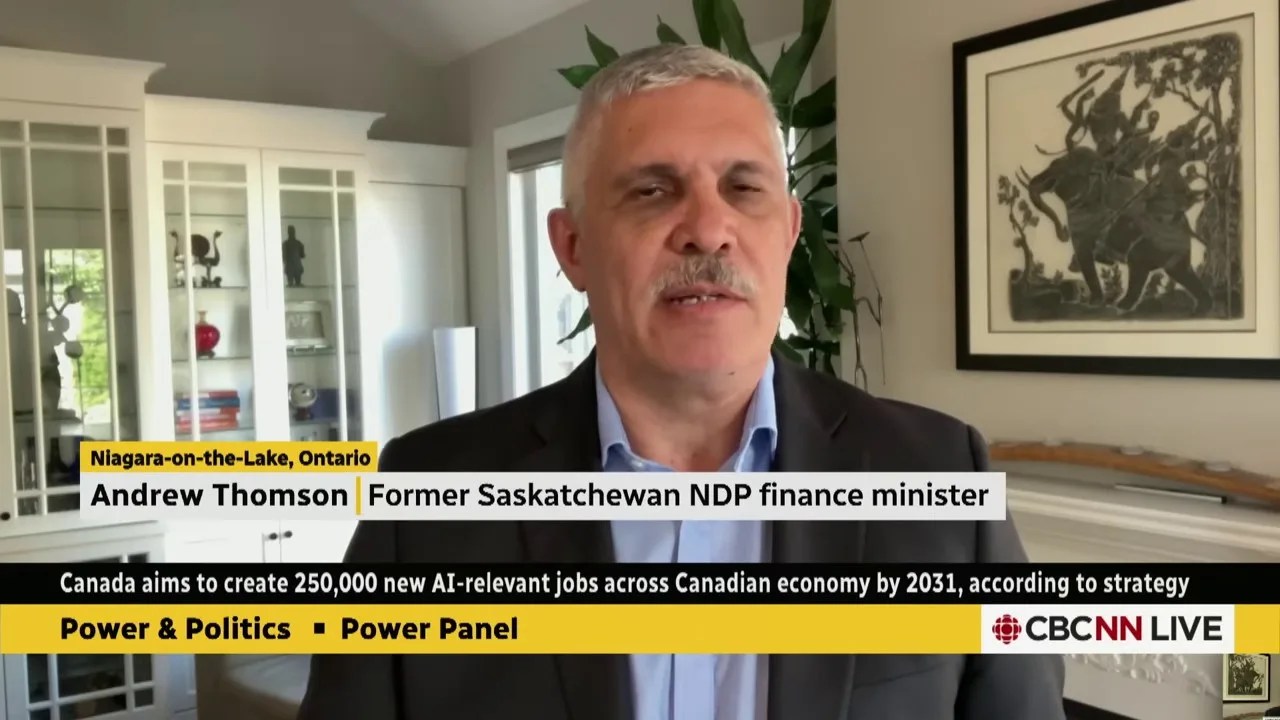
Targeted surgical strikes: Funding is directed at specialized sectors like medical tech and drug discovery where Canada holds a competitive edge.
But while investing in medical AI and keeping brilliant minds at Canadian universities is a noble pursuit, it doesn’t solve the immediate, grinding anxiety of the working class. To many Canadians, the promise of “future jobs” feels like a hollow consolation prize when their current administrative or service jobs are actively being optimized out of existence. Thompson argues that this is simply the reality of any industrial transition—and that the government will eventually have to roll out transition funds, just as they have for the forestry, coal, or automotive sectors in the past. But is comparing the cognitive revolution of AI to the decline of traditional manufacturing a fair comparison? Or are we dealing with a beast of an entirely different scale?
100 Steel Mills or One Data Center? The Mind-Boggling Energy Crunch
If you want to see what happens when the lofty promises of Canada’s AI for All strategy collide head-on with physical reality, look no further than Manitoba. Recently, Premier Wab Kinew made headlines by flatly rejecting a proposal for a massive, hyper-scale AI data center in his province. His reasoning was simple, pragmatic, and incredibly eye-opening.
Kinew offered a brilliant analogy to describe the sheer, mind-boggling scale of these facilities. He asked Manitobans to picture the Selkirk steel mill—a massive, roaring industrial plant that shoots immense amounts of electricity through its furnaces to melt and shape steel. A single modern hyper-scale data center, Kinew pointed out, wants to draw up to one hundred times that amount of power.

The physical cost of virtual intelligence: A single hyper-scale data center can consume as much power as two million residential homes.
Think about that for a second. Some of the data centers being proposed today are projected to consume enough energy to power two million homes—nearly five times the entire residential power needs of the city of Ottawa. They can also guzzle up to 19 million liters of water per day just to keep their server racks from melting.
This energy dilemma exposes the Achilles’ heel of Canada’s AI for All strategy. Premier Kinew raised the ultimate public-interest question: If a province has a finite amount of clean hydro-electricity, what is the best use of that power? Do you give it to a data center that employs a handful of technicians and spits out virtual tokens, or do you reserve it for industries that build physical things, support local communities, and create thousands of stable, long-term careers?
The Local Realities: Water Scarcity and Tech Promises
This resource bottleneck isn’t just Manitoba’s problem; it’s playing out in real-time across the prairies. In Saskatchewan, tech giant Bell has proposed a massive data facility adjacent to Regina—a city that is already notoriously constrained when it comes to water resources.
When questioned about how a water-starved region can support a thirst-heavy data hub, tech companies invariably point to their upcoming, proprietary cooling technologies that promise to use closed-loop systems or drastically reduce water consumption. But as Andrew Thompson dryly noted, we are essentially forced to take these companies at their word, hoping their engineering keeps pace with their ambitions before our local aquifers run dry.
This is where the rubber meets the road for provincial regulators. Rebecca Schultz emphasized that while “bringing your own power” (such as co-locating a data center next to a dedicated natural gas or small modular nuclear reactor) is one pathway, the burden cannot simply be shifted onto public utilities and everyday ratepayers. If a tech company wants to build a digital fortress in Alberta or Saskatchewan, they must navigate a rigorous, uncompromising environmental review process. The question is: will Canada’s regulatory frameworks stand firm, or will they bend under the pressure to secure high-tech investment at any cost?
Yet, the debate over physical infrastructure is only half the battle. The even bigger question hanging over Ottawa is simple: even if we build the infrastructure, can the federal government actually regulate the tech giants who run it?
Regulating a Leviathan: Can Ottawa Actually Tame Big Tech?
Let’s look at the track record. In recent years, Canada’s attempts to regulate major technology players have been a mixed bag at best. From the controversial Online News Act to the back-and-forth over digital streaming content contributions and the sudden dropping of the digital services tax, Ottawa has repeatedly struggled to hold Big Tech’s feet to the fire.

A history of friction: Ottawa’s previous attempts to regulate digital platforms show just how difficult it is to enforce local laws on global tech giants.
And let’s be clear: AI is a leviathan compared to social media algorithms or digital news sharing. It is an entirely different class of technology. Michelle Caderia, former deputy chief of staff to Paul Martin, offered some defense of the government’s approach, noting that the entire world is currently building the regulatory plane while flying it. “There’s not a lot of templates that you can just pick up and follow,” she noted. When you’re starting from scratch, policy errors are inevitable.
But Caderia’s core point is one of pragmatism: Canada simply cannot afford to sit this one out. The technology is coming, whether we like it or not. The challenge for Canada’s AI for All strategy is finding a way to make forward progress without getting so far ahead of public consensus that the entire plan collapses under the weight of political backlash.
The “Trend Bro” Dilemma and the Social Anxiety of AI
This brings us back to the heart of the matter: the psychology of the Canadian public. Shachi Curl issued a stern warning to policy-makers, advising them to stop acting like over-excited “trend bros” rushing to be the first through the door. Canadians aren’t pushing back because they are technophobes; they are pushing back because they are deeply worried about the societal and psychological toll this technology is already taking on their families.

The human cost: As AI mimics human connection, society faces unprecedented psychological challenges, particularly among youth.
Curl pointed to alarming data from the United States, where roughly three in ten teenage boys report having an AI chatbot that they consider to be their “girlfriend.” For parents, this isn’t progress—it’s a terrifying glimpse into a future of profound human isolation. Across Canada, grassroots resistance is already building. In Vancouver, citizens are signing petitions to demand a two-year pause on AI in schools to protect children’s critical thinking skills.
Furthermore, the physical environmental strains are starting to hit home. Curl noted that in downtown Vancouver, residents are currently facing strict Stage 3 watering restrictions—meaning they can’t wash their cars or water their lawns. At the very same time, they are watching a national conversation about building massive data centers that will guzzle millions of liters of local water a day. It is an incredibly tough sell to tell a citizen they can’t water their garden while greenlighting a tech giant’s cooling systems.
Conclusion: The High Stakes of the AI Transition
Ultimately, Canada’s AI for All strategy is a massive gamble. While the economic potential of artificial intelligence is undeniable, the government cannot treat this as a simple business upgrade. AI is a deeply disruptive force that touches on energy grids, water supplies, mental health, and the future of work.
If the government acts merely as a cheerleader for tech advancement, they will continue to widen the massive trust gap with the public. But if they can implement real, enforceable guardrails—protecting privacy, ensuring resource sustainability, and cushioning workers from job displacement—then Canada might just find a way to navigate this transition safely. Right now, however, the risks remain incredibly high, and the rewards are far from guaranteed.
Frequently Asked Questions
What is the primary objective of Canada’s AI for All strategy?
The strategy is a $2 billion initiative designed to boost Canada’s AI competitiveness, increase business adoption of AI from 12% to 60% by 2034, create up to 250,000 new jobs within five years, and build a world-leading sovereign supercomputer by 2031 to protect national data.
Why are Canadians so skeptical about the government’s AI strategy?
According to polling from the Angus Reed Institute, 73% of Canadians do not believe AI is a force for good in society, and 70% want heavy regulation even if it slows economic growth. Public concern stems from potential job losses, environmental damage, and the negative social impacts of AI on children and human relationships.
How do AI data centers impact local environments in Canada?
AI data centers require immense amounts of electricity and water. A single hyper-scale data center can consume as much power as two million homes and require up to 19 million liters of water daily for cooling, leading to conflicts over local resources in water-constrained or energy-limited provinces.