Let’s be completely honest: 99% of what you see on social media about artificial intelligence is pure vaporware. We are constantly bombarded by creators telling us how some obscure, single-feature AI wrapper is going to “revolutionize” our lives and make us millions overnight. But when you actually log in, pay the subscription, and try to apply it to a real-world business, it falls completely flat.
If you are looking for the absolute best AI tools to make money, you don’t need a list of 50 shiny objects. You need a brutal, battle-tested, no-nonsense filter. Having analyzed the real-world utility of hundreds of systems, I’ve categorized them based on a single, uncompromising metric: ROI (Return on Investment). How much time, effort, and money do you pour into the tool versus how much real-world cash flow and operational leverage does it actually hand back to you?
The Ultimate Filter: Finding the Best AI Tools to Make Money
To evaluate these platforms fairly, we use a simple, structured tier system ranging from S-Tier down to F-Tier. This framework isn’t about how “cool” a technology is; it is strictly about business execution. If a tool saves you thousands of dollars in hiring costs, instantly retrieves lost hours, or generates high-paying client assets, it climbs the ladder. If it causes constant security alerts, requires a PhD to maintain, or simply mimics basic search queries, it drops.
The standard: Every tool is evaluated on real-world business ROI rather than hype.
Before spending another dollar on subscription fees, you need to understand where the industry giants and emerging niche platforms actually sit. Let’s start with the one tool that everyone seems to think is irreplaceable—but is actually losing its grip on the market.
The Kleenex of AI: Why ChatGPT is Sliding into C-Tier
It’s hard to overstate the impact of OpenAI’s flagship product. ChatGPT is the “Kleenex” of the generative era. It was first to market, it got everyone hooked, and it remains the default household name. But in business, nostalgia doesn’t pay the rent. If we look at the actual output quality, context memory, and developer utility today, ChatGPT is starting to look less like the future and more like the “MySpace” of AI.

First to market, but no longer the best: ChatGPT sits at C-Tier for business leverage.
While OpenAI continues to focus on mass-market features, serious builders are running into walls with ChatGPT’s deteriorating code execution, limited file management, and occasionally generic outputs. For simple copywriting or basic brainstorming, it’s fine. But if you want to run high-value business operations or build custom software assets, you will quickly find yourself outgrowing it. It sits firmly in C-Tier—a decent generalist, but far from the powerhouse you need to build a modern, high-margin business.
The S-Tier Heavyweights: Claude, Gemini, and the Power of Custom Agents
If ChatGPT is slipping, who is claiming the crown? The answer is Anthropic’s Claude. Over the past year, Claude has quietly become the absolute gold standard for technical founders, developers, and knowledge workers. It possesses vastly superior long-term memory, an intuitive understanding of complex system design, and a far cleaner codebase generation capability.

The developer’s darling: Claude takes the crown in S-Tier for its unmatched coding and analytical power.
What makes Claude an S-Tier asset is its ability to let non-technical founders write, test, and deploy functional software in record time. If you can clearly articulate a business problem, Claude can build the tool to solve it. This is where the true leverage of the best AI tools to make money comes alive—eliminating the need for $100k/year developer contracts for internal tooling.
But the real magic happens when you move from raw models to dedicated, autonomous agents. This brings us to customized system assistants, such as those built on enterprise layers like Apex.

Meet Kai Boss: A customized AI agent running on top of Claude’s brain with full system memory.
An agent like Kai Boss isn’t just a chat window. It’s an untiring virtual teammate with perfect historical recall, direct access to your company’s internal databases, and the ability to proactively spot operational bottlenecks. Instead of you prompting the tool constantly, the agent acts as an autonomous coordinator that executes tasks, runs quality checks, and updates your team in real time.
Rounding out the S-Tier is Google’s Gemini. While initially criticized at launch, Google’s massive infrastructure investments have paid off. Gemini’s massive context window and native integration across Google Workspace, YouTube, and Chrome make it an absolute beast for deep research and high-volume data digestion.

Google Gemini: Securing its spot in S-Tier through unparalleled integration and massive context windows.
The Practical Workhorses: Higgsfield, Frank, and Buddy Pro
While S-Tier tools handle the core engine of your business, the A-Tier is where highly specialized, task-specific platforms reside. These are the tools designed to do one thing exceptionally well, instantly replacing expensive agencies or heavy manual workflows.
1. Higgsfield.ai (The Generative Video Disrupter)
Creating high-impact video marketing material historically required expensive camera gear, actors, and editing teams. Higgsfield.ai changes that equation entirely. By providing creators with top-tier generative video models under a single interface, it allows marketing teams to produce high-quality social media B-roll, conceptual ads, and hyper-dynamic visuals in minutes.

Higgsfield.ai takes video production out of the studio and onto the cloud, earning a strong A-Tier spot.
2. Frank AI (The AI Financial Co-Pilot)
How much are you spending on micro-SaaS subscriptions? Which of your product lines is actually driving net margin? Most business owners can’t answer these questions without waiting weeks for their accountant’s report. Frank AI integrates directly with your business data to act as an on-demand financial analyst.

Frank AI visualizes complex business margins instantly, letting you make high-stakes financial decisions in seconds.
3. Buddy Pro (The Knowledge Monetization Engine)
For consultants, coaches, and industry experts, time is the ultimate bottleneck. You can only hop on so many Zoom calls a day. Buddy Pro allows you to clone your brain, creating an interactive, highly trained AI avatar of yourself that clients can query 24/7. It delivers your frameworks, your tone, and your strategies without you needing to sit at a laptop.

Monetizing expertise at scale: Buddy Pro sits at A-Tier for coaches, authors, and consultants looking to reclaim their time.
Niche Goldmines vs. Total Failures
Beyond the primary utilities, we find highly specific creative tools like Nano Banana. For businesses in physical product design, architectural rendering, or 3D modeling, this tool is an absolute goldmine. It bridges the gap between a vague concept in your head and a photorealistic 3D render that you can show to clients or manufacturers.

Nano Banana turns raw conceptual text into high-fidelity 3D modeling and rendering.
However, the AI landscape is also littered with overhyped failures. At the very bottom of the barrel sits Apple Intelligence. Touted as the ultimate personal assistant integrated into your hardware, its current iteration is practically dead on arrival for serious business use. It lacks complex reasoning, struggles with cross-app execution, and offers little to no financial ROI, placing it firmly in the F-Tier.
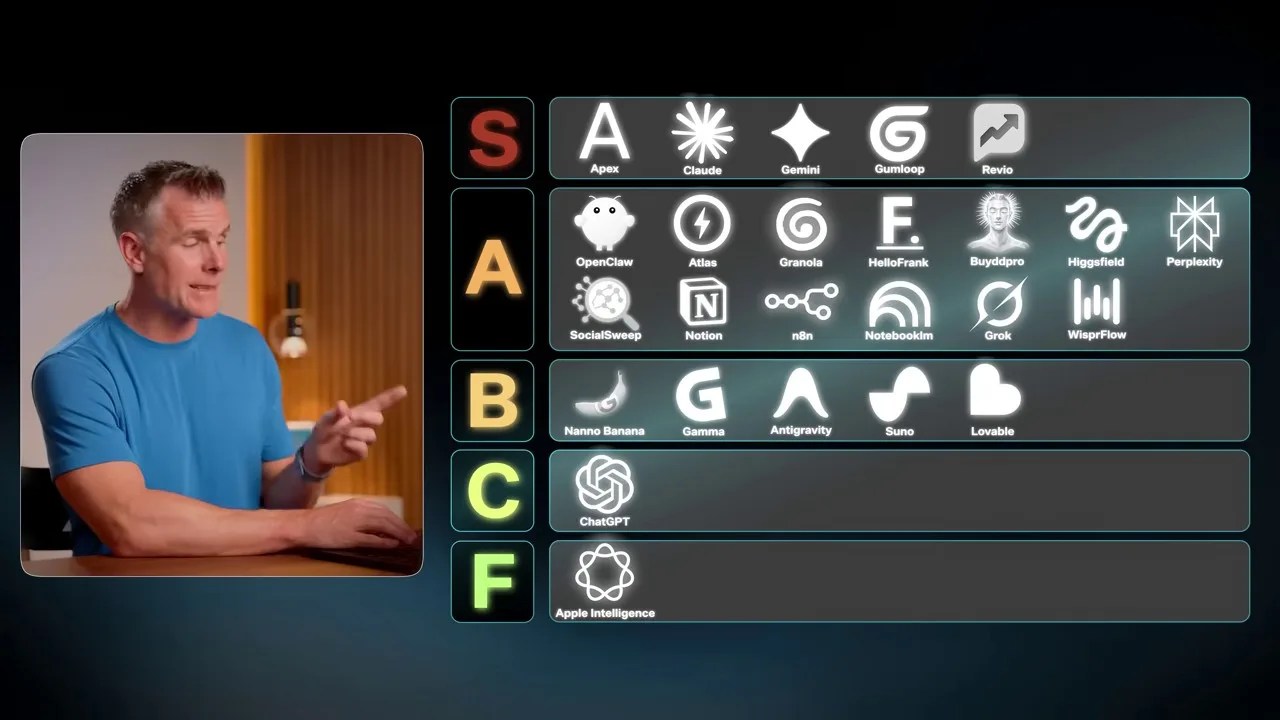
The big picture: The complete overview of how these 500+ AI tools stack up against each other.
The Ultimate Pivot: Transitioning from “Doer” to “Director”
Here is the ultimate secret that separate those who get rich using AI from those who simply burn money on subscriptions: **The value is not in the tool itself; it is in your ability to step away from the keyboard.**
In the traditional economy, you were the “doer.” You researched, you wrote, you formatted slides, you generated code, and you hit send. If you use AI simply to write slightly faster drafts which you then manually copy-paste into another system, you are missing the entire point of this technology.
To truly build a high-leverage business, you must transition into the role of a Director. When you query an agent, don’t stop at the output. Challenge the system to complete the entire loop. Don’t copy-paste its response—tell it to “Post this draft to our Slack channel,” “Send this outbound email directly via Gmail,” or “Generate this report and upload it to Notion.” Keep the human in the loop as the editor and strategic guide, but let the machine run the execution lines.
Stop playing with toys. Choose one S-Tier engine like Claude, pair it with a task-specific A-Tier tool like Frank or Higgsfield, build your workflows, and start acting like the director your business needs.
🎥 Watch Original Video: I Tested 500+ AI Tools, These Will Make You Rich (by Dan Martell)