The AI arms race isn’t just heating up; it’s boiling over. If you thought the battle between OpenAI and Anthropic had reached a temporary, comfortable plateau, think again. Rumors, silent A/B testing, and cryptic messages from key insiders point to one massive event: the imminent release of OpenAI’s next flagship model, GPT-5.6.
As someone who tracks every model update, API tweak, and developer tweet daily, I can feel the pre-launch electricity in the air. This isn’t just another incremental patch to keep investors happy; it’s a calculated, high-stakes move to reclaim undisputed dominance in the developer ecosystem. Let’s cut through the noise and analyze what is actually happening behind the closed doors of Silicon Valley’s most talked-about laboratory.
| Topic | Key Details | My Take / Impact |
|---|---|---|
| GPT-5.6 Release | Rumored launch as early as next week; heavily teased by OpenAI product leads. | A direct counter-strike to Anthropic’s Claude Mythos. Expect aggressive pricing and high token efficiency. |
| OpenAI Codex Update | Expanding to non-developers with role-specific plugins and a new “Sites” feature. | The boundary between raw code generation and user-friendly interface creation is officially dissolving. |
| Vibe Coding Platform | The launch of the first-ever independent vibe coding benchmark. | Bypasses polished vendor benchmarks to show how models actually perform in real-world, messy coding scenarios. |
The GPT-5.6 Whispers: Inside Tibor’s Crucial Hint and ChatGPT’s Stealth Upgrades
For weeks, the AI community has been locked in a fierce debate: Has OpenAI lost its edge? With Anthropic’s Claude consistently winning over developers and power users, ChatGPT has felt more like a reliable utility than an undisputed pioneer. But that narrative is about to face a massive reality check.
The rumor mill is spinning fast: Slides and leaks suggest OpenAI is preparing a massive counter-strike with GPT-5.6.
The first real crack in the secrecy came from Tibor Blaho, one of OpenAI’s key product leads. On social media platform X, a developer mused about how neck-and-neck OpenAI and Anthropic currently are, with users constantly jumping back and forth depending on who pushed the latest update. It was a fair assessment of the current state of the market. Then, Tibor dropped a single-word reply that sent shockwaves through the developer community:
“Soon.”
In the highly calculated world of tech PR, product leads don’t drop casual “soon” comments unless a release is locked, loaded, and undergoing final staging. It strongly suggests that OpenAI believes they have a model capable of moving the needle decisively, breaking the current parity.
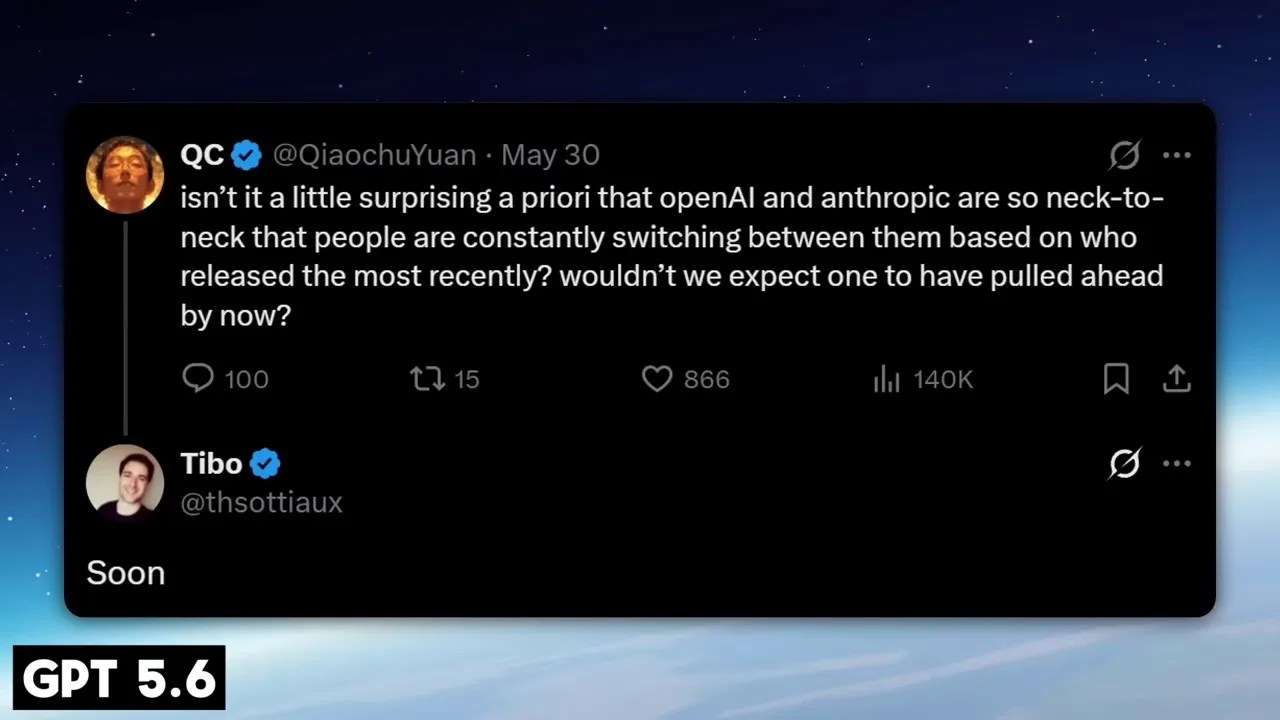
One word was all it took. Tibor Blaho’s reply on X sparked intense speculation about the next major model drop.
But we don’t have to rely solely on social media breadcrumbs. If you’ve been using ChatGPT over the past week, you might have unconsciously participated in their testing phase. OpenAI has been aggressively running silent A/B tests. Users have spotted highly unusual, experimental text and image models appearing randomly inside their ChatGPT interfaces. This sudden surge in live, production-level testing is the classic, final step in OpenAI’s pre-launch playbook.
Beyond “Slop”: The Pelican on a Bike and OpenAI’s Leap in Real-Time Code Execution
So, what does this new model actually look like in practice? It’s easy to get lost in sterile benchmark numbers, but the real test of an AI is what it can build on the first try. During these silent A/B tests, some developers managed to push the experimental models to their limits—and the results are frankly astonishing.
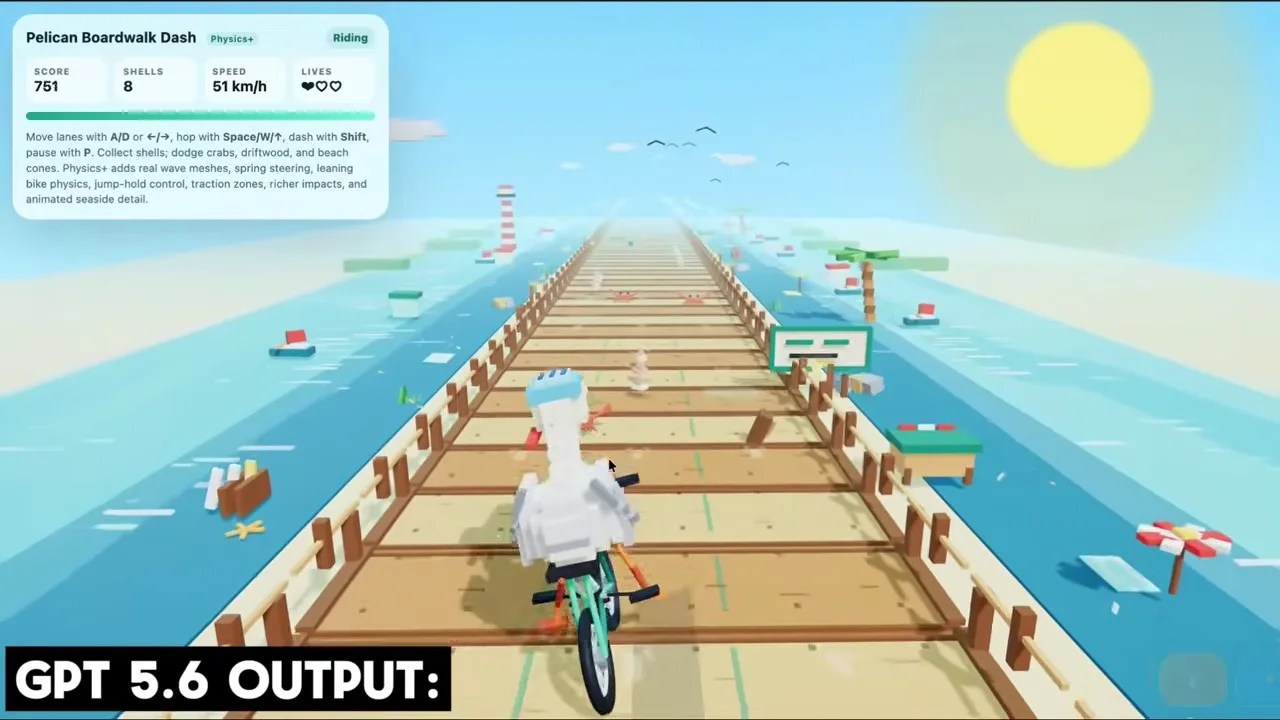
Take a look at this demo that surfaced on X. A user asked the experimental ChatGPT model to build a simple game: “A pelican riding a bike.” Now, normally, an LLM would spit out some basic, buggy HTML/JS code, maybe render a static, cartoonish image of a bird, and call it a day. But this model generated a fully playable game from scratch.
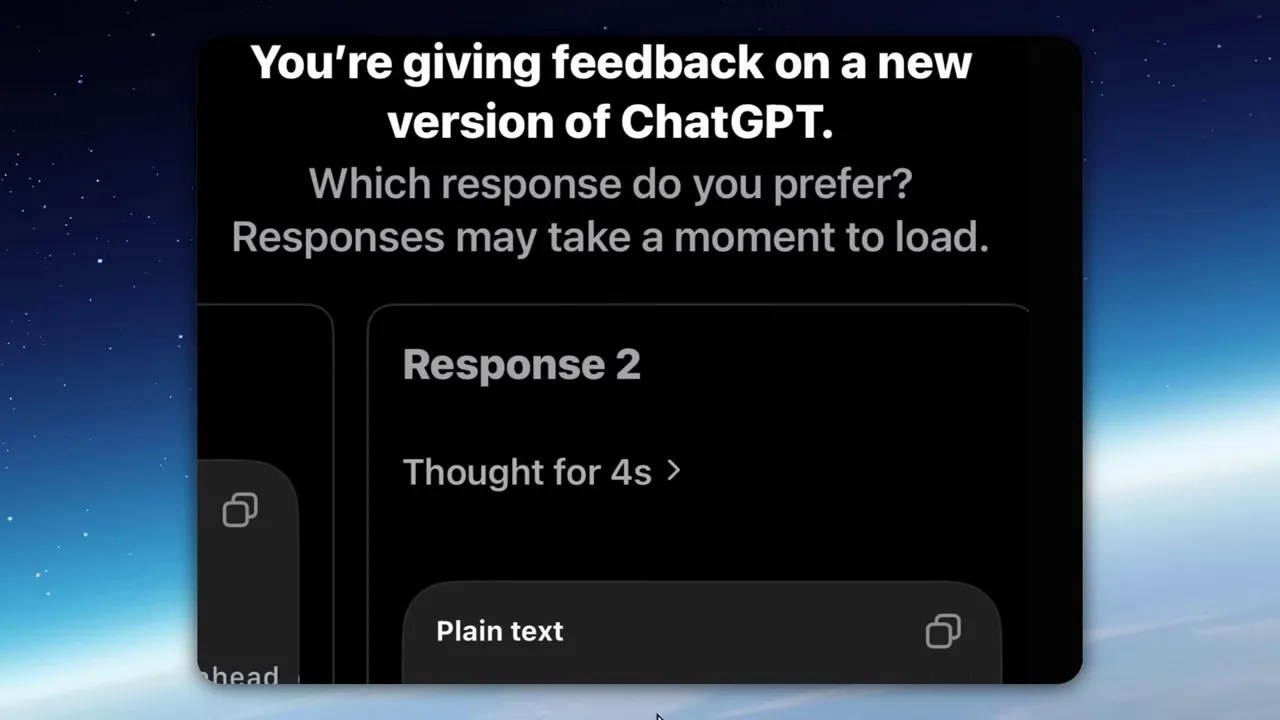
This isn’t just basic code generation; it’s a fully functional mini-game with physics, scoring, and smooth controls, built entirely by the experimental model.
We are talking about real physics, collectable items, a functional scoring system, smooth movement mechanics, and a surprisingly clean UI. It represents a massive leap in how the model understands spatial logic and real-time code execution.
According to early whisperings from developer circles, GPT-5.6 is designed to go toe-to-toe with Anthropic’s highly anticipated “Claude Mythos” preview. But here is the kicker: OpenAI is reportedly focusing heavily on token efficiency. If the rumors hold true, GPT-5.6 will not only match Mythos-level reasoning on key benchmarks, but it will do so at a fraction of the inference cost, making it significantly cheaper and faster to run in production.
Furthermore, we are finally seeing a cure for “UI slop”—that generic, misaligned, messy interface design that AI models usually generate when asked to build front-ends. The outputs coming out of this new model look clean, intentional, and highly usable, reflecting the kind of massive leap in design sensibility that we’ve all been waiting for.
Codex Reimagined: Why OpenAI is Turning Code into Interactive “Sites”
While everyone is hyper-focused on the raw power of GPT-5.6, OpenAI quietly dropped a massive update to Codex that reveals where their long-term strategy is heading. And frankly, it’s a brilliant pivot.
OpenAI revealed a fascinating statistic: non-developers now make up roughly 20% of the Codex user base, and this cohort is growing three times faster than traditional software engineers. People who don’t know the difference between a GET and a POST request are using Codex to build tools. To lean into this, OpenAI is expanding Codex far beyond raw code generation.
OpenAI is previewing ‘Sites’—a new Codex feature that allows users to instantly generate and host interactive dashboards and web apps.
They have introduced role-specific plugins tailored for analysts, marketers, designers, sales teams, and investors. These plugins allow Codex to connect directly to existing enterprise tools to generate live reports, interactive dashboards, presentations, and working prototypes without requiring the user to touch a code editor.
The crown jewel of this update is the new “Sites” feature. Currently in preview, Sites allows Codex to not only write the code for an interactive app or project planner but also host it instantly. You can generate a custom dashboard for your team and share it via a simple, live URL in seconds.
What we are witnessing is the slow, deliberate merging of ChatGPT and Codex. Over time, the line between these two products will likely vanish, leaving us with a single, highly collaborative workspace where natural language seamlessly translates into functional, hosted software.
The Vibe Coding Revolution: Introducing the World’s First Real-World AI Benchmark
But let’s keep our feet on the ground for a second. Every time a major company launches a model, they present beautiful, cherry-picked graphs showing how their model beats everyone else by 0.5% on some obscure academic benchmark. We’ve all grown incredibly cynical of vendor-provided benchmarks. They don’t reflect how these models perform when you are tired, at 2 AM, trying to get a messy React component to work.
That is why my team and I at World of AI have officially launched the world’s first **Vibe Coding Benchmark and Evaluation Platform**.
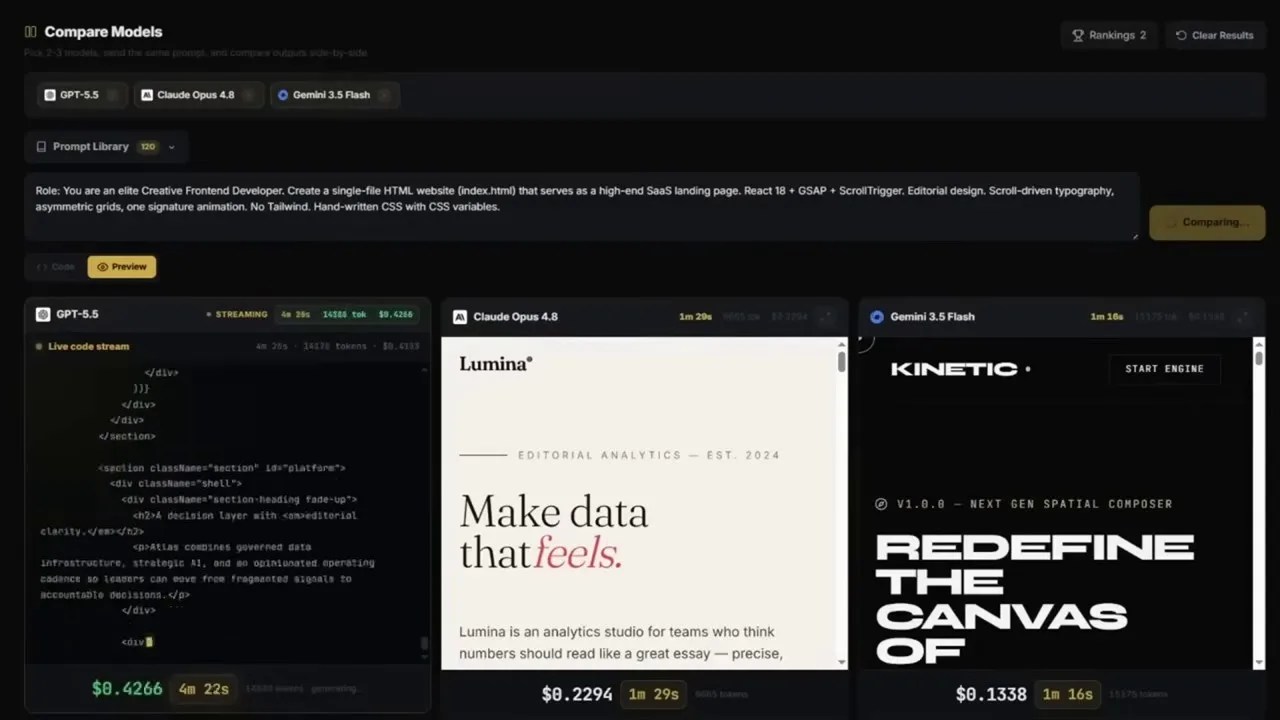
Tired of corporate marketing? The new Vibe Coding Benchmark evaluates models based on real-world usability and developer experience.
The premise is simple: we wanted to create an independent, community-driven platform that tests these models on actual, real-world use cases. No synthetic datasets, no pre-optimized test questions that the models might have already memorized during training. We are evaluating how these models handle the chaotic, unpredictable nature of “vibe coding”—where developers guide the AI iteratively to build, debug, and ship applications in real-time.
By testing models on actual development workflow speed, logical consistency under pressure, and error-correction capabilities, we aim to give developers a transparent, unbiased leaderboard. Best of all, we are keeping key features of this platform completely free for the community, ensuring everyone has access to honest data before choosing which API to build their business on.
What makes this vibe coding platform genuinely useful is its ability to let you compare multiple models side-by-side across highly specific domains. Instead of relying on a single, static score, you get granular insights into how different LLMs handle complex reasoning tasks, alongside a curated prompt catalog of nearly 4,000 rigorous testing prompts.
To make the evaluation as objective as possible, we built an automated AI judge system. This system doesn’t just check if the code runs; it dissects the output across five critical dimensions: functionality, visual design, structural code quality, creative problem-solving, and edge-case handling. You can even hook up your own custom API endpoints to get detailed, diagnostic feedback on exactly why a model failed a task and—more importantly—how to tweak your prompts, structure your system instructions, or select a more appropriate model to get the job done right.
Microsoft’s Quiet Rebellion: MAI-thinking-1 and the MoE Threat
For the past two years, the tech industry has treated Microsoft as OpenAI’s wealthy benefactor—the cloud-hosting giant content to let Sam Altman’s team build the brains while they supply the silicon. But at their latest showcase, Microsoft made it clear they are tired of sitting in the passenger seat. They launched seven brand-new, proprietary AI models spanning reasoning, coding, image editing, and multimodal speech processing.
The clear standout of this release is MAI-thinking-1. Unlike many “new” models on the market that are simply distilled, fine-tuned versions of OpenAI’s GPT-4, Microsoft claims they built and trained MAI-thinking-1 entirely from scratch. This is a critical distinction; it proves Microsoft is building its own sovereign intellectual property, free from dependency on third-party model weights.
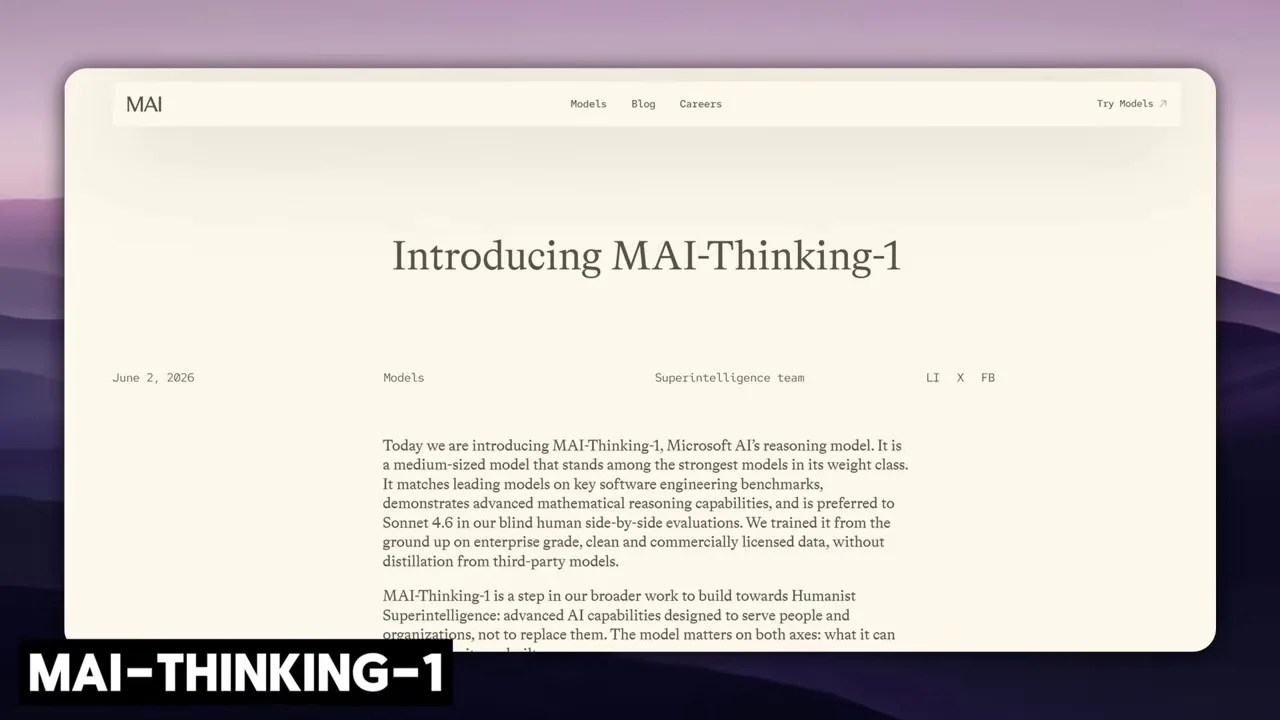
Microsoft’s MAI-thinking-1 spec sheet shows highly competitive reasoning scores despite its relatively compact model size.
Even more surprising is its architecture. MAI-thinking-1 is a relatively compact Mixture of Experts (MoE) model with only 35 billion active parameters. Yet, Microsoft’s internal benchmarks show it going toe-to-toe with behemoths like Anthropic’s Claude 3.5 Opus on complex software engineering tasks. In blind human evaluations, developers actually preferred MAI-thinking-1 over Claude 3.5 Sonnet for coding and logical reasoning.
Alongside their flagship reasoning model, Microsoft also debuted MAI-code-1-flash. Specifically optimized for speed and integration within GitHub Copilot, this model reportedly beats Claude Haiku 3.5 on SWE-bench Verified while slashing token consumption by up to 60%. While it might not replace your primary reasoning engine for complex system architecture, it represents a highly efficient utility player for rapid, day-to-day debugging and autocomplete tasks.
The Slide That Leaked Mythos: Are We Looking at a Trillion-Parameter Beast?
Of course, no major tech conference is complete without a little drama. During one of the technical presentations, Microsoft accidentally displayed a slide containing a highly sensitive estimate: the projected compute budget used to train Anthropic’s upcoming flagship model, Claude Mythos.
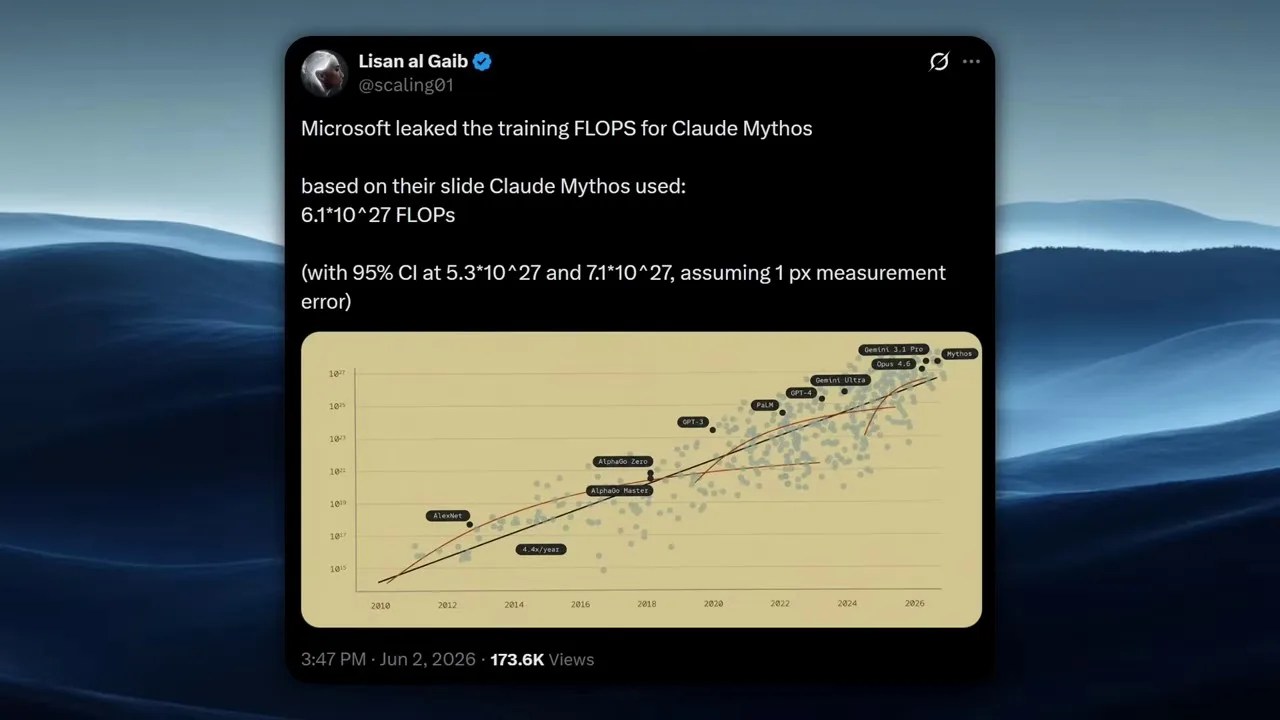
An accidental slide exposure during a Microsoft presentation revealed what appears to be the massive compute footprint of Claude Mythos.
The slide listed the compute footprint for Mythos at a staggering 6.1 × 1027 FLOPs (Floating Point Operations). To put that in perspective, FLOPs measure the total number of mathematical calculations performed during a model’s training run. The higher the FLOP count, the more data, GPUs, and electricity were consumed to build the AI.
Almost immediately, independent AI researchers took to X to dissect the number. Many argued that Microsoft’s public estimate might be slightly overstated or based on imperfect external projections. However, even when researchers adjusted the math to be more conservative, the revised numbers remained jaw-dropping.
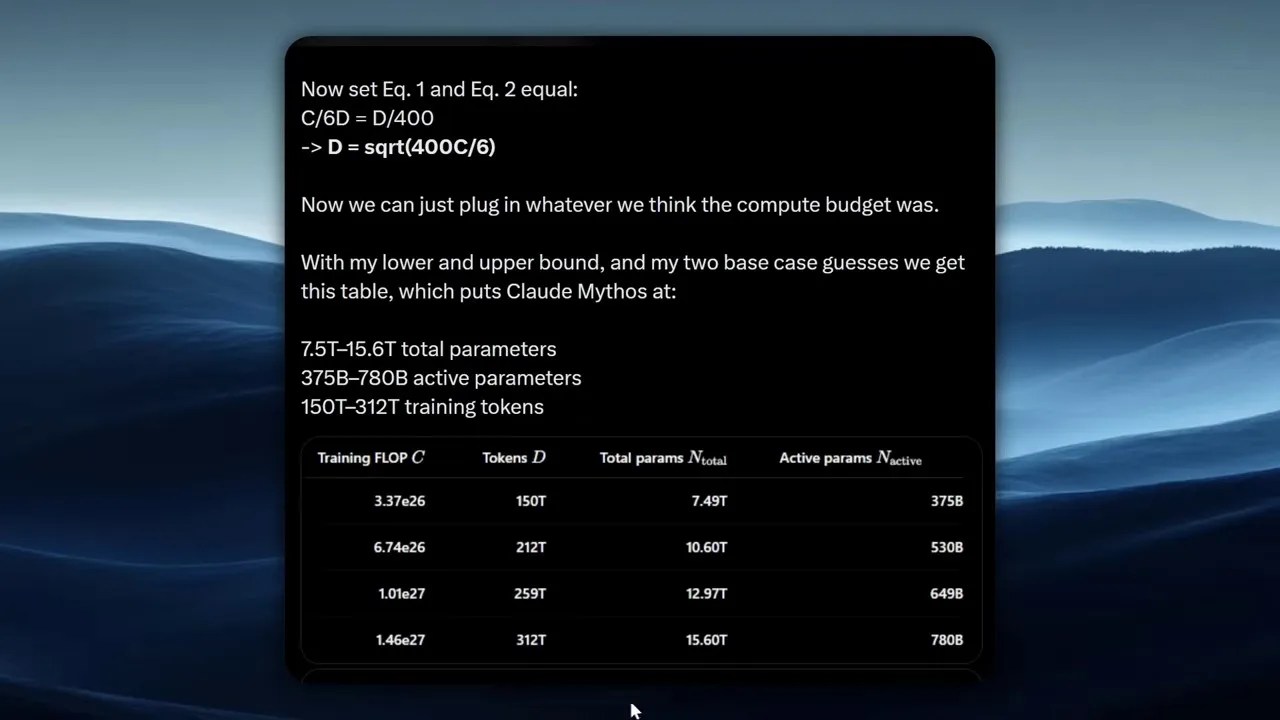
The consensus is that Anthropic has trained an absolute monster. We are likely looking at a model built on trillions of parameters and fed hundreds of trillions of tokens. This explains why Anthropic has bypassed minor point-releases to position Mythos as a fundamental, generational leap in agentic capabilities, complex reasoning, and deep coding automation. If these compute estimates are even remotely accurate, Mythos will likely set a massive new benchmark for what raw scale can achieve.
Hermes Goes Native: The Power of Open-Source AI on Your Desktop
While the tech giants are busy throwing billions of dollars of compute at closed models, the open-source community continues to execute brilliant, highly practical counter-moves. Case in point: the official launch of the Hermes Agent Desktop app.
For those who have been following the space, Hermes has quickly established itself as one of the most flexible, capable open-source agent frameworks available. It supports complex multi-agent orchestration, Model Context Protocol (MCP) integrations, local memory systems, and even direct “computer use” automation. But until now, running it required navigating a web browser or terminal interface.
The Hermes Agent Desktop app brings powerful, multi-agent workflows directly to your local machine with a polished, native UI.
By launching a dedicated, native desktop application (with full support for Linux and other major operating systems), the creators of Hermes have bridged the gap between raw open-source power and commercial-grade user experience. Running natively on your local machine means tighter system integration, lower latency, and absolute privacy. It proves that you don’t need to sacrifice ease of use to keep your data local and secure.
Alibaba’s Qwen 3.7 Plus: The Next Open-Weight Contender
Not to be outdone, Alibaba has officially expanded its highly regarded open-weight lineup with the release of Qwen 3.7 Plus. This is a highly optimized multimodal model designed to sit comfortably between their standard models and the upcoming heavy-duty Qwen 3.7 Max.
Early developer feedback indicates that Qwen 3.7 Plus punches well above its weight class, demonstrating remarkably robust coding capabilities and visual reasoning while remaining highly token-efficient. This release signals that Alibaba is getting ready to drop the fully open-weight versions of the Qwen 3.7 family, a move that will undoubtedly democratize high-end coding assistance for developers worldwide who prefer to run their stacks on custom infrastructure.
Unlike traditional text-only models, the Qwen 3.7 Plus variant is fully multimodal and built specifically with agentic workflows in mind. By combining vision and language processing into a single foundational model, Alibaba has created a system that can see, reason, write code, and take action in real-time.
Alibaba is positioning this model as a hybrid coding assistant and productivity agent. Because it natively supports both graphical user interface (GUI) interactions and traditional command-line operations, it can analyze design mockups, visually identify UI bugs, ground its reasoning in what it sees, and then write and execute the terminal commands needed to fix the codebase. It represents a highly efficient alternative to the larger Qwen 3.7 Max, offering developers a lightweight yet incredibly capable multimodal partner.
Anthropic’s Silent Power Moves: Claude Code Updates and Terminal Dominance
While the industry was distracted by hardware announcements, Anthropic quietly rolled out a series of updates to Claude Code that will fundamentally change how developers interact with their terminal. The most significant of these is the newly upgraded /fork command.
Previously, running a fork command in Claude Code simply duplicated your chat session—a useful but basic feature. The new implementation, however, is a game-changer. When you execute /fork, the system spawns an independent background agent pre-loaded with your exact context, active tool configurations, model parameters, chat history, and prompt cache. This background agent runs complex, multi-step tasks in parallel and pipes the final outputs directly back into your active terminal workspace.
If you prefer the old behavior of manually branching off into a clean workspace, Anthropic hasn’t removed it; they have simply renamed it to /branch. This elegant distinction allows developers to choose between spawning autonomous background workers or manually exploring alternative coding pathways.
To complement this, Anthropic also released a new dedicated Command Line Interface (CLI) for the Claude platform. This tool gives developers direct terminal access to virtually every Claude API endpoint. Whether you need to make rapid calls to the Messages API, orchestrate managed Claude agents, or pipe terminal outputs straight into complex shell scripts, the new CLI makes building custom, automated workflows incredibly straightforward. It is a clear sign that Anthropic wants to dominate the developer’s terminal, turning it into the ultimate command center for AI-driven development.
Google’s NotebookLM Upgrade and Microsoft’s Agent-First Hardware
On the consumer productivity front, Google is reportedly preparing a substantial upgrade for NotebookLM. Technical sleuths recently spotted a hidden “planning mode” designed specifically for video overviews. This new interface gives users precise, granular control over how NotebookLM structures, narrates, and generates its highly popular audio and video summaries.
Speculation is mounting that this upgrade is powered by Google’s recently announced Gemini Omni model. If true, we can expect a massive leap forward in video generation quality, featuring incredibly realistic voice narration, deeper visual understanding, and highly polished, professional-grade presentations generated directly from your raw notes.
Meanwhile, Microsoft is thinking outside the software box by pioneering “agent-native hardware.” The company unveiled a prototype suite of dedicated handheld and desktop devices engineered specifically for interacting with autonomous AI agents.
Rather than treating AI agents as just another background app or browser tab, Microsoft’s vision is to create physical, purpose-built control centers. These devices are designed to let you delegate tasks, monitor active agent workflows, and receive physical haptic or visual feedback on your desk as your digital workforce completes tasks throughout the day. It is an intriguing glimpse into a future where physical workspaces are designed from the ground up to accommodate human-AI collaboration.
The Uncanny Valley: Hyper-Realistic Humanoids at the World Intelligence Expo
To end things on a fascinating, if slightly unsettling note, we must look at the physical embodiment of these rapidly evolving intelligence systems. At the 26th World Intelligence Expo in China, a series of hyper-realistic humanoid robots took center stage, pushing us deep into the uncanny valley.

The line between human and machine continues to blur. These humanoid robots feature synthetic skin and motion-capture systems capable of mimicking micro-expressions.
These machines are capable of blinking, nodding, maintaining natural eye contact, and mimicking subtle human micro-expressions with a degree of realism that is almost jarring. By combining advanced motion-capture technology, synthetic skin, realistic hair, and intricate facial actuators, these robots move with a fluidity that was completely impossible just a few years ago.
The engineering on display is undeniably brilliant, showcasing the breathtaking pace of modern robotics. However, it also raises profound questions. As we get closer to a world where distinguishing between a human and a machine becomes difficult at a glance, the ethical implications are massive. The hope, of course, is that these hyper-realistic systems will be deployed in genuinely beneficial fields like healthcare, eldercare, and education, rather than for deceptive customer service or surveillance. Either way, the future is arriving far faster than most people are prepared for.
Looking Ahead: The Agentic Future is Already Here
If this week’s developments prove anything, it’s that we are moving rapidly past the era of simple, passive chatbots. Whether it is the highly anticipated release of OpenAI’s GPT-5.6, the staggering compute investments behind Anthropic’s Claude Mythos, or the rise of native desktop agents and physical agent-first hardware, the focus has shifted entirely to execution, autonomy, and real-world integration.
As these models become cheaper, faster, and more capable of acting on our behalf, the tools we use to evaluate and interact with them must evolve too. Independent benchmarks, local agent environments, and open-source flexibility will be the keys to navigating this next wave of technological evolution without losing control of our data—or our workflows.
Frequently Asked Questions (FAQ)
Q1: What is the estimated release window for GPT-5.6, and how will it differ from GPT-4o?
While OpenAI has not officially confirmed a date, cryptic hints from product leads and a sudden surge in public A/B testing suggest a release could happen very soon. Unlike GPT-4o, GPT-5.6 is expected to focus heavily on advanced reasoning, highly polished UI generation (eliminating “UI slop”), and exceptional token efficiency to make running complex agentic workflows significantly cheaper.
Q2: What are the leaked compute estimates for Claude Mythos, and why do they matter?
An accidental slide exposure at a Microsoft event estimated the compute footprint of Anthropic’s upcoming Claude Mythos at roughly 6.1 × 1027 FLOPs. Even if this number is slightly overstated, it indicates one of the most massive AI training runs in history, suggesting Mythos will be a trillion-parameter class model designed for deep reasoning and autonomous agent execution rather than incremental improvements.
Q3: How does Anthropic’s new /fork command improve developer workflows?
Unlike the old command (now renamed to /branch) which simply duplicated a chat session, the new /fork command spawns an autonomous background agent. This agent inherits your exact context, tools, and prompt cache to execute complex tasks in parallel, returning the results directly to your active terminal window once completed.