I’m writing this from a slightly chaotic headspace. Between traveling for events and tracking the absolute deluge of AI news that drops every single hour, it feels like we’re constantly drinking from a firehose. If you’re feeling overwhelmed trying to keep up, you’re not alone.
This week was particularly bizarre. We had massive tech giants quiet-dropping powerful models, startup valuations soaring to heights that don’t even feel like real money anymore, and some genuinely jaw-dropping creative tools that might change how we think about video production. But we also got a heavy dose of AI reality—from corporate PR spin on layoffs to a “95% accurate” pet translator that sounds suspiciously like a movie prop. Let’s break down what’s real, what’s hype, and what is just plain cursed.
1. Anthropic’s Paradox: Claude Opus 4.8 and a $965B Valuation
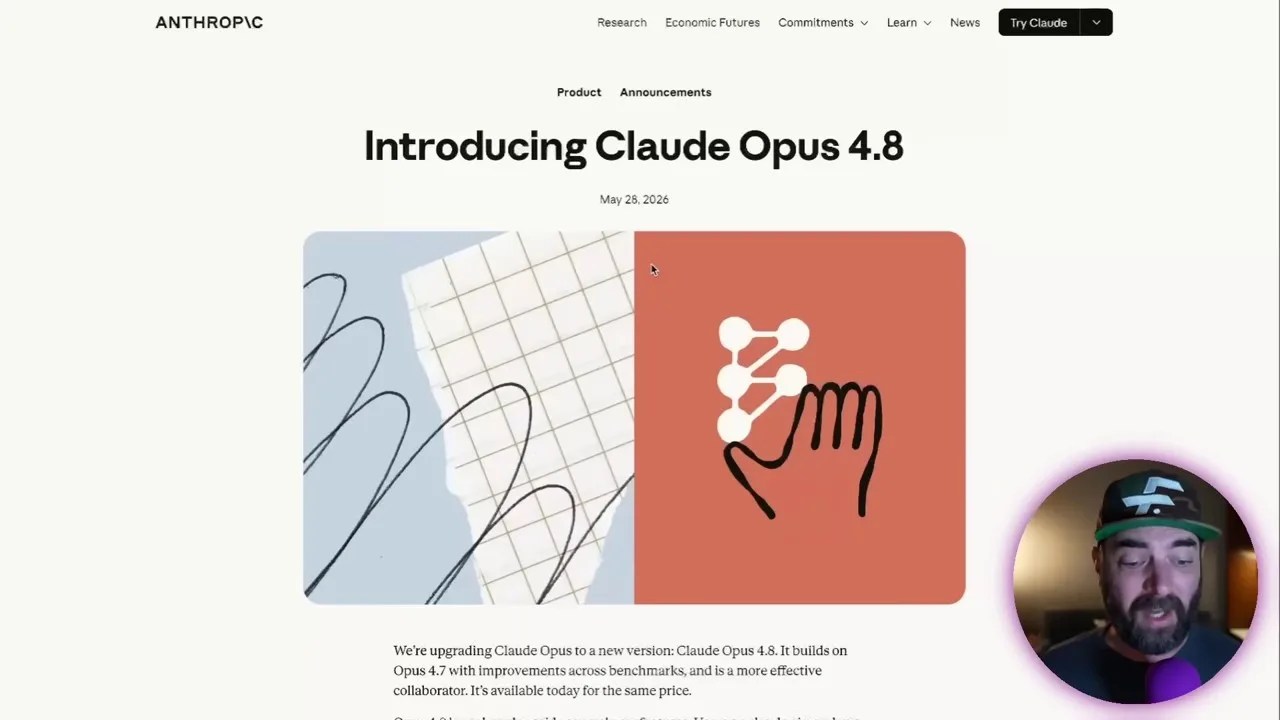
Let’s start with the heavy hitter. Anthropic rolled out Claude Opus 4.8. Now, if I’m being completely honest, this isn’t the earth-shattering leap forward that some hype-merchants on social media will claim. It’s a modest, iterative upgrade. But what makes it interesting is where those improvements happened.
Instead of just trying to inflate raw benchmark scores, Anthropic focused on something far more practical: coding, reasoning, and—crucially—honesty. They claim Opus 4.8 is significantly better at admitting when it doesn’t know something, rather than confidently hallucinating a lie. To me, that’s a massive win for actual, day-to-day utility.
Anthropic’s official data shows modest, targeted boosts on coding and reasoning benchmarks for Opus 4.8.
Alongside the model update, they introduced something that might actually change the game for developers using Claude Code: dynamic workflows. If you’ve ever tried to make an AI build a complex app, you know it quickly loses the plot. Anthropic’s new architecture attempts to solve this by creating an internal, self-correcting hierarchy of agents.

The new Claude Code agentic system: breaking prompts into subtasks, spinning off parallel agents, and peer-reviewing results before delivering the final code.
Think of it as a virtual software development team inside the terminal. One agent maps out the plan, spins up three “sub-agents” to code different components in parallel, and then has other agents aggressively try to refute and debug their work until they reach a consensus. It’s an elegant, highly structured way of managing agentic drift.
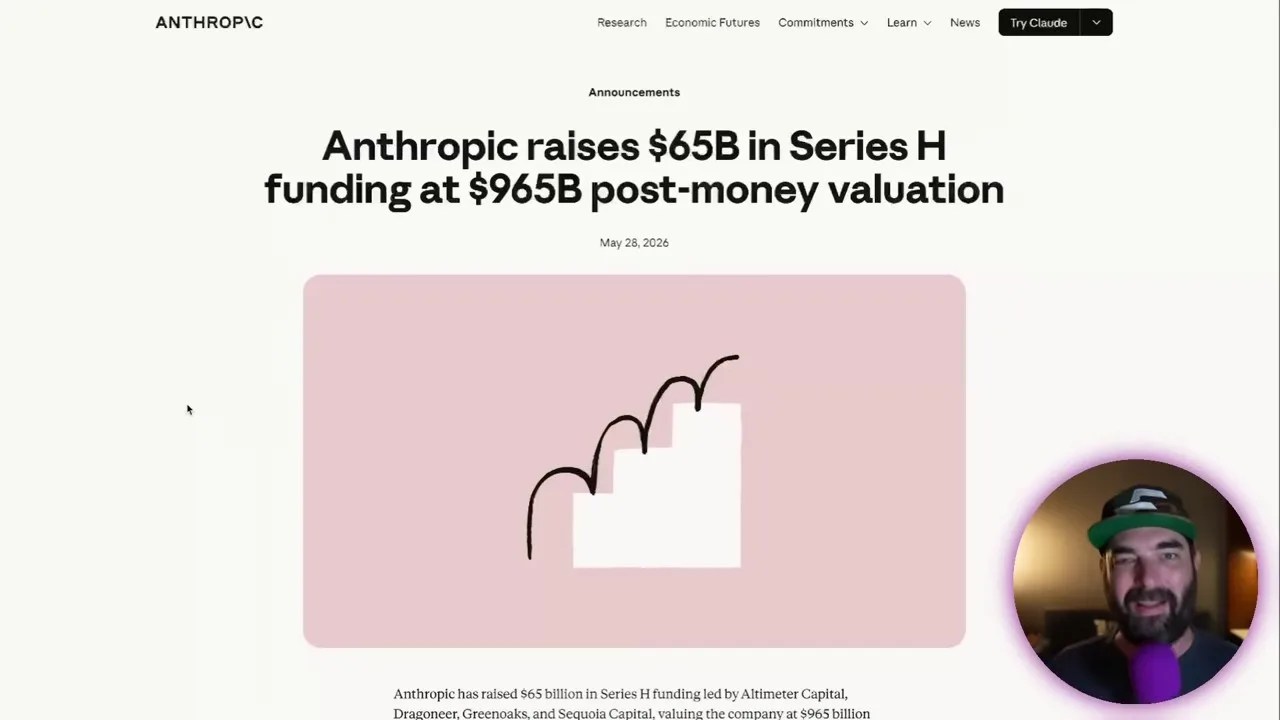
And then came the financial bombshell: Anthropic raised a Series H round at a staggering $965 billion valuation. Yes, almost a trillion dollars for a private startup. It makes them the most valuable startup in history, temporarily leapfrogging OpenAI. But let’s be real—at this scale, these numbers feel completely abstract. It’s a high-stakes game of valuation leapfrog that will likely keep going until the IPO dam finally breaks.
2. Microsoft’s Quiet Image Powerhouse & Copilot’s Facelift
While everyone is busy arguing about Midjourney and DALL-E, Microsoft quietly crept up the blind side of the image generation race. They released MAI Image 2.5, and according to the highly respected Arena.ai blind-test leaderboard, it has shot straight to the number three spot.
The crowd-sourced Arena.ai leaderboard places Microsoft’s MAI Image 2.5 directly behind GPT Image 2 and Gemini 3.1 Flash.
I wanted to see if the hype was justified, so I threw a test at it in the Arena.ai playground. I asked it to design an event flyer with a mix of literal concepts, dates, and graphics. The result was surprisingly cohesive. It didn’t just slap gibberish text on a background; it actually understood spacing, layout, and visual hierarchy.

The output for ‘Learn AI with the Wolf’—clean text rendering, smart use of themed elements, and a solid graphic layout from a single prompt.
Beyond image generation, Microsoft is also redesigning how we interact with Copilot inside Microsoft 365. Instead of that cramped, basic chat box we’ve been stuck with, they’re introducing a wider, more expressive inline canvas. It allows you to format prompts on the fly, use bullet points, and—most importantly—it pulls live data from your emails, chats, and meetings to generate charts directly in your workflow.

The revamped Copilot interface feels much more like an interactive workspace than a simple chat box, generating live charts directly from internal data.
Oh, and for those who find basic LLM chat inside Office a bit too simplistic, Perplexity Pro is now officially integrated into Microsoft 365 apps. If you need Copilot to do deep, multi-step research or analyze a complex negotiation draft in Word, it can hand those heavy-duty tasks over to Perplexity’s engine. With Microsoft Build happening next week, I suspect this is just the opening salvo of a massive product rollout.
3. Crossing Dimensions: Image-to-3D and Ethical Pop Punk
Let’s talk about creative tools. Leonardo AI rolled out a feature that converts flat 2D images into interactive 3D models. As someone who loves playing around with game design and digital art, this is fascinating.
If you feed it a simple 2D generation, the initial 3D mesh is decent but can look flat or distorted when you rotate it to the back. However, Leonardo introduced a “3D Reference View Creator” that generates multiple blueprint angles first (top-down, profile, back) and uses them collectively to construct the 3D asset. The difference in detail is night and day.
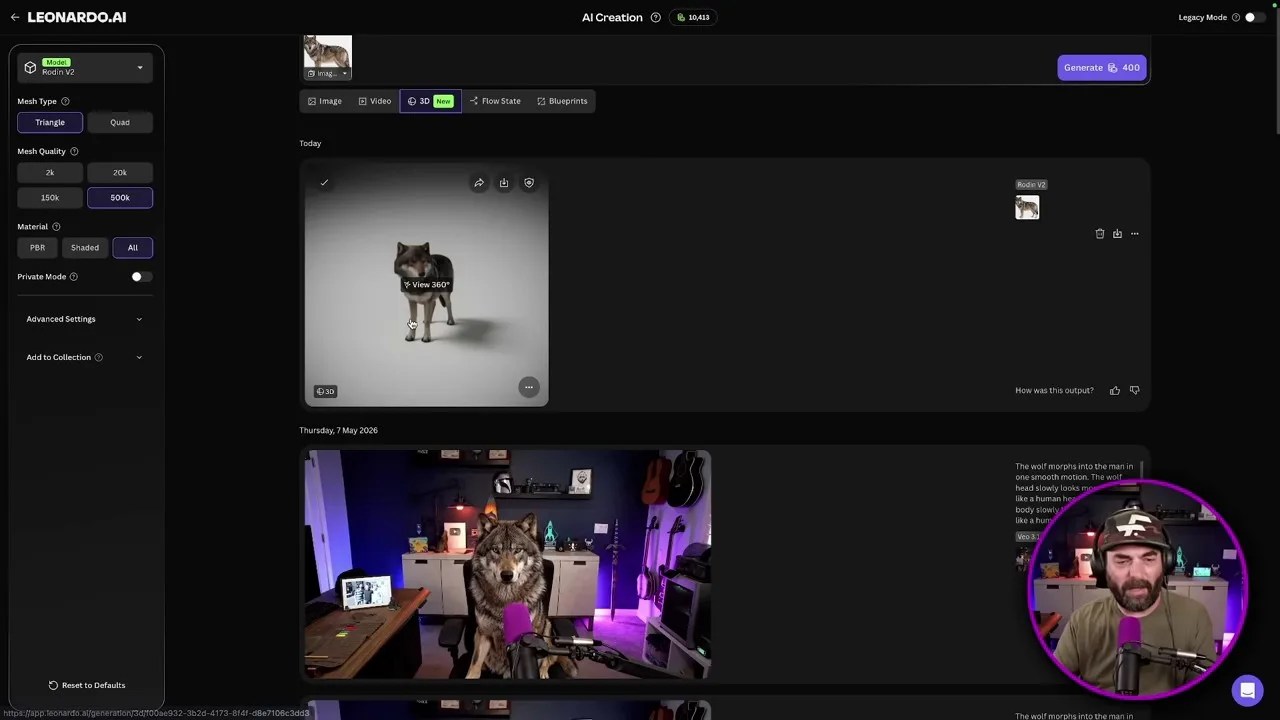
A rotatable 3D wolf asset created in Leonardo AI using multiple generated angles as reference blueprints.
Now, I did try generating a 3D model of my own face using this method, and let’s just say… it was incredibly cursed. It looked like a melting wax sculpture. But for props, game assets, or e-commerce products, this is going to save creators hours of manual modeling work.
On the audio side, ElevenLabs dropped Music V2. The audio generation space is currently a legal minefield, with massive lawsuits hitting Suno and Udio over training data. ElevenLabs is taking a different approach: they claim their model is trained entirely on licensed, cleared data. That means commercial creators can actually use these tracks without worrying about a sudden copyright strike.

Testing ElevenLabs Music V2 with a highly specific pop-punk prompt about eating tacos in San Diego.
I prompted it to create a high-energy pop-punk track about watching baseball and eating tacos in San Diego. It didn’t just nail the genre’s distinct vocal whine and driving bassline; it actually displayed some impressive world knowledge, dropping references to Petco Park and Fernando Tatís Jr. seamlessly into the lyrics. The quality is remarkably clean, showing that ethically sourced training data doesn’t have to mean compromised quality.
4. Mind-Bending Omni Hacks: Sketching Drone POV Videos
Since Google released the Gemini Omni models, developers have been pushing its multimodal capabilities to the absolute limit. But the most mind-bending use case I saw this week involves translating flat spatial maps into immersive, first-person video paths.
First, Chris Frantz uploaded a screenshot of a Google Maps route to Gemini Omni, drew a simple red path over the streets, and prompted the model to generate a first-person taxi ride along that route. The resulting video was astonishingly accurate, matching the spatial progression of the map.
Then, my friend Bilawal took it a step further. He drew a 3D trajectory path over an angled aerial image of a city and asked Gemini Omni to generate a realistic drone POV shot following that exact flight path.

The model effortlessly translates a 2D line drawn across a static map into a dynamic, physics-compliant flight video, complete with wind and drone engine audio.
In the generated video, the “camera” dives under a bridge, maneuvers around a skyscraper on the right, and maintains a perfect drone-like momentum. If you’re an indie filmmaker looking for a specific establishing shot but don’t have the budget or FAA clearance to fly a physical drone over a city, this is a glimpse of how production workflows are about to change forever.
5. The Reality Check: YouTube Disclosures, Altman Backtracking, and “Vibe-Coded” Maps
As these tools get more powerful, we are seeing some fascinating societal and corporate pushback. Let’s look at three big stories that happened this week that highlight this friction:
YouTube is taking AI labeling into its own hands. Up until now, creators had to self-disclose if their content was AI-generated via a checkbox in the backend. Unsurprisingly, most people just ignored it. So, starting this month, YouTube is rolling out internal detection systems. If their algorithms detect realistic, synthetic media and you didn’t label it, they will automatically apply a prominent warning label under your video or overlay it on your Shorts.

YouTube’s new prominent warning labels for AI-generated content will live directly under the player for long-form videos and as an overlay on Shorts.
Sam Altman is quietly walking back the “jobs apocalypse” doom. After months of raising alarm bells about AI taking everyone’s jobs, the OpenAI CEO admitted this week that the technology hasn’t wiped out nearly as many white-collar roles as he feared. He tried to frame it as a pleasant surprise, but let’s be realistic: OpenAI is rumored to be preparing for a massive IPO. Dialing down the “existential threat to humanity’s livelihood” narrative is an incredibly convenient PR move when you’re trying to win over mainstream public market investors.
Meanwhile, Nvidia’s Jensen Huang and DeepMind’s Demis Hassabis went on television to call out tech companies using “AI efficiencies” as a lazy excuse for layoffs. Let’s call it what it actually is: during the pandemic boom of 2020-2021, these companies over-hired and became bloated. Now, to keep their profit margins high and satisfy shareholders, they are cutting staff and blaming “AI automation” because it sounds much more forward-thinking than admits of poor corporate planning.
Erin Brockovich is tracking the AI power drain. The physical footprint of AI is massive, and famous environmental advocate Erin Brockovich has launched a crowd-sourced tracking map to show exactly where data centers are being planned, built, or operated near residential communities.
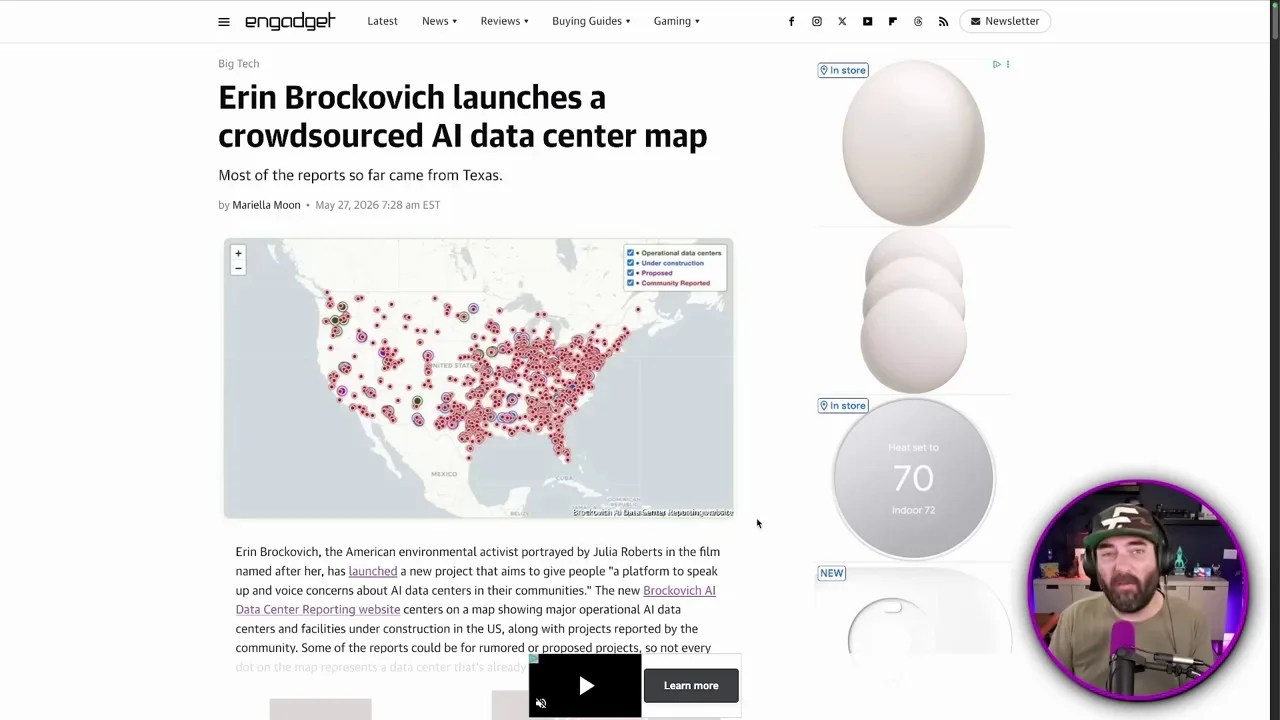
The brokovichdatacenter.com map uses crowd-sourced reports to track the massive, power-hungry infrastructure supporting the AI boom.
If you visit the site, it has all the hallmarks of a classic, slightly chaotic “vibe-coded” website, but the underlying data is crucial. AI isn’t just “in the cloud”—it requires massive, water-cooling, power-guzzling facilities that are rapidly encroaching on local grids. This map is a great way to see what’s happening in your backyard.
6. The Bizarre Zone: Dog Translators and Robot Barbers
To wrap things up, we have to look at the weirder side of this week’s news. A startup in China has launched a wearable collar that claims to be a 95% accurate pet translator. Powered by Alibaba’s Qwen LLM, the device analyze vocalizations, body language, and biometrics to translate your dog’s thoughts into spoken human speech. It sounds remarkably like Dug from Pixar’s Up. Personally, I’m highly skeptical of that 95% metric, but at $118, I’m sure plenty of people will buy it just for the novelty.
And finally, we are starting to see AI-powered robotic barber kiosks rolling out across major cities in China. For under a dollar, a robotic arm will 3D scan your skull and use millimeter-precision clippers to give you a haircut. Look, I love automation as much as anyone, but I think I’ll be letting an actual, living human touch my neck with sharp objects for a long, long time to come.
That’s the real signal through the noise this week. We have massive corporate chess moves, incredible new creative options for filmmakers, and a healthy dose of reality checking our expectations. I’ll keep drinking from the firehose so you don’t have to—see you next week after Microsoft Build!
Source & Reference Credits
This comprehensive article was thoroughly analyzed, compiled, and adapted based on the original video content created by Matt Wolfe on YouTube. All rights, trademarks, and intellectual credits belong to the original creator.